
Developer Walter Defortuna’s plans for a 14-story, glass-filled condo at the end of Galen Drive on Key Biscayne remains grounded after questions and plenty of opposition from area residents dominated last Thursday evening’s Special Council Meeting.
Yet some still want the project to go forward, citing progress and enhanced beautification.
“It looks like I have a lot of enemies,” Defortuna said, jokingly, after 23 of 37 public speakers during the three hour-plus meeting voiced their concerns about the project.
Some of the issues raised were that the project would overtake an otherwise laid-back area of the Garden District community; cause additional population and traffic adding to an already crowded island; and others asked why Village officials seem to be bending backward to appease just one developer by making adjustments to codes that have been locked in for years.
“It’s been an entertaining night,” said Defortuna, a 45-year resident of Key Biscayne, who said he now has a better understanding of people’s concerns. “I wasn’t trying to shove anything down anyone’s throat. I’m a responsible neighbor and I’m not going to change that. Good development is needed on this island.”
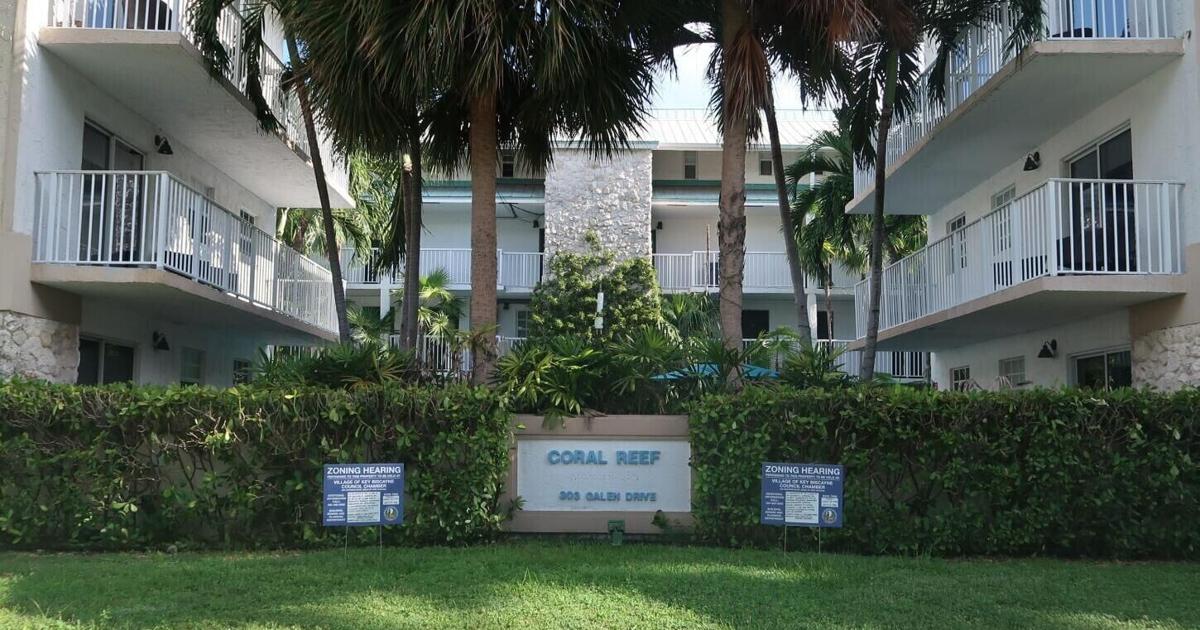
At stake is a potential sale of the 1967-built Coral Reef apartments at 303 Galen Drive to Defortuna, who wants to convert those 51 one- and two-bedroom rental units into a beautiful, modern structure with the same “density” of 51, albeit larger units, with lower-level parking, a floor with amenities such as pickleball and a pool, and a resilient drainage system to improve years of significant flooding in that area.
After an impasse on the first reading of the agenda item, Council members voted to defer the project for now without a timeline, something that Defortuna worries about because real estate deals can shut down at any minute.
“I won’t be around forever,” he said.

Walter Defortuna.
(Photo courtesy: Fortune Christie’s International Real Estate)
Councilman Fernando Vazquez argued that it was important to give Defortuna and his attorney representative, Mario Garcia-Serra, the courtesy of not only a timeline but of actual actions that would be expected.
Vazquez “didn’t want to punt” the item, getting a similar response later from Nancy Stoner.
“The public and Walter deserve an answer,” Vazquez said.
Outgoing Mayor Joe Rasco, in declaring the impasse, said, “The answer is we’re not there.”
Although he said the current situation emanating from the meeting doesn’t bode well (at this time) for Mr. Defortuna, Rasco said he did not hear positive things about the current structure.
“I have not heard anyone step up about (Coral Reef) being a great building or that we ought to preserve it,” he said. “We need to find a way, maybe find a middle ground, but how do we get to that place?”
Rasco said, first, a debt of gratitude should be given to Defortuna, Garcia-Serra and the architects at Arquitectonica for looking at a project in such depth and how zoning laws could be changed or protected.
“This is happening in the rest of Miami,” Rasco said. “We need to be prepared.”
Rasco’s motion was to get an independent consultant, or a new ZORC (Zoning Ordinance Review Committee) team, that could work with the Village Attorney and the staff to see how to satisfy as many as possible.
“We don’t want density or intensity, but people have property rights and they eventually want to redevelop these properties,” Rasco said. “We just can’t say you can’t do anything.”
Incoming Mayor Brett Moss, currently the chair of the ZORC, said he would be happy to expand the jurisdiction of his committee to the Garden District and study solutions to the current RM-16 and RM-30 floor area ratios.
“No problem; I’ll start looking into it until November,” said Moss, whose ZORC ties would be displaced upon becoming the mayor.
Defortuna said he would speak to as many neighbors as possible to address their concerns and have a valuable discourse aiming toward an appeasing conclusion.
“We don’t want to rush this,” Rasco said.
Plenty at stake in decision
Also at stake will be a re-evaluation of the Village’s High Density Multi-Use Family Residential future land use code to allow properties to be reconstructed (currently only when natural disasters strike) with their current density and expanded intensity (impact) via a bonus system.
The current density and floor area ratio (FAR) were set at levels lower than existing buildings (some public speakers Thursday suggested that was intentional and not a mistake as previously stated by a former Village official), and the Village had tried to control the population by setting a limit of 30 units per acre.
That is less density than nine of the 13 units on the Key under the HDMFR regulations. Those 13 buildings are an average of 54.3 years old.
The Coral Reef Apartments were built 59 years ago.
The words “density” and “intensity” in describing the impact of the project were a long subject of debate throughout the evening.
The 51 units in Defortuna’s development, with more beds and more full-time residents, would appear to have more impact on traffic, for example, in the long run, although others argued that Ubers have been part of the vehicle traffic for renters in the current Coral Reef apartments. A traffic study, several residents said, was necessary.
“I probably received more emails on this (project) than anything else we’ve done,” Rasco said.
Councilman Frank Caplan said it was a good time to recognize the positives and negatives, and address the elements of zoning.
“I’d like to start with that and move on … people care so much about this because they’re invested,” Caplan said. “I’m committed to work on this process. It ain’t going to be solved tonight.”
Vice Mayor Oscar Sardinas called it a “wonderful project,” and enjoyed the conversations, but he cautioned against unintended consequences if time isn’t taken to study it further.
“Progress is important, development is important, but only if we do it right,” he said.
Many of the public speakers say they were caught off-guard on this potential development vote, saying it wasn’t until 48 hours before Thursday’s meeting that they became aware of the situation, either through Islander News stories or a petition trying to block the 14-floor structure quickly generated some 750 signatures.
“We don’t want to become Brickell,” one resident said. “I support a redevelopment on Galen, but within the existing rules.”
Scott Hardie, who lives on Sunrise, said, “No one in the Garden District wants this building … it’s so pathetic to watch this, really hard that so many are massaging this (rules) for one person.”
Hardie said if he asked 100 people in his area, 99 would be against it.
“Only Doug the mailman would like it because he said he would be in air-conditioning when he delivers the mail,” he said, eliciting laughter from a good portion of the overflow crowd.
One of the younger residents who spoke feared that by bringing in a ritzy development, nearby property values would increase so much that many of her friends of similar age would not be able to afford to live here and join her in such a peaceful community.
Greg Sanders said he has lived on Galen Drive for 30 years, and recalls the days of crab crossings, parakeets flying around, “birds walking among us,” and, “yes, armadillos,” replying to an audience member.
“I swim the beach and I’ve noticed over the past 10 years, the sea life has disappeared,” he said. “Now we have golf carts on the grass. There comes a time when we say, ‘Enough!’ ”
Sanders said developers and others who come in “don’t have the same vision as the 99 percent of those who live here.”
Regarding the flood drainage plan, “You can’t fight Mother Nature. (They) can tell you everything … (but) the site plan is flawed,” Sanders added, preferring not to rush to a decision that evening.
A few, however, favored progress. After all, impressive-looking structures have made the Miami skyline a world-class centerpiece. A couple of residents said a nice-looking structure would be what their kids would enjoy growing up on the Key.
One resident pointed to a discrepancy in similar redevelopments on Key Biscayne, saying on the other side of the island, the old Mackle houses are turning into mansions, and no one is stopping that progress. So, why should this be different?
Another resident said Coral Reef “has come to the end of its life cycle” and is not even FEMA compliant in its present status. “This is America; we like progress,” he said.
Garcia-Serra, who once headed the Village’s Vision Plan committee, emphasized that there are several good reasons for redevelopment, including rising the first floor above base-flood elevation, and contributing an immense tax value to the Village as the Coral Reef property valuation continues to decline.
“This property should be something better,” he said. “I think we all agree it should be improved.”