
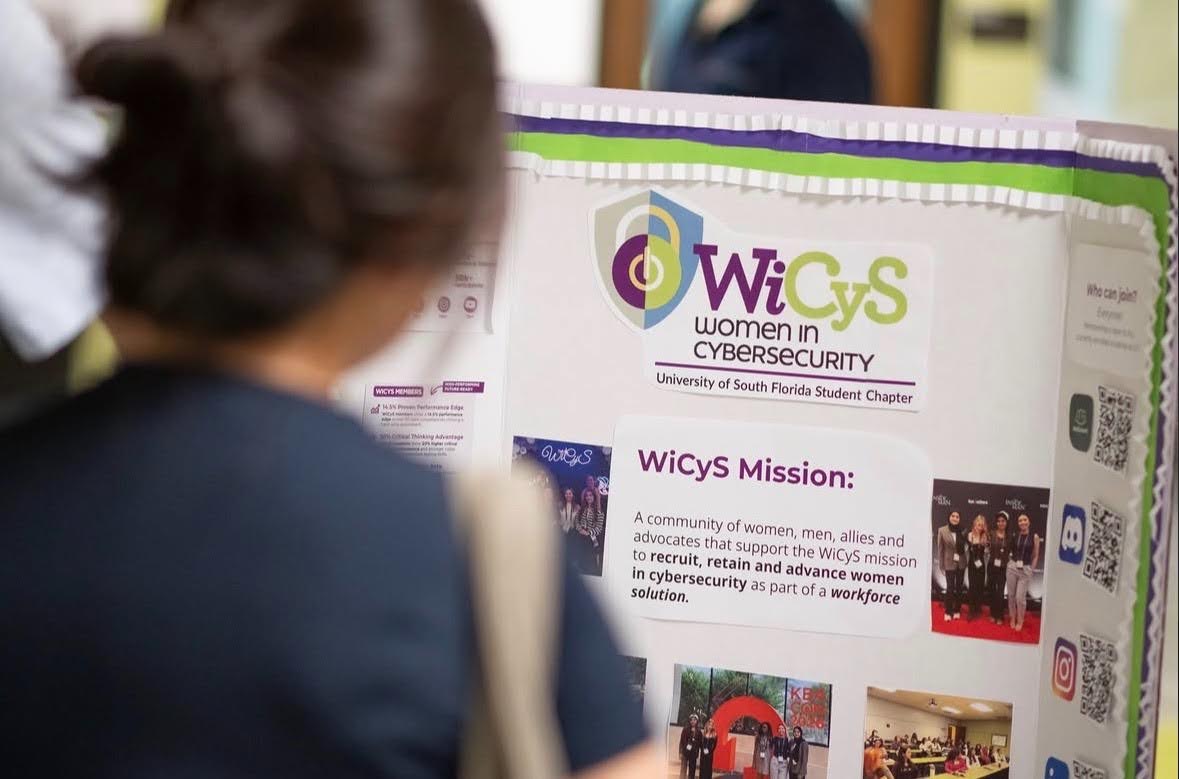
 Student leaders at USF’s Fortnite Club and Women in Cybersecurity chapter say their groups offer mentorship and support in fields where women are often underrepresented. SPECIAL TO THE ORACLE/JEREMY MAREADY
Two student-led organizations at the University of South Florida are working to support women in gaming and cybersecurity, fields where members say women are often outnumbered and face added pressure to prove themselves.
Cobalt estimates that as of 2024, “women comprise between 20% and 25% of the global cybersecurity workforce.” Rivaltech calculated that “women aged 18-35 comprise 30% of all gamers in the US.”
Through the USF Fortnite Club and the campus chapter of Women in Cybersecurity, or WiCyS, student leaders say they are building spaces focused on mentorship and community.
Grace Swann, a third-year biomedical sciences major, started the Fortnite Club after noticing no similar group existed on campus for one of gaming’s biggest titles.
“Esports and video games in general have always been such a male-dominated sphere,” said Swann, the club’s founder and two-time president. “I think video games [have] always had such ingrained misogyny in it.”
USF’s Women in Cybersecurity chapter applies a similar approach to career development by giving their members an opportunity to get further ahead in the tech field, all while working to address gender gaps in the tech sector through career preparation and networking.
Bryce Forrester, the chapter’s vice president and a cybersecurity major, said visibility of women-led organizations helps build career confidence.
“The cybersecurity and tech space in general is very male-dominated,” Forrester said. “If you enter the workforce without having been in a club that was women-led, it could be more intimidating because you feel like you’re kind of alone.”
Forrester said that finding community early on transforms how students view their place in the industry.
“Being a part of this club, it helps to show you that you’re not alone and other women are trying to achieve the same goals that you are,” she said.
Related: USF students collaborate on solar water heater prototype
Swann said that the struggle of being a woman with a male-dominated hobby began long before college, and breaking into the gaming scene meant directly challenging that patriarchal culture.
“Ever since I was a kid, you could kind of feel that you weren’t welcome,” Swann said. “I think that makes it even more important that we force ourselves into these spaces and kind of take up space where we weren’t usually allowed to.”
Swann said leadership in gaming spaces often comes with double standards.
“Anytime a woman is in a leadership position, you can’t be too abrasive or you get called emotional,” Swann said. “You have to find this weird balance between being professional and being respected, which is difficult, especially from your male peers.”
Kemanique Gumbs, the club’s risk manager and a sophomore psychology major, said having women in leadership shapes the club’s atmosphere.
“I think that having women in leadership brings out a deeper sense of connection and warmth to the club,” Gumbs said. “It also creates a sense of safety within the club…because there’s strength in numbers, and sometimes the gaming world can be very hostile towards women and minority groups.”
Gumbs said the club prioritizes fun over skill and welcomes players of all experience levels. It holds tryouts for Fortnite tournaments open to both seasoned and casual players.
Related: The future of sports lies in the hands of pro gamers
A similar strategy is used by USF’s Women in Cybersecurity chapter, which aims to close gender inequalities in the computer industry through networking and job preparation.
Forrester said visibility of women-led organizations helps build career confidence.
The chapter hosts industry tours, alumni panels and career development sessions, including résumé reviews and LinkedIn workshops, while members work toward CompTIA Security+ certifications this semester, Forrester said.
She said the panels connecting students with alumni are valuable and give students an opportunity to learn from professionals who once were in their position.
“It’s great to connect students with people who used to be in their shoes and be able to talk with them,” she said. “[It’s important to] figure out what they did or how their experience at USF led them to become the professional that they are.”
Gracie Brunelle, the chapter’s treasurer and a junior cybersecurity major, said the group helped her navigate isolation and imposter syndrome in tech classrooms.
“Overall, it’s definitely isolating, and again, you do feel imposter syndrome, especially being one of the only girls in a huge lecture hall,” Brunelle said. “This organization replaces this intimidating feeling with a shared sense of belonging.”
Brunelle said the trial-and-error nature of cybersecurity makes having a supportive community especially important for students navigating the field.
“Cybersecurity is sort of about failing dozens of times until you find a solution,” Brunelle said. “So having an encouraging and supportive space removes the dread of feeling like you don’t belong.”
Brunelle said students do not need a technical background to get involved with the organization.
“Nobody comes out of the womb knowing how to code and operate a terminal,” Brunelle said. “You just need to have an affinity for puzzles and problem-solving, and crave a deeper understanding of how things work in the background.”
As for the Fortnite Club’s future, Swann and Gumbs said they want to grow membership and expand merchandise and campus collaborations.
Brunelle said WiCyS aims to become a talent pipeline for Florida’s defense, intelligence and financial technology sectors while expanding mentorship for high school students and community college transfers.
“Our long-term goal is normalizing women in leadership across every single computing classroom and lab here at the college,” Brunelle said. “That way, being one of the only women in a lab is just out of the picture. That’s not a thing anymore.”