
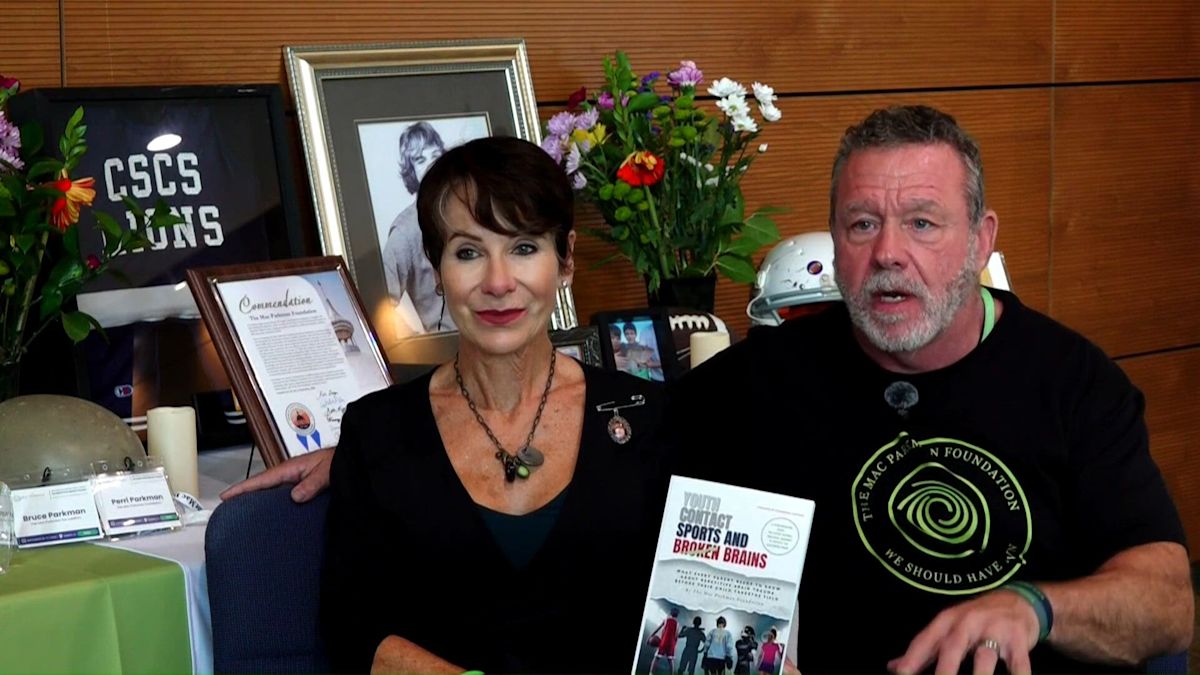
Two battered helmets rested beside each other at the University of South Florida’s Center for Advanced Medical Learning and Simulation.
One was a football helmet worn by Mac Parkman. The other was a military helmet. Both carried visible scrapes and marks, but neither could show what may have happened beneath it.
The helmets represented the two groups at the center of the third annual International Summit on Repetitive Brain Trauma: athletes exposed to repeated head impacts and military service members exposed to blasts and other potentially injurious forces.
For Bruce and Perri Parkman, the two-day summit was also deeply personal.
Their son, Mac, began wrestling in first grade and later played football. His father said Mac was not driven by dreams of becoming a professional athlete.
“Our son only played sports to be with his friends,” Bruce Parkman said. “He wasn’t the best athlete. But he loved being with his friends.”
Mac was also studying for the Armed Services Vocational Aptitude Battery and hoped to join the Army as a cyberwarfare specialist, following in the footsteps of his father, a retired Green Beret sergeant major.
Mac died by suicide in September 2020. He was 17.
Bruce Parkman remembers kissing his son goodbye before Mac left for football practice on the final day of his life.
“He said, ‘Dad, I’m going to practice,'” Parkman recalled. “So I always kissed my son. If I ever left him, I kissed him on the cheek.”
Following Mac’s death, his parents decided to donate his brain to the UNITE Brain Bank for research because of his history of contact sports.
The Parkmans said the examination revealed changes and damage to Mac’s brain that they believe were connected to his years of exposure to repeated head impacts. They said they had not understood the potential risks while Mac was playing.
“We were, like the majority of Americans out there, just pretty ignorant about it — the risks and the effects of repetitive head impacts and repetitive blast exposures,” Perri Parkman said.
Chronic traumatic encephalopathy, or CTE, is a neurodegenerative disease associated with exposure to repeated head impacts. It can currently be definitively diagnosed only after death. Research continues into the possible relationships among repetitive brain trauma, changes in the brain and neuropsychiatric symptoms.
The Parkmans founded the Mac Parkman Foundation to support research, educate families and advocate for changes intended to reduce young athletes’ exposure to repetitive head impacts. The foundation says it has committed $258,000 to research at Boston University and the Icahn School of Medicine at Mount Sinai involving brain changes and neuropsychiatric symptoms among young contact-sport athletes.
The Tampa summit expanded the conversation beyond youth sports. Its agenda included sessions on preventing head impacts, screening veterans for brain injuries, caregiver support and Florida’s coordinated approach to veteran brain health.
Veteran Don Freed said military brain trauma does not always result from one catastrophic explosion or accident. Training, falls and other repeated impacts can build over years of service.
“Repeated head impact, repeated head impact, repeated head impact,” Freed said. “It just starts compounding and compounding over the years.”
Military service members can also experience repeated blast exposure through combat and training involving weapons and explosives. Some service-related brain injuries may produce symptoms that overlap with mental-health conditions, making proper screening an important part of identifying potential causes and treatment options.
Michael Hartford, a health care consultant and program adviser working with the foundation, said the effects can be difficult for other people to recognize.
“I’ve had many veterans come up to me and say, ‘Sir, I wish I had lost an arm or a leg because people would see that I’m in pain,'” Hartford said.
Tampa is home to MacDill Air Force Base, U.S. Central Command, U.S. Special Operations Command and a large veteran population. The James A. Haley Veterans’ Hospital also operates one of five polytrauma rehabilitation centers in the Department of Veterans Affairs system, providing intensive rehabilitation for veterans and active-duty service members with complex injuries, including traumatic brain injuries.
The summit brought clinicians, researchers, military leaders, advocates, caregivers and families together Sept. 16 and 17 at USF CAMLS. Organizers said the goal was to improve recognition of repetitive brain trauma and connect affected families with appropriate resources.
For the Parkmans, the work remains rooted in the information they wish they had received while Mac was alive.
“Because we should have known,” Perri Parkman said. “And we did not.”
She said the foundation’s mission can be measured one family at a time.
“When we started this foundation and started pouring our heart into it, I just kept saying, ‘Just save one child,'” she said. “If we just save one child, we’ve done our job.”
If you or someone you know is experiencing a mental-health crisis or having thoughts of suicide, call or text the 988 Suicide & Crisis Lifeline. The service is free, confidential and available 24 hours a day.