
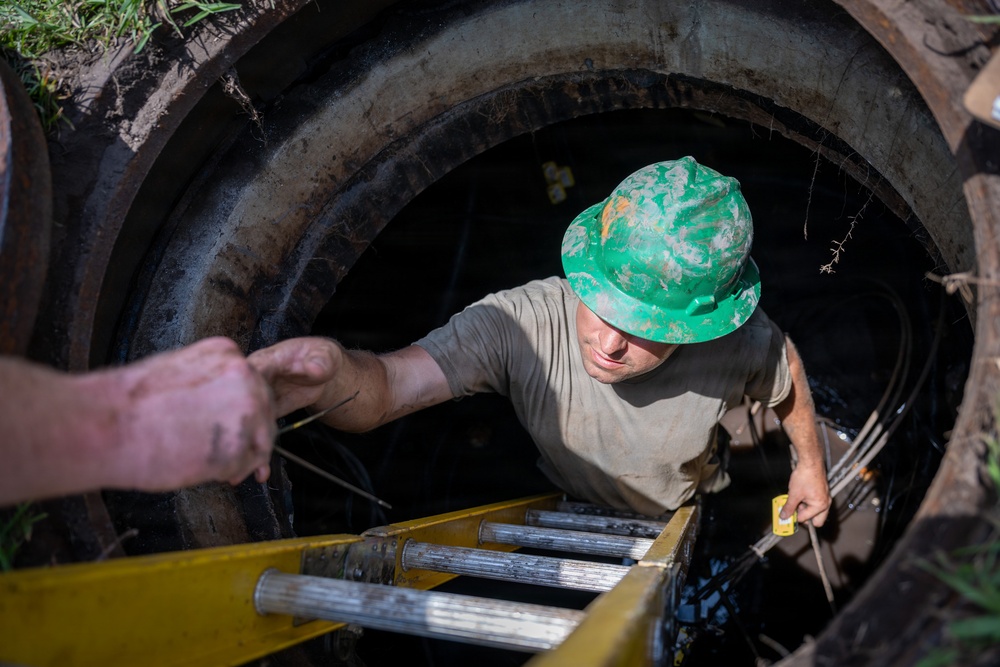
JACKSONVILLE AIR NATIONAL GUARD BASE, Fla. – The 125th Fighter Wing (125th FW), Florida National Guard, recently joined forces with the 220th Engineering Installation Squadron (220th EIS), Ohio National Guard, to improve communications infrastructure, strengthen mission readiness and provide hands-on training for Airmen.
Airmen from the 220th Engineering Installation Squadron, which specializes in capabilities such as network infrastructure, communications systems installation and maintenance, and spectrum analysis, traveled to the Jacksonville Air National Guard Base, Florida, in July to assess and document its existing communications infrastructure, serving as an opportunity to integrate and provide expert support.
“We are documenting the layout of the communications infrastructure currently in place,” said U.S. Air Force 1st Lt. Grant Warren, a cyberspace operations engineer assigned to the 220th EIS. “We are making sure it’s properly labeled and accurately updated within the digital repository used by communications squadrons and engineering installation units across the service.”
The team’s work includes tracing communications pathways between facilities, confirming cable routes, reviewing labels and updating infrastructure records.
Accurate documentation is critical when communications systems are damaged or disrupted. If a cable is cut or a building experiences an outage, technicians must quickly determine where the problem occurred and how it affects the broader network.
Having keen and accurate insight into the communications infrastructure keeps the base out of the dark, said Warren.
“We may know that it starts in one building and ends in another, but we need to know what happens in between,” Warren said. “Having a better understanding of that infrastructure increases our strategic capabilities when it comes to the mission.”
The assessment also supports long-term planning. By understanding which pathways and resources are currently available, the 125th FW can make informed decisions about future communications requirements, infrastructure upgrades and support for new mission systems.
Reliable communications enable command and control, aircraft operations, maintenance, logistics and coordination with military and civilian partners. According to Warren, that makes communications infrastructure a critical part of mission success.
“Without communications, many operational missions would not be possible,” Warren said. “We provide that capability, and it’s a critical linchpin to have individuals who are capable of meeting the standards, ensuring that missions can go uninterrupted.”
This project also gives junior Airmen new experiences outside their normal day-to-day practice, giving them a greater sense of the capabilities and expectations of the communications squadron’s mission.
“It’s important to do the job right the first time, because that means less work for the Airmen who come after us,” said Airman 1st Class Jacob Brommeland, a radar, airfield and weather system specialist assigned to the 220th EIS.
Brommeland said serving as a multi-capable Airman broadens his experience and gives him opportunities to work with his hands while learning different parts of the mission.
The partnership demonstrates one of the National Guard’s key strengths: the ability to share expertise and resources across states. The 125th FW gained a clearer understanding of its communications network, while the 220th EIS received realistic training in a differing operational landscape.
By working together, both units improved their capabilities and contributed to a force that is always ready and always there.