
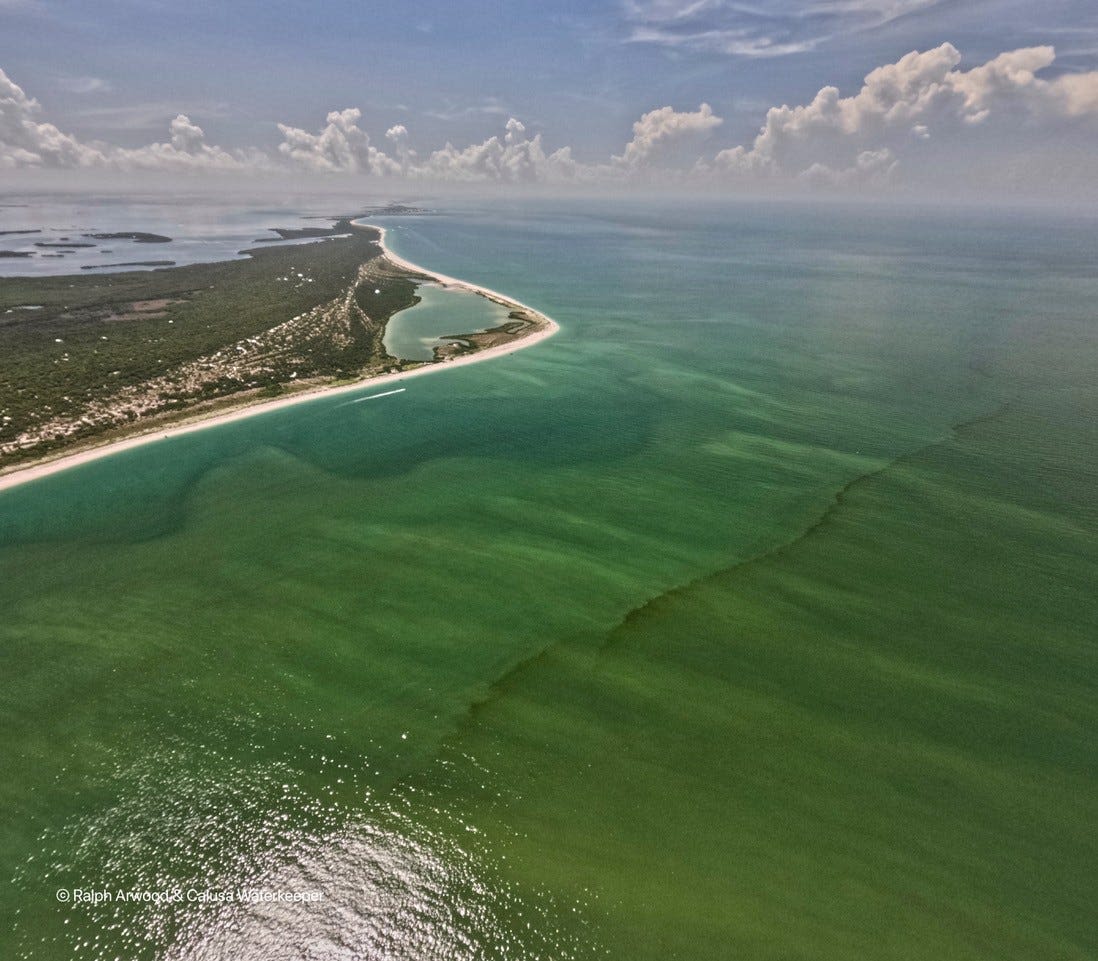
A muddy-appearing algae bloom is fouling the back bays and passes around Sanibel, Captiva and Pine Island.
Known as rust tide, it can produce toxins and has caused fish kills elsewhere, says Florida Gulf Coast University marine science Professor Mike Parsons, a founding member of the state’s Blue-Green Algae Task Force.
Unlike its famous cousin, it’s not known to cause the respiratory irritation and human health woes associated with red tide, but its potential risks to marine life bear watching, Parsons says. “We should keep a wary eye on it to see if wildlife are affected,” said Parsons, who directs the university’s Vester Field Station.
Both blooms are caused by dinoflagellates, one-celled marine organisms that paddle their way through the water with thin, whip-like tails. In high concentrations, they stain the water a murky, ruddy brown – hence the nickname.
Pilot Ralph Arwood has photographed discolored water around Sanibel, Tarpon Bay, Captiva Pass, Pine Island Sound and Cayo Costa and shared his photos with Calusa Waterkeeper and The News-Press.
Water samples analyzed by Sanibel-Captiva Conservation Foundation Research Biologist Rick Bartleson contained extremely high concentrations of the dinoflagellate Margalefidinium, which produces rust tide.
Concentrations exceeded 1 million cells per liter in some places, Calusa Waterkeeper Emeritus John Cassani said. “Ralph Arwood has some recent and remarkable imagery of (the) blooms in local back bays, Pine Island Sound and elsewhere,” Cassani wrote in an email. “Bartleson’s ground-truthing reveals high cell counts.”

“Rust tide” is a harmful algal bloom that can discolor water and cause low oxygen levels. It’s been showing up in Southwest Florida’s back bays recently.
Bartleson said populations were especially dense at the surface in Captiva Pass, though SCCF recently began finding the organism “everywhere” in the area, he said.
The samples were nearly a monoculture, Bartleson said, dominated almost entirely by the bloom organism, along with a few ciliates and newly hatched copepods, tiny plankton-grazing crustaceans called “cows of the sea”
Rust tide cysts can linger in sediment for years
Rust tide is caused by a microscopic organism that joins together in chains that wiggle their way through water, Bartleson said. “They go pretty fast when they’re healthy.” Unlike some of their relatives, their cells lack rigid, armor-like plates.
Late summer blooms occur regularly in parts of Chesapeake Bay and the mid-Atlantic.
SCCF documented a Southwest Florida bloom in 2023, the first time its researchers had seen it happen locally, Bartleson said. That bloom likely seeded this year’s outbreak, he says. The organism creates cysts that can settle to the bottom and rest in the sediment, then emerge when conditions are favorable.

Sanibel-Captiva Conservation Foundation Research Scientist Rick Bartleson photographed this dense patch of rust tide off Captiva Island
Like the red tide organism, rust tide can obtain nutrients by killing or consuming other plankton, he said.
Despite superficial similarities, rust tide differs in one major way from red tide: It is not known to produce airborne toxins that can cause coughing and neurologic symptoms in humans and harm sea life during concentrated blooms. The Florida Department of Health did not immediately respond to a request for comment.
Earlier this month, the Florida Fish and Wildlife Research Institute sampled discolored water near Captiva Pass after reports of respiratory irritation. No red tide was found. The institute did not immediately respond to a request for comment.

“Rust tide” is a harmful algal bloom that can discolor water and cause low oxygen levels. It’s been showing up in Southwest Florida’s back bays recently.
Are marine mammals like manatees at risk from rust tide?
Rust tide can be harmful to marine life. Scientists have linked dense blooms elsewhere to fish kills, though the precise mechanism is yet unknown. Young and larval animals may be particularly vulnerable, according to the National Centers for Coastal Ocean Science.
“Invertebrates could be affected but I wouldn’t worry about manatees or sea turtles, Bartleson said. “At least it’s not as bad as red tide.”
Cassani said the potential effects bear watching and continued attention. “There could be impacts to local fish and invertebrates and perhaps also bioaccumulation of its toxic byproducts higher in the food chain.”
Calusa Waterkeeper said it would continue monitoring the bloom.
This article originally appeared on Marco Eagle: Strange bloom coloring Southwest Florida waters