
When hurricanes pummeled Tampa Bay in 2024, Tampa International Airport never lost power.
The airport was lucky, airport construction director Dan Seeley said. But staff saw water approach the airport’s west runway higher than ever before, he added.
“That kind of opened our eyes to say, ‘We need to take a hard look at all of our infrastructure to make sure that we’re ready for the next storm,” Seeley said.
That convinced airport officials to invest in a barrier, called an AquaFence, around electrical vaults that power the airport’s lights, signs and other communication on airfields. Construction on the $1.9 million project started in July, and the cost was included in the airport’s budget.
And on Thursday, Tampa International became the first airport in Florida to debut an AquaFence. Officials revealed a custom-engineered 9-foot barrier that helps keep the roughly $50 million vaults operational in case of a storm.
Without thepower supply, airplanes can’t take off when it’s dark, and the airport can’t start up recovery efforts as quickly. Seeley said if the electrical vaults — susceptible to flooding from a Category 3 hurricane or higher — were breached, the airport wouldn’t be able to support its daily operations. Replacing the equipment would take months or years.

Some machinery hums inside Tampa International Airport’s electric vaults. The machinery powers lights and signs at the airport’s airfield, and a new AquaFence is intended to protect the vaults from storm surge.
The fence is the largest size AquaFence makes. Seeley said he chose the 9-foot tall fence because of rising sea levels.
“We’re building for the future,” Seeley said. “We want to make sure that what we put in now for our infrastructure is good for the next five, 10, 15, 20 years.”
AquaFence gained local and national attention for its barriers, which protected Tampa General Hospital from Hurricane Helene’s 7-foot storm surge in 2024. Other institutions across Tampa Bay have gotten the barriers in recent years.
The company donated a fence to the Florida Aquarium earlier this year, while St. Petersburg installed one around its low-lying wastewater facility.
Patrik Hansson, AquaFence’s president, said each one is custom made to the site whereit’s deployed. Before getting the fence, Tampa International used sandbags to protect its vaults.
“You’re comparing a bicycle to a Ferrari,” Hansson said. “This is a completely different animal than sandbagging.”
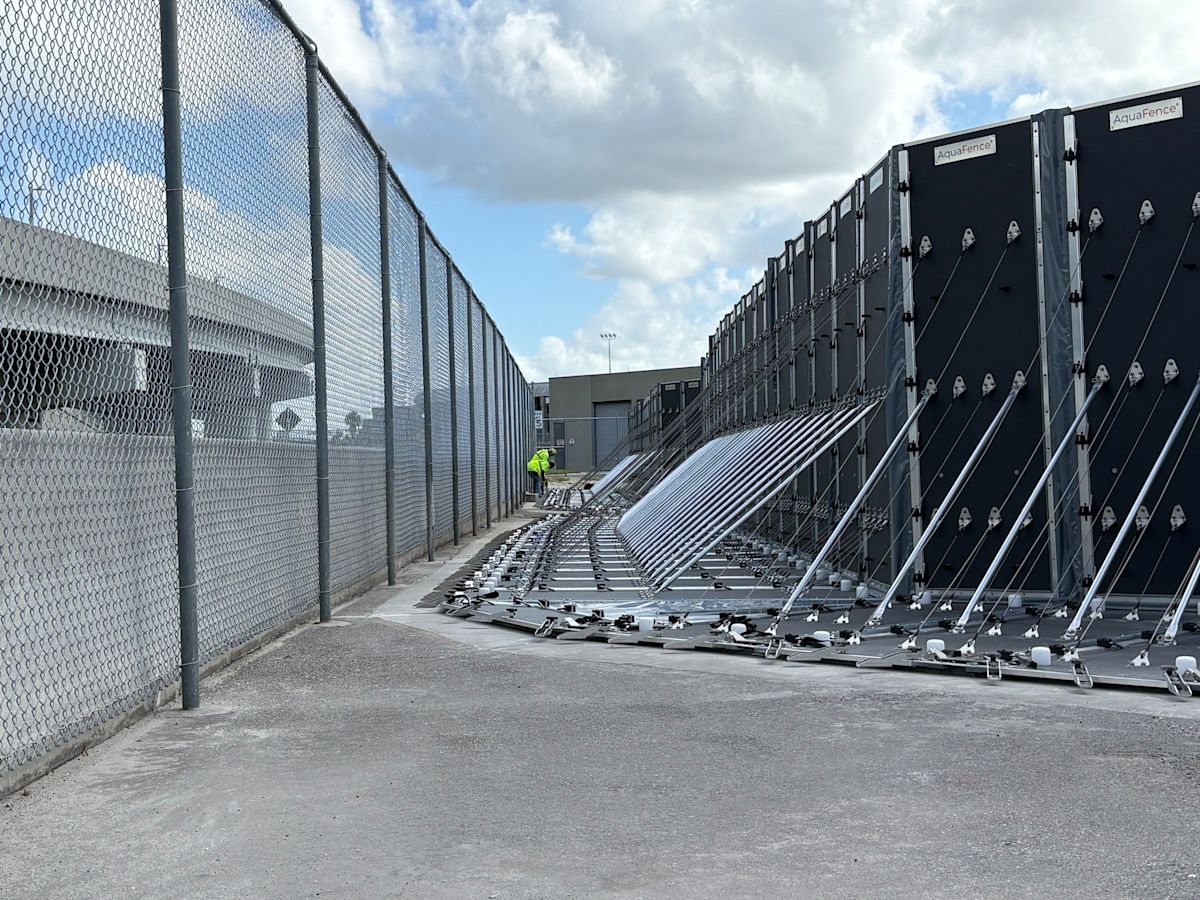
The fence resembles a laptop, Hansson added. It’s built from panels that are latched together with a material similar to pool liner. Each panel is bolted into the ground and secured side by side to establish the barrier.

Two AquaFence employees demonstrate how each fence panel folds up and bolts into the ones next to it. The company’s president said the fence resembles a laptop.
Winds tend to be the first big pressure from a storm, Hansson added. Each panel has straps on the inside that anchor the fence into the ground for stability.
And when storm surge creeps in, Hansson said, the panels become stronger. The more pressure on each panel’s front, the stronger the fence sits vertically.
“We’re very confident that it’s going to hold back the water,” Hansson said.
The fence will be stored in crates until it’s needed, Seeley said. It would take no more than two days todeploy and securethe barriers in an emergency, he said.
The airport also added a drainage system around the vaults for heavy rains. Rainwaterwill flow down a new drain, which then pumps the water back out away from the vaults.

The AquaFence is viewed from the inside of the barrier. Each panel is set to be bolted to the ground with ropes, which keeps the fence stable for high-power winds.
Seeley said the airport isn’t looking to add another AquaFence to other areas that may be affected by storm surge. Officials are assessing whether they need other methods for storm resilience and hardening.
The electric vaults were first on the airport’s list of critical infrastructure to get protection, Seeley added.
“The airport functions as an emergency response airport,” Seeley said. “We need to make sure that airport operations remain open and operational pre-hurricane as well as post-hurricane.”