
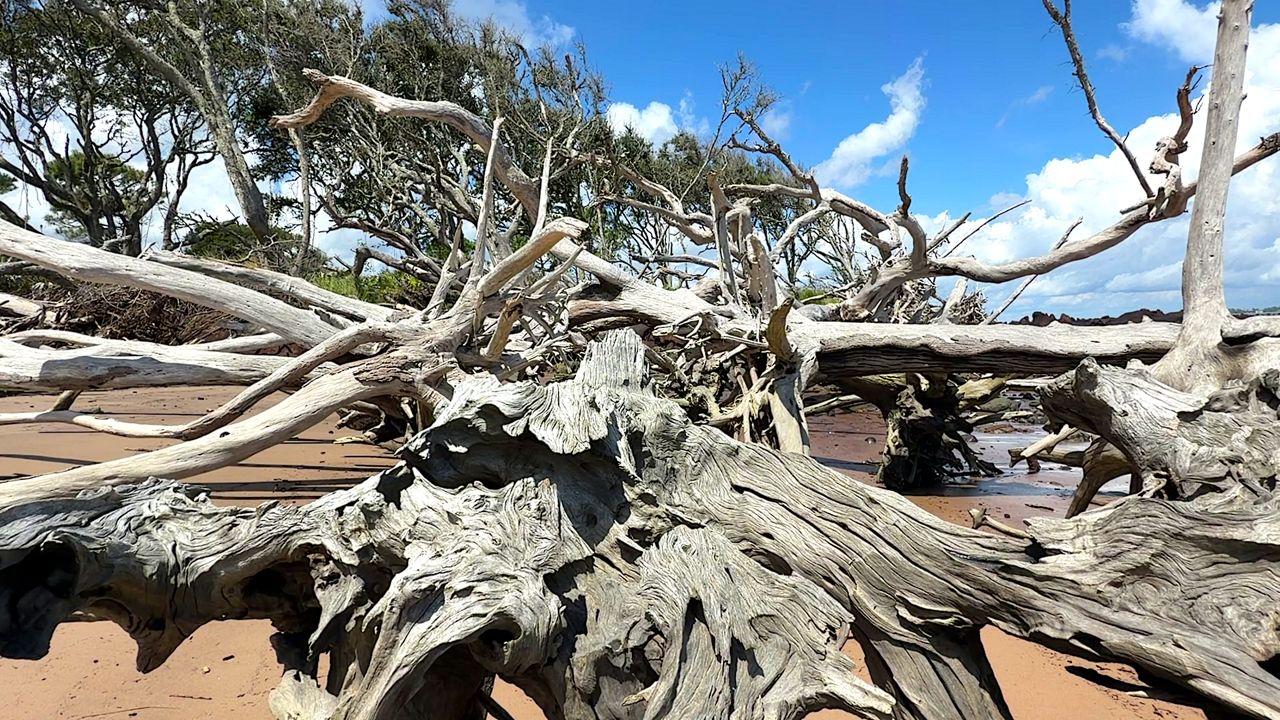
FLORIDA — It looks like something from another world, but this strange landscape is right here in Northeast Florida.
Black Rock Beach and Boneyard Beach, on Big Talbot Island near Jacksonville, offer a Florida shoreline unlike any other.
Massive, weathered oak and cedar trees stretch across the sand, with twisted trunks and exposed roots creating an eerie, almost otherworldly landscape.
Photographer Paul Farace says the setting is unlike anything else.
“This place is just like nothing else on Earth,” Farace expressed.
Farace considers Black Rock Beach a photographer’s playground.
“Oh, this place is amazing. It’s like stepping back in time, stepping into another world. Call it what you want,” Farace explained.
He says the giant weathered tree skeletons are what make the area so compelling to photograph.
“Photographing out here is just amazing. I mean, you kind of have an endless compositions. The light comes in through different things.
Farace also points out the feature that gives Blackrock Beach its name.
“This black rock is actually not rock. It’s spodosol. And it’s 10,000-year-old, compressed, fossilized soil. And it makes some of the most unique landscapes that you can find in Florida.”
The dark formations can give the beach an almost volcanic appearance.
A family visiting from Georgia came to explore the fallen trees and take pictures.
Melissa Valli says, “it’s prehistoric. And, I just haven’t really ever seen anything like this before. I didn’t know Florida had this.”
Just up the beach is Boneyard Beach, another popular destination for photographers.
Will Dickey has photographed the landscape for decades, often coming at sunrise.
“I was a photographer for the Florida Times-Union for 37 years. As a photojournalist. I photographed a little bit of everything. So, I kind of take that idea to photographing nature.”
The unusual landscape was created by nature.
Erosion and storms gradually eat away at the sloped coastline, eventually toppling trees onto the sand.
Black Rock Beach and Boneyard Beach are both located on Big Talbot Island near Jacksonville.
The best time to visit is at low tide, when more of the unusual shoreline is exposed.