
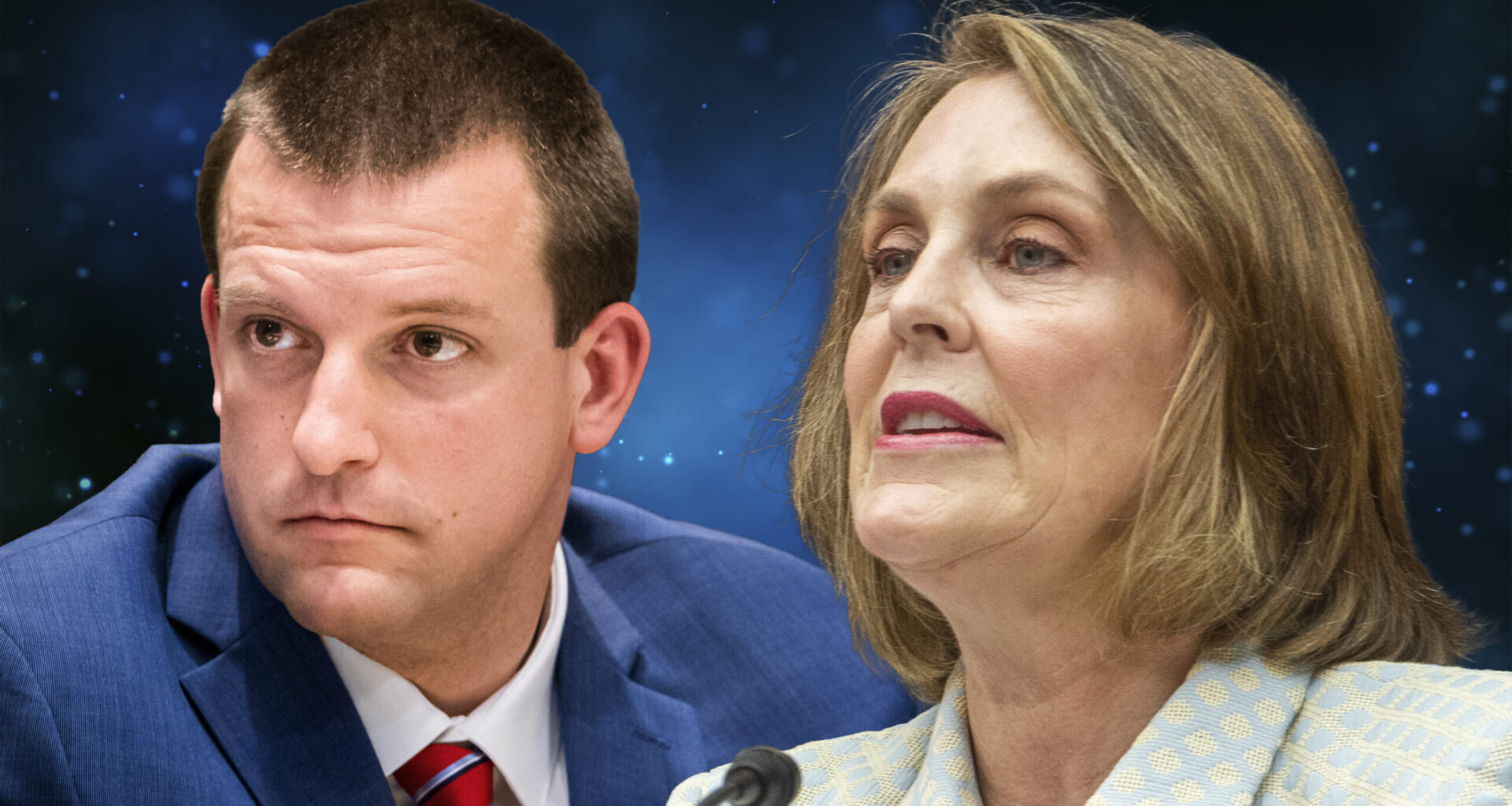
During the Republican Primary, Mike Beltran made President Donald Trump central to his pitch to voters.
His campaign website described Beltran as inspired by Trump’s 2016 victory, branded him as an “America First” fighter, said the former state lawmaker had stood with Trump “every step of the way,” and framed his congressional campaign as an effort to stand with the President “to finish making America great again.”
In an example of the age-old strategy of moderating messaging for the General Election, that is no longer how Beltran introduces himself to voters.
In the weeks since Beltran won the Aug. 18 Primary, national Republicans have increasingly lined up behind him. Club for Growth PAC endorsed him Aug. 31, Trump followed Sept. 1 and the National Republican Congressional Committee added him to its MAGA Majority program a week later.
But Beltran has also scrubbed much of the Trump-centered language from his campaign website, swapped out a prominent photo of himself, his family and Trump for one featuring only Beltran and his family, and shifted his pitch toward a focus on local Tampa Bay issues as he tries to unseat a Democrat who has spent more than two decades building a political base in Hillsborough County.

Beltran told Florida Politics this week that the change is more of an effort to appeal to moderate Democrats and independents during the General Election, although he later accused Castor of drifting toward the center as well during criticism of her party-line stances. He said support from Trump and the GOP reflects his conservative record.
Beltran’s campaign has rejected suggestions that the website changes amount to an effort to distance him from Trump. After The Washington Post reported that the changes earlier this month are among a broader shift made by a number of Republican House candidates, his campaign said Beltran had taken new family photographs after the Primary and liked them enough to put them on the site.
But the changes extend beyond the photographs. Beltran’s homepage replaced “Fighting for Florida. Putting America First” with “Fighting for Florida. Putting Tampa Bay First,” while his biography now emphasizes lower costs, health care access and a willingness to stand up to both parties.
“We’re using different messaging than we did in the Primary where we’re talking to a smaller section of the electorate,” Beltran said, pointing to the President’s direct endorsement as evidence of his conservative credentials.
Asked what that affordability message would mean in office, Beltran blamed rising costs on Democratic policies. He aims to scale back regulation and government subsidies he believes have fueled the affordability crisis by creating what he called “statutory schemes” that inhibit the private market.

Beltran’s voting record in Tallahassee reflects that skepticism of government spending and subsidies. In 2023, he was one of six House members to oppose the $711 million Live Local affordable housing package, writing at the time that his constituents “should not pay taxes to subsidize urban areas.” A year later, he cast the lone House vote against the $717 million Live Healthy package, which included major Medicaid reimbursement increases and state investments in the health care workforce.
Castor Campaign Spokesperson Sarah Green highlighted Castor’s work on health care and energy costs while criticizing Beltran’s record in Tallahassee, including his opposition to state health care and affordable housing packages. She also called Beltran’s repositioning an “identity crisis.”
“MAGA Mike Beltran is having an identity crisis, trying to run from his own record of self-dealing, extremism, and higher costs,” Green said.
Beltran’s Tampa Bay turn and messaging shift also reflects the impact of a redrawn CD 14.
Redistricting transformed Castor’s once-safe seat into one that favors Republicans on paper. Trump carried the new CD 14 by about 11 points in 2024 after winning the same territory by just 3 points four years earlier.
“She lost a lot of her old District, including northwest Hillsborough and St. Petersburg,” Beltran said.
Yet one week after the Primary, the Cook Political Report moved the race from “Lean Republican” to “Toss Up.” Sabato’s Crystal Ball followed suit and shifted CD 14 to “Toss Up” in late July, while Inside Elections moved it from “Lean Republican” to “Tilt Republican” in early September.
The redraw made the electorate substantially more Republican, but it also kept CD 14 entirely within Hillsborough County, where both candidates have political histories and Castor has spent virtually her entire career in public office.
“Republicans thought they could gerrymander this seat, but they underestimated Kathy Castor. She’s delivered bipartisan results for Tampa and Hillsborough — cracking down on stock trading in Congress, lowering health care and energy costs, and protecting veterans’ benefits for service members and their families,” Green said.
Before Congress, Castor represented Hillsborough County Commission District 1 from 2002 through 2006. She left the Commission to run for Congress in 2006 and has represented the Tampa Bay area in Washington since 2007. Her work on health care, energy and the environment dates back to her years in county government and later helped build a national profile that included chairing the House Select Committee on the Climate Crisis. At home, she has remained closely tied to major institutions including MacDill Air Force Base, USF, Moffitt Cancer Center and Tampa General Hospital.
Beltran touts Hillsborough connections of his own. He was elected to House District 57 in 2018 and later represented House District 70 after legislative redistricting before leaving the Legislature in 2024. He built his profile largely in South and East Hillsborough as a staunch conservative and Trump supporter, but also one willing to break with Republican leadership over issues such as spending, individual liberty and local control. In 2024, he was the only House Republican to join Democrats in voting against legislation loosening work-hour restrictions for 16- and 17-year-olds.
The candidates’ campaign accounts are close, but the way they built those war chests is markedly different, with Beltran largely bankrolling his own campaign.
Federal Election Commission records show just over $2.01 million of Beltran’s roughly $2.12 million in receipts came from loans he made to his own campaign. His campaign received about $103,000 from individual donors and reported no contributions from political action committees, party committees or other federal political committees during the reporting period.
Castor’s campaign reported about $2.34 million in receipts, including roughly $1.45 million from individual contributors and about $877,000 from PACs and other federal political committees.
Beltran reported nearly $1.94 million in cash on hand through July 29, compared with Castor’s roughly $1.74 million. Beltran’s campaign also reported about $2.02 million in outstanding debts and loans, nearly all of it tied to the money he loaned the campaign.
Those filings closed July 29, before Beltran won the GOP Primary and before the burst of Republican support that followed.
He told Florida Politics the General Election is different, and that the added support has helped his campaign raise more funds since the last report.
“There’s definitely been more fundraising now,” Beltran said.