
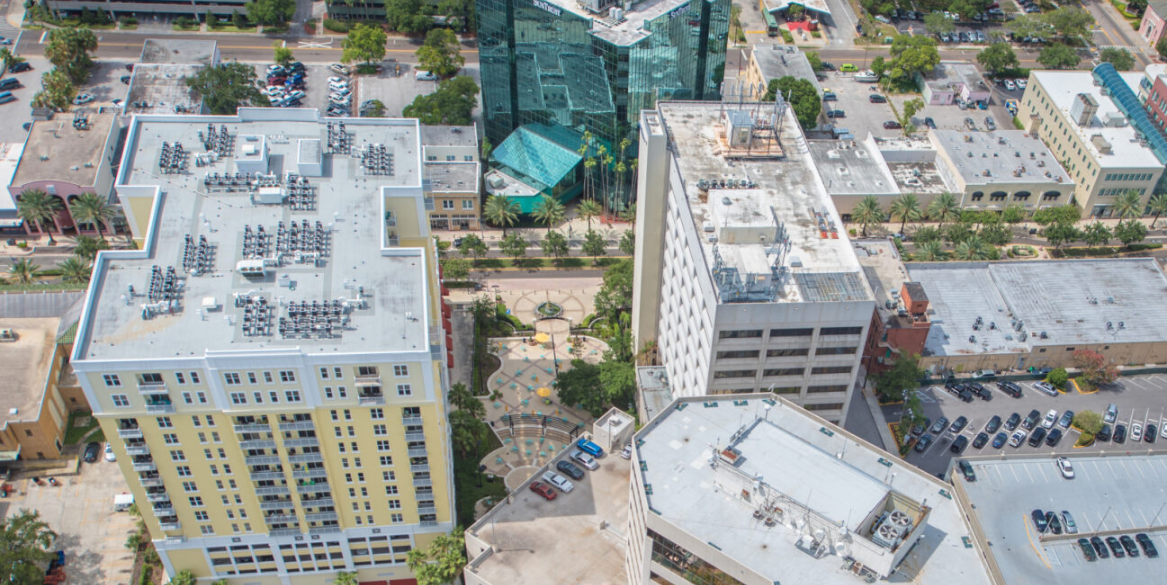
Developers have until the end of today to submit their visions for nearly 25 acres of county-owned land in downtown Clearwater, beginning a selection process that is expected to stretch into 2027.
Pinellas County opened its Request for Negotiations (RFN) in June for 17 properties encompassing 34 parcels and roughly 24.5 acres. The land will become available as the county prepares to relocate most of its downtown operations to a new government complex near Ulmerton Road and Icot Boulevard.
Today’s deadline marks a significant step in an effort county officials have spent more than two years assembling. The goal is to use their redevelopment to bring more residents, businesses and year-round activity into downtown Clearwater.
The county is seeking a master developer capable of creating a mixed-use district with residential, commercial, retail, hospitality, civic and public spaces. Officials have also identified marine, technology and creative industries as potential additions to an economy long anchored by tourism.
What developers propose, however, will not immediately be available for public review. The county’s procurement process provides for a period of confidential evaluation before proposals become public. Florida law generally exempts sealed responses to competitive solicitations until an agency announces an intended decision, or 30 days after opening the proposals or final replies, whichever occurs first. The county’s specific timetable for releasing these RFN submissions should therefore be confirmed before describing it as a 90-day public-record exemption.
The county will first determine which proposals warrant further consideration.
Its redevelopment timeline calls for staff to analyze submissions in October before beginning term-sheet negotiations with qualified developers in November. Those negotiations are expected to continue through January 2027.
That flexibility is one reason commissioners chose an RFN rather than a conventional request for proposals (RFP).
As the Catalyst previously reported, an RFN allows the county to negotiate development terms after reviewing initial concepts rather than restricting officials to static proposals submitted at the beginning of the process. It also allows the county to consider the properties collectively, rather than negotiating redevelopment one parcel at a time.
The approach is intended to give officials greater control over how the 17 properties work together as part of a larger downtown district.
Pinellas has hired commercial real estate firm CBRE Inc. to help structure and evaluate the redevelopment process. County Administrator Barry Burton previously said the scale of the properties required outside expertise to help officials vet prospective developers and structure a deal.
“This is a large project to be able to vet, look and structure this process to get the outcome we’re looking for,” Burton said earlier this year.
The county has since established several criteria for evaluating developers, including experience completing comparable projects, financial strength and funding sources, compatibility with the county’s redevelopment goals and whether proposed development schedules are realistic. The county is not obligated to select a proposal if none meets its expectations.
Commissioners are expected to select a developer in April 2027. Negotiations over the legal agreements would then continue from roughly May through November, with final commission approval anticipated by December.
The county anticipates another 12 to 24 months of work after awarding the project, including environmental assessments, title searches and surveys, infrastructure analysis, zoning and entitlements, design, permitting and other public approvals.
Redevelopment is tied to Pinellas County’s decision to leave its aging downtown government buildings. The county purchased 21 acres at 13600 Icot Blvd. for $33 million in 2023 and expects to complete the new government center in 2029. County officials estimate the move will save more than $150 million over 50 years, compared with remaining in and renovating the existing downtown facilities.
The county also intends to use proceeds from the properties to reduce how much it must borrow for the new government complex. Moving the downtown parcels from government ownership to private development would also put currently tax-exempt land onto city and county tax rolls.
The redevelopment would build on public and private investment already reshaping downtown Clearwater, including Coachman Park and improvements along Osceola Avenue. County and city officials have emphasized pedestrian connections between downtown, the waterfront, Clearwater Beach and existing commercial corridors.