
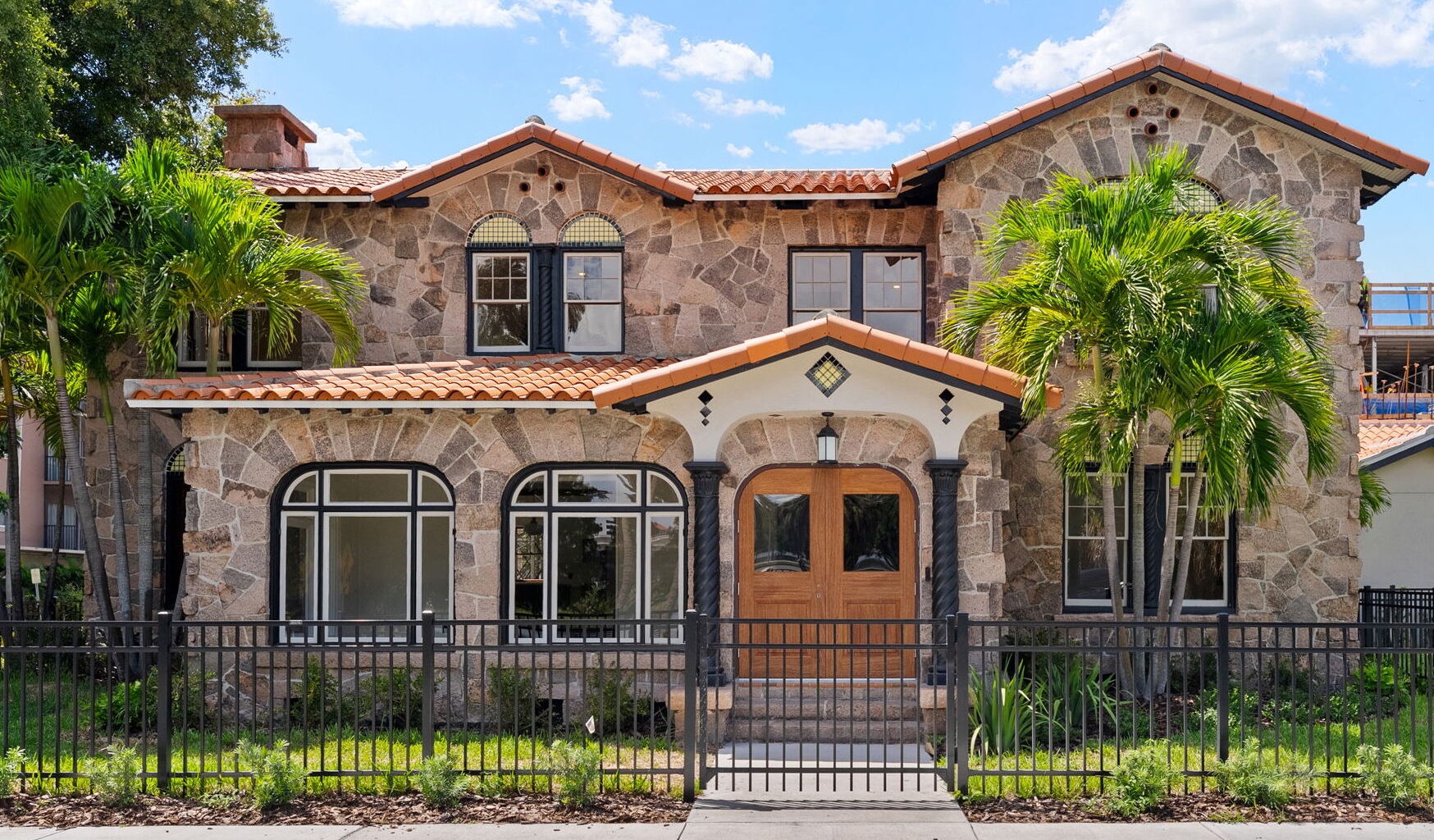
After nearly 7,800 hours spent restoring windows, doors, floors and granite, one of downtown St. Petersburg’s last historic single-family homes is ready for its next owner.
Backstreets Capital has completed its restoration of the Cade Allen home at 250 Mirror Lake Drive, returning the more than 4,000-square-foot property from its most recent use as a law office to its original purpose as a residence. The 90-year-old home was listed Thursday for $3.5 million.
The restoration is also one piece of a larger redevelopment now taking shape around it. Backstreets is building The Cade, a seven-story, 15-unit condominium project behind the historic home, with construction already about halfway through.
When St. Petersburg’s Development Review Commission approved the redevelopment in 2024, preservation of the Cade Allen home was a condition of the project. The home is not individually listed on the local or national historic registers, but the city considers it a contributing structure to the downtown historic district.
“The 7,800 hours – that was just the restoration. The overall work was many multiples of that,” Backstreets founder Will Conroy told the Catalyst.
The work included restoring 16 original doors and 30 windows, rebuilding four additional windows to match the originals and spending more than 1,000 hours on the exterior. About a third of the restoration hours went into the windows.
“The most difficult thing was coordination between everyone involved,” Conroy said. “It was our favorite part, because you’re working with so many talented people.”
Some of the surprises were hidden inside the walls. Conroy said the density of the home’s original pine became apparent as crews worked through the restoration.
“One of the things that stood out was just how solid the pine wood was,” he said. “Some of this old wood was petrified. You had to slam the nail in with a hammer extremely hard to get it to go in at all.”
Older pine used in homes like Allen’s typically came from slower-growing, mature trees, producing tighter growth rings and denser lumber than much of the faster-grown pine used in modern construction. Backstreets reused original wood where possible, although portions of the home required new pine to augment existing walls.
The house was built by pioneering St. Petersburg developer Cade Allen, whose work helped define the architectural character of the Allendale neighborhood that bears his name. Conroy also lives in Allendale, putting him among Allen-designed homes even when he is away from the Mirror Lake project.
Backstreets acquired the property with a larger redevelopment in mind. The original plan called for 18 condominiums behind the historic residence, but the developer later reduced that to 15 larger three- and four-bedroom units exceeding 2,100 square feet.
In February, contracts had opened for those residences and the historic home was still undergoing restoration. Conroy said at the time that Backstreets intended to complete the house before moving forward with the condominiums.
Construction, instead, has since accelerated.
“We are pouring the fourth-floor slab next week,” Conroy said. “So we are about 50% done with the structure. We started in April and have the foundations set.”
Backstreets anticipates completing The Cade in 2028. Six of its 15 residences have sold.
“Now people can see the views and skyline from a distance, and that will sell itself,” Conroy said.
The restored house, meanwhile, will remain separate from the condominium project and return to the residential use for which it was built.
“It was used as a law office, so our restoration is to bring it back to its original single-family home,” Conroy noted. However, while separate, the old and new portions of the development will still share some of the same material. Making room for The Cade required demolition of the historic home’s detached garage. Backstreets salvaged its original granite.
About 250 of those stones have now been preserved for the condominium project. They will form part of The Cade’s foyer and entrance, meaning residents entering the new building will walk across material used on the property nearly a century earlier.
That connection was part of the development plan well before construction began; using the garage’s granite in the new building was a way to connect the site’s history with what was being built behind it.