
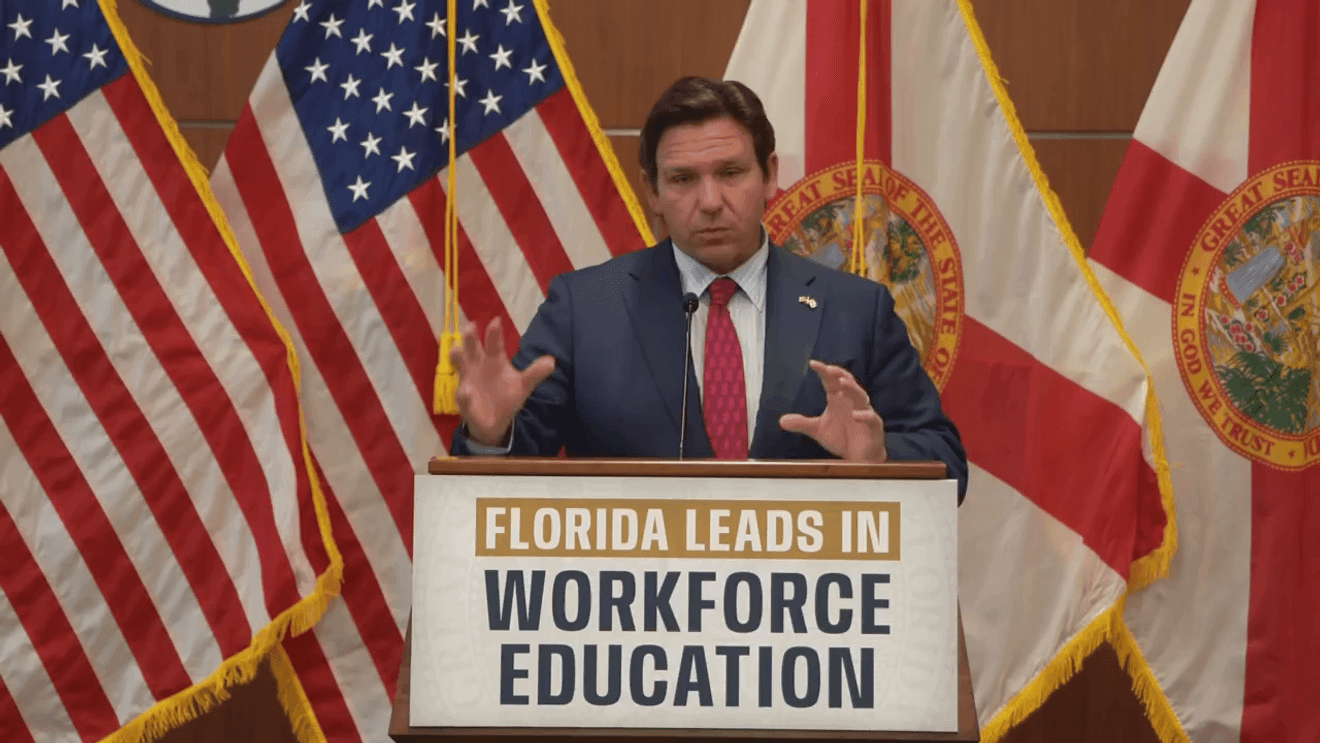
Gov. Ron DeSantis says Florida will allow artificial intelligence to supplement classroom learning but not replace teachers or students’ own thinking. Education Commissioner Henry Mack says parents must opt children into AI use and districts will have until July 1 to implement the state’s new rules.
MELBOURNE, Fla. — Florida is drawing a line around artificial intelligence in its classrooms: AI can be a tool, but state leaders say it cannot become the teacher — or do the thinking for the student.
Gov. Ron DeSantis outlined that approach after the State Board of Education approved new AI rules for K-12 schools.
“We are not going to be displacing a classroom teacher with machines,” DeSantis said. “Technology is a tool that can enhance and that can supplement.”
Parents must opt in
A key part of Florida’s approach is parental consent.
DeSantis said AI use will be opt-in rather than opt-out, meaning a student’s default experience does not change unless a parent affirmatively agrees to additional AI use.
“If it’s something that you think would be beneficial, then you as a parent have the ability to opt into that,” DeSantis said.
Education Commissioner Henry Mack said students who are not opted in must be provided a “substantively similar” alternative that accomplishes the same instructional objective. Individual school districts will establish policies for how that requirement works in classrooms.
Mack warns of ‘cognitive surrender’
The concern extends beyond K-12 schools.
Mack said Florida also adopted a higher-education rule allowing faculty to set limits on AI use in their courses.
He warned of what he called “cognitive surrender” — students turning to AI at the first sign of academic difficulty rather than struggling through a problem and developing critical-thinking skills.
Mack described that as an “illusion of learning.”
“We do not want AI doing that on behalf of the learner,” Mack said.
DeSantis raised a similar concern, pointing to college students using large language models to complete work and professors responding by returning to handwritten exams.
“We don’t want to go down that road in our K-12,” DeSantis said.
Districts have until July 1
Mack said Florida school districts have until July 1 to implement the new K-12 regulations.
The Department of Education plans to establish work groups, work with superintendents and provide resources as districts develop their policies — assistance Mack said will extend to rural districts.
Florida isn’t banning artificial intelligence from education.
But state leaders also aren’t embracing unrestricted use.
“We’re not putting our head in the sand,” Mack said, “nor are we allowing for unfettered access.”
For DeSantis, the dividing line is whether technology helps students learn — or begins learning for them.
“Technology has a role,” DeSantis said. “But it is a supplementary role.”