
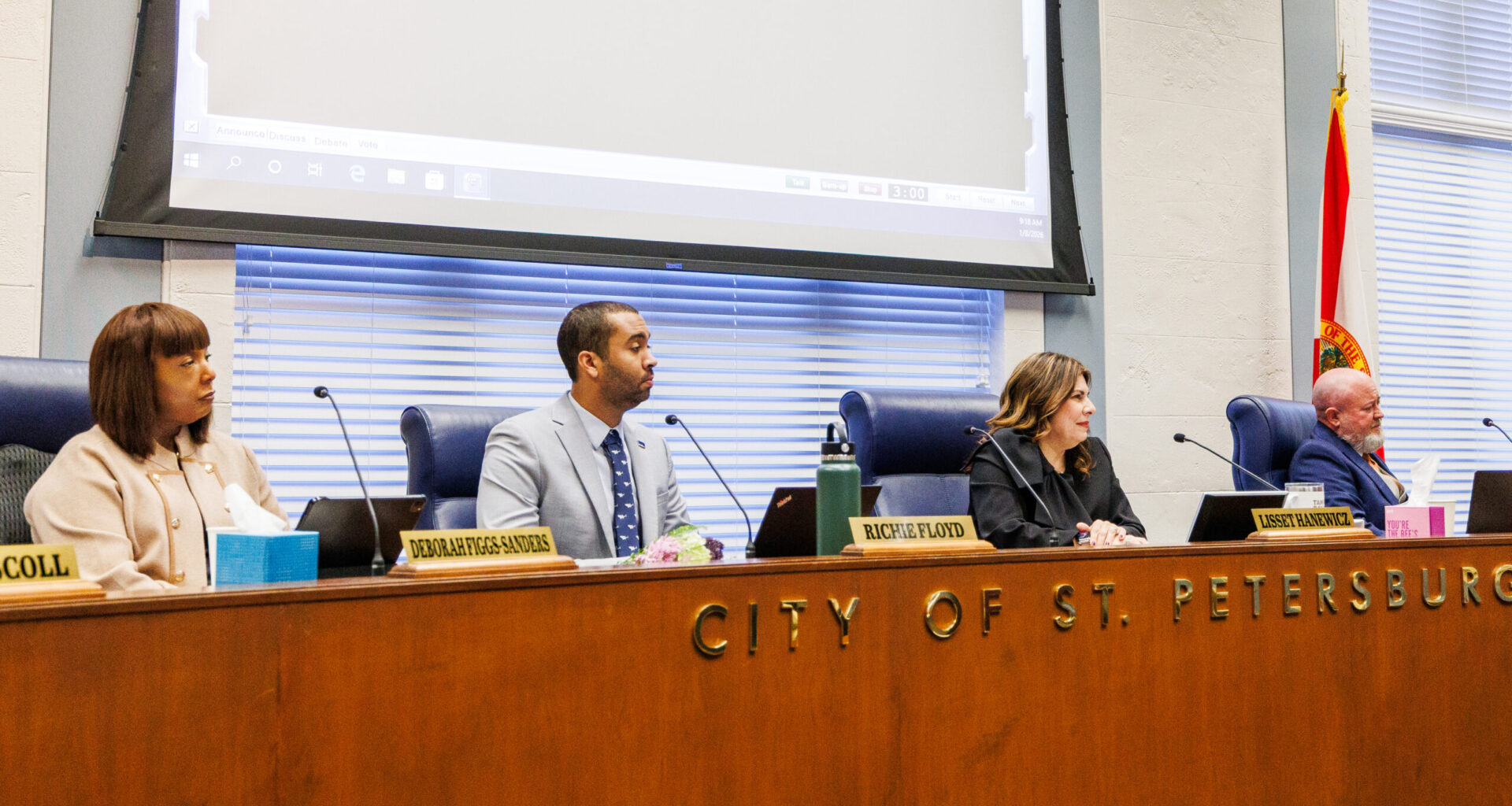
The St. Petersburg City Council has approved its Fiscal Year 2027 budget, with higher Axon costs fueling scrutiny of the city’s police technology contracts and Flock license plate readers.
The city is setting its property tax rate at 6.4525 mills, about 1.05% above the rolled-back rate of 6.3854 mills that would generate roughly the same property tax revenue as the current year. St. Petersburg expects to collect about $14.8 million more in ad valorem revenue year over year under the millage.
The spending plan includes a $1.02 billion operating budget that is about 4.25% larger than the current year’s, with public safety accounting for about $240.9 million, or 55%, of the city’s roughly $437.3 million General Fund.
City officials attributed much of that pressure to contracted raises for police and firefighters, six additional sworn Fire Rescue positions and higher costs under existing agreements. About $185.8 million goes to police, which is a roughly $11.5 million increase over the current year, while $55.1 million goes to Fire Rescue.
Among those agreements is the city’s contract with Axon, which provides St. Petersburg Police with body-worn cameras and other law enforcement technology. That became a point of concern during the hearing when a resident questioned how much the city was spending with Axon and connected the company to St. Petersburg’s separate Flock automatic license plate reader system.

Assistant Chief David Gerardo promptly pushed back on that connection, stressing that Axon and Flock operate under separate city contracts and serve different purposes.
Prior to Gerardo’s explanation, resident Brad Farbo urged the Council to reject the budget, raising concern that allocations associated with Axon could rise from roughly $3.3 million to nearly $6 million under the spending plan and arguing that the spending should be considered alongside the city’s investment in Flock. The published budget does not provide enough vendor-level detail to independently confirm the figures.
Farbo also criticized what he described as barriers to accessing detailed city spending records.
The issue carried into Council’s discussion, where Council Member Corey Givens Jr. asked Gerardo to clarify how much the city spends with Axon and whether it was tied to the Flock system.
Gerardo said he believed St. Petersburg spent about $2.7 million with Axon this year, though he cautioned that he did not have the exact figure in front of him. He also drew a firm distinction between Axon and Flock.

“Axon is a completely separate contract,” Gerardo said.
He said Axon does not provide the city’s license plate reader technology. Instead, the agreement covers police equipment and services that include Fleet in-car systems, body-worn cameras, training tools and Taser technology.
St. Petersburg contracts separately with Flock Group, which has become a point of controversy at City Hall. The city’s network grew from a 25-camera Police Department pilot in 2022 to more than 50 readers, largely before Council had a substantive public debate over privacy, data retention or how the information could be shared.
Council only recently voted to take a closer look at the system after Vice Chair Richie Floyd raised concerns about the city’s control over Flock data and the tradeoff between public safety and surveillance.
The scrutiny has intensified as St. Petersburg was also forced to remove six readers from state roads under a Florida Department of Transportation crackdown on automated license plate readers.
That scrutiny carried into Thursday’s budget discussion, where questions about Axon became tangled with the city’s separate Flock system.
The two remain distinct city contracts. Flock is still operating under the five-year, $730,250 agreement Council approved in 2024, not a new expense created by the FY 2027 budget.
Other speakers focused on whether more of the city’s public safety investment should go toward prevention.
Members of the Bay Area Dream Defenders urged the city to spend more on youth programs, outreach and neighborhood-based services.
Council members later highlighted programs already in place, including free recreation programming for middle school students, subsidized childcare and technology-focused youth programs, and discussed ways to connect some of the group’s proposals with existing funding and services.
Before the final votes, Council Chair Lisset Hanewicz also warned that the budget picture could look significantly different after November if voters approve Amendment 3, which would expand Florida’s homestead exemption. She cited state estimates projecting St. Petersburg could lose about $34.6 million in property tax revenue in 2027-28, with the impact growing in subsequent years.
“That would be money that is not in our budget and goes into our General Fund, so that would be a huge impact,” Hanewicz said.
She warned that cuts of that scale would ultimately translate into fewer services or require the burden to be shifted elsewhere.
“This cost doesn’t just disappear, it’s absorbed by someone, it’s shifted to someone else,” Hanewicz said.
Council ultimately approved the tax rate 6-2, then adopted the FY 2027 budget on another 6-2 vote, with Council Members Gina Driscoll and Givens voting against both. The city’s five-year capital improvement program, totaling about $1.19 billion, passed 7-1, with Driscoll opposed.