
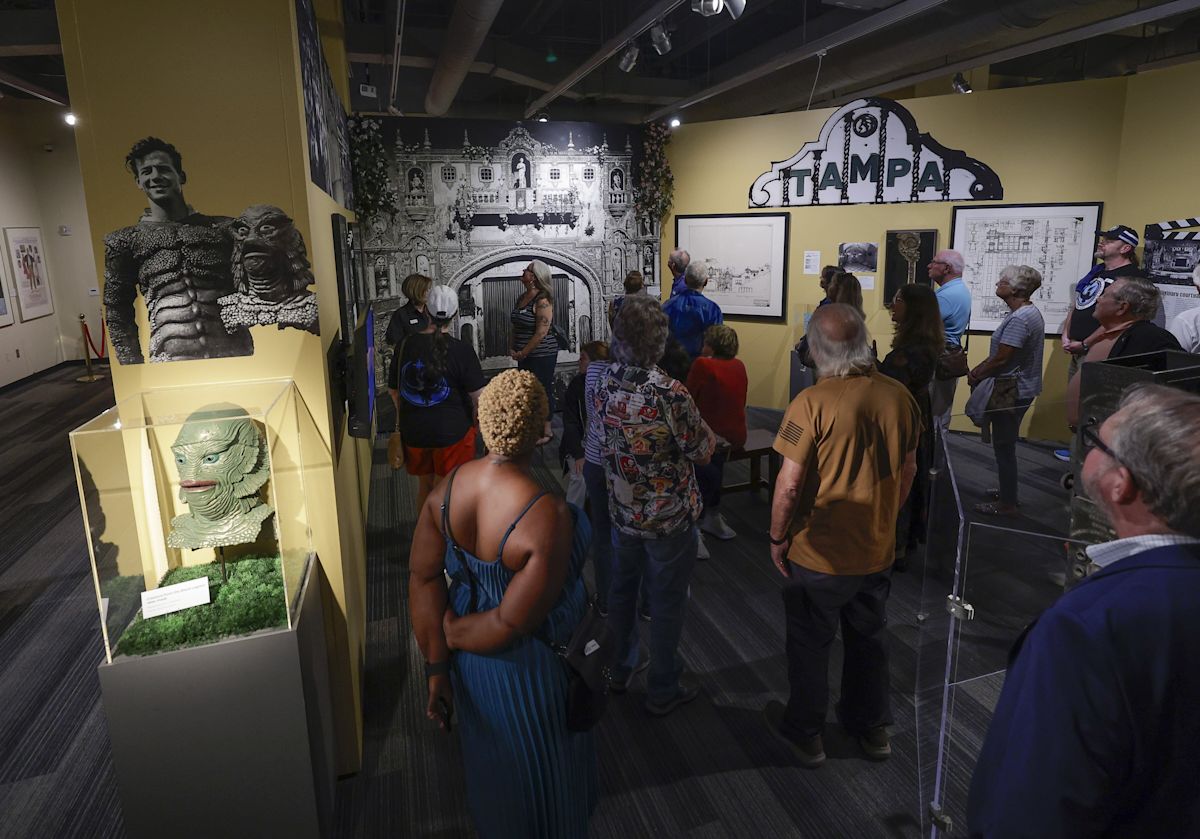
While many people now associate cinema with California, Florida’s sunny days and natural beauty once made it a hotbed for movie making.
“Cinema in the Sunshine State,” which opens today at the Tampa Bay History Center, explores more than a century of Florida filmmaking.
The exhibit features — and was inspired by — “Beaches, Creatures, and Cowboys,” a traveling exhibit of movie posters from Tallahassee’s Museum of Florida History.
“You have Hollywood movies that are filmed in Florida, often using Florida as the backdrop, but then you have movies that are really based on a Florida topic or something that could have only happened in Florida,” said Rodney Kite-Powell, director of the Touchton Map Library and Florida Center for Cartographic Education at the Tampa Bay History Center.
“Florida is a surrogate for some other kind of wild, mysterious place,” Kite-Powell said, citing classics like “Creature from the Black Lagoon” and several “Tarzan” films, which shot scenes at Wakulla Springs in the Panhandle. “It’s perfect for Florida to be that.”

A lantern project similar to the one used in the Tampa Theatre is on display at Tampa Bay History Center in the new Cinema in the Sunshine State exhibit.
Michelle Hearn, the history center’s director of curatorial affairs, led the charge to assemble the exhibit in Tampa. Guests will learn about movie studios once found in Jacksonville, Sun City and St. Petersburg’s Weedon Island.
Visitors will also learn about lesser-known but historically significant films with local ties. For example, the 1930 drama “Hell Harbor,” shot in Tampa’s Rocky Point.
“It wasn’t a particularly great movie from a screenplay standpoint,” Kite-Powell said. “But it was really groundbreaking in that it was one of the first sound movies that was filmed on a location (instead of) a soundstage.”

A poster from the movie The Punisher, which was filmed in Tampa, is on display at the Tampa Bay History Center.
The exhibit also nods to 1918’s “Birth of a Race,” made in response to 1915’s “Birth of a Nation,” which glorified racism and the Ku Klux Klan. The former, made in Sulfur Springs, explored “Africa and the origins of humanity, and the importance of Blacks and Africans in our culture,” Kite-Powell said.
“Even the idea of spring break almost was created through film,” Kite-Powell continued, pointing out the 1960 movie “Where the Boys Are,” filmed in Fort Lauderdale. “It was a movie that became real life.”
In addition to movie posters and lobby cards, the exhibit features props, replicas and behind-the-scenes tools used to bring these stories to life. The Clearwater Marine Aquarium loaned one of the prosthetic tails that Winter the dolphin, of “Dolphin Tale” fame, once wore. The Edison and Ford Winter Estates in Fort Myers, where film innovator Thomas Edison lived as a snowbird, sent over historic artifacts.

Movie posters and artifacts from “Beneath the 12-Mile Reef,” filmed in Tarpon Springs, are on display at the Tampa Bay History Center.
And the Tampa Theatre donated original tapestries, and furniture and items that once helped to create the illusion of day and night inside its main auditorium. In honor of the Tampa Theatre’s centennial celebration next month, the exhibit includes a special section commemorating the landmark’s long history.
“I’ve been going there since I was a kid,” said Kite-Powell, who contributed edits to a new book about the Tampa Theatre. “They have really done an amazing job both preserving the history of the theater, but also creating a space that is very comfortable for the modern audience.”
Cinema in the Sunshine State
“Cinema in the Sunshine State” opens Saturday at the Tampa Bay History Center and runs until March 21. The museum, located at 801 Water Street in Tampa, is open daily from 10 a.m. to 5 p.m. Admission is $18.95 for adults, $16.95 for seniors and college students, $14.95 for children 7-17, and free for children younger than 6 or museum members. Visit tampabayhistorycenter.org for more information.