
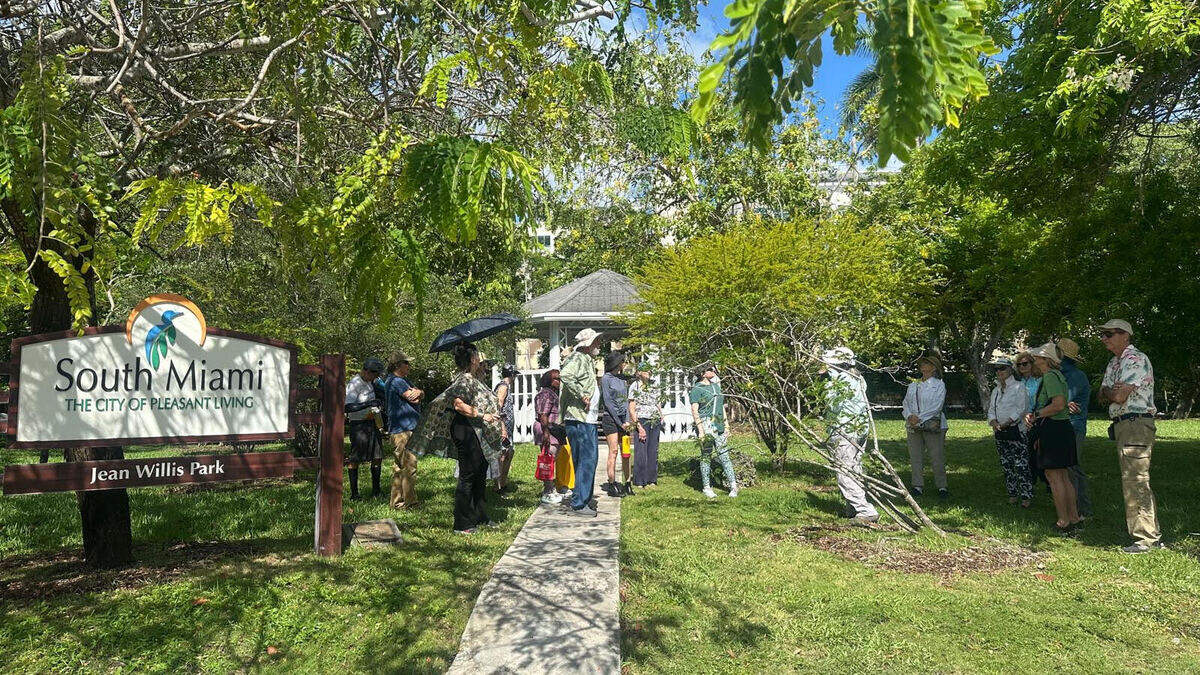
Visitors attend a tour of the trees at Jean Willis Park in South Miami in June 2026. The Tropical Flowering Tree Society planted dozens of flowering trees and shrubs at the park.
Provided
In a region that’s under pressure to develop every last piece of empty land, the relocation of a small park to build a residential building feels symbolic.
We recently wrote about the closure of developer-owned Allen Morris Park in Brickell, which is planned to become a restaurant and making neighbors unhappy over the loss of green space. The plans for Jean Willis Park in South Miami are different: The park is not expected to shut down, but it would move to a new, slightly bigger location a few hundred feet away. The city plans to lease the land, plus some additional property, to a developer to erect a 16-story tower and a parking garage that are part of a city initiative, years in the making, to revitalize the area west of downtown.
The city says the park relocation will make it the centerpiece of the redeveloped area, but some residents and park advocates see this as a sign that officials look at green spaces as areas to be swapped on behalf of progress. They want Jean Willis and its beloved trees to stay where they are. “I don’t understand why you have to destroy public parks to make tall buildings,” former South Miami Mayor Sally Philips told the Editorial Board.
In the grand scheme of South Florida’s bulldoze-and-build development frenzy, relocating a park is probably not the worst-case scenario. But if tree lovers won’t fight for the biodiversity and the canopy trees provide in the scorching heat, who will? Certainly, not developers.
Jean Willis Park is located south of Sunset Drive, east of U.S. 1 and across from South Miami’s City Hall. It is a flowering tree garden with 65 to 70 trees and shrubs planted by the Tropical Flowering Tree Society, a local organization that gives tours at the park to admire orange and yellow poincianas.
The relocation plans are part of a bigger proposal to move and rebuild an obsolete City Hall building complex. The City Commission is scheduled Tuesday to have its first hearing on the approval of the plan. (Two hearings are required for final passage.)
Under the proposal, City Hall and the Police Department would move into a new four-to-five-story civic building that is also expected to house the nearby South Miami Branch Library, Mayor Javier Fernandez told the Editorial Board. Jean Willis Park would move closer to U.S. 1, next to the civic building, and would be connected to the Underline, the urban linear park that’s below the Metrorail tracks. The whole project would cost about $50 million.
The current site of the park and a portion of City Hall land would be leased to developer 13th Floor Investments for the constructions of two 16-story multifamily buildings with 670 residential units, up to 30,000 square feet of retail space and two parking garages with 910 spots, according to a city document.
The redevelopment would create something that Fernandez said South Miami needs: more public space where residents can live, shop, go to restaurants and enjoy the relocated park and Underline. He added that few people use Jean Wills — it is surrounded by medical and government offices, a gas station and South Miami Hospital — and that the relocation would bring new visitors. The city has not yet designed the new park and surrounding space and Fernandez said the community will be able to provide input.
Jean Willis, in its current location, would remain open for roughly four years while the new civic building and one of the apartment towers are developed, and that gives the city time to prepare the trees for relocation, he said.
“My goal has never been to get rid of the park,” Fernandez said.
One curious fact about Fernandez: He’s the lawyer representing the Allen Morris Company in its decision to develop the Brickell park. He’s allowed to have an outside job, but that connection doesn’t sit well with some residents.
As for moving the trees, mature ones may not survive a move, and poincianas are particularly difficult to relocate, said Stephen Pearson, one of the founders of the Tropical Flowering Tree Society. The city could plant new trees, but lose the canopy of older ones.
Philips and others believe the proposed new location is too close to the traffic, noise and fumes coming from U.S. 1. (Fernandez disagrees, saying the current location is already close to the road.) They want the city to maintain the park where it is, but Fernandez said that the new location makes Jean Willis the “centerpiece” of the re-imagined area.
With the redevelopment looking like a done deal, the focus should on preserving as many trees as possible. “Save the trees” may sounds like a hippie slogan, but that’s exactly what South Florida needs in these booming times.
BEHIND THE STORY MORE What’s an editorial?
Editorials are opinion pieces that reflect the views of the Miami Herald Editorial Board, a group of opinion journalists that operates separately from the Miami Herald newsroom. Miami Herald Editorial Board members are: opinion editor Amy Driscoll and editorial writers Isadora Rangel and Mary Anna Mancuso. Read more by clicking the arrow in the upper right.
What’s the difference between an op-ed and a column?
Op-Eds, short for “opposite the editorial page,” are opinion pieces written by contributors who are not affiliated with our Editorial Board.
Columns are recurring opinion pieces that represent the views of staff columnists that regularly appear on the op-ed page.
How does the Miami Herald Editorial Board decide what to write about?
The Editorial Board, made up of experienced opinion journalists, primarily addresses local and state issues that affect South Florida residents. Each board member has an area of focus, such as education, COVID or local government policy. Board members meet daily and bring up an array of topics for discussion. Once a topic is fully discussed, board members will further report the issue, interviewing stakeholders and others involved and affected, so that the board can present the most informed opinion possible. We strive to provide our community with thought leadership that advocates for policies and priorities that strengthen our communities. Our editorials promote social justice, fairness in economic, educational and social opportunities and an end to systemic racism and inequality. The Editorial Board is separate from the reporters and editors of the Miami Herald newsroom.
How can I contribute to the Miami Herald Opinion section?
The Editorial Board accepts op-ed submissions of 650-700 words from community members who want to argue a specific viewpoint or idea that is relevant to our area. You can email an op-ed submission to oped@miamiherald.com. We also accept 150-word letters to the editor from readers who want to offer their points of view on current issues. For more information on how to submit a letter, go here.