
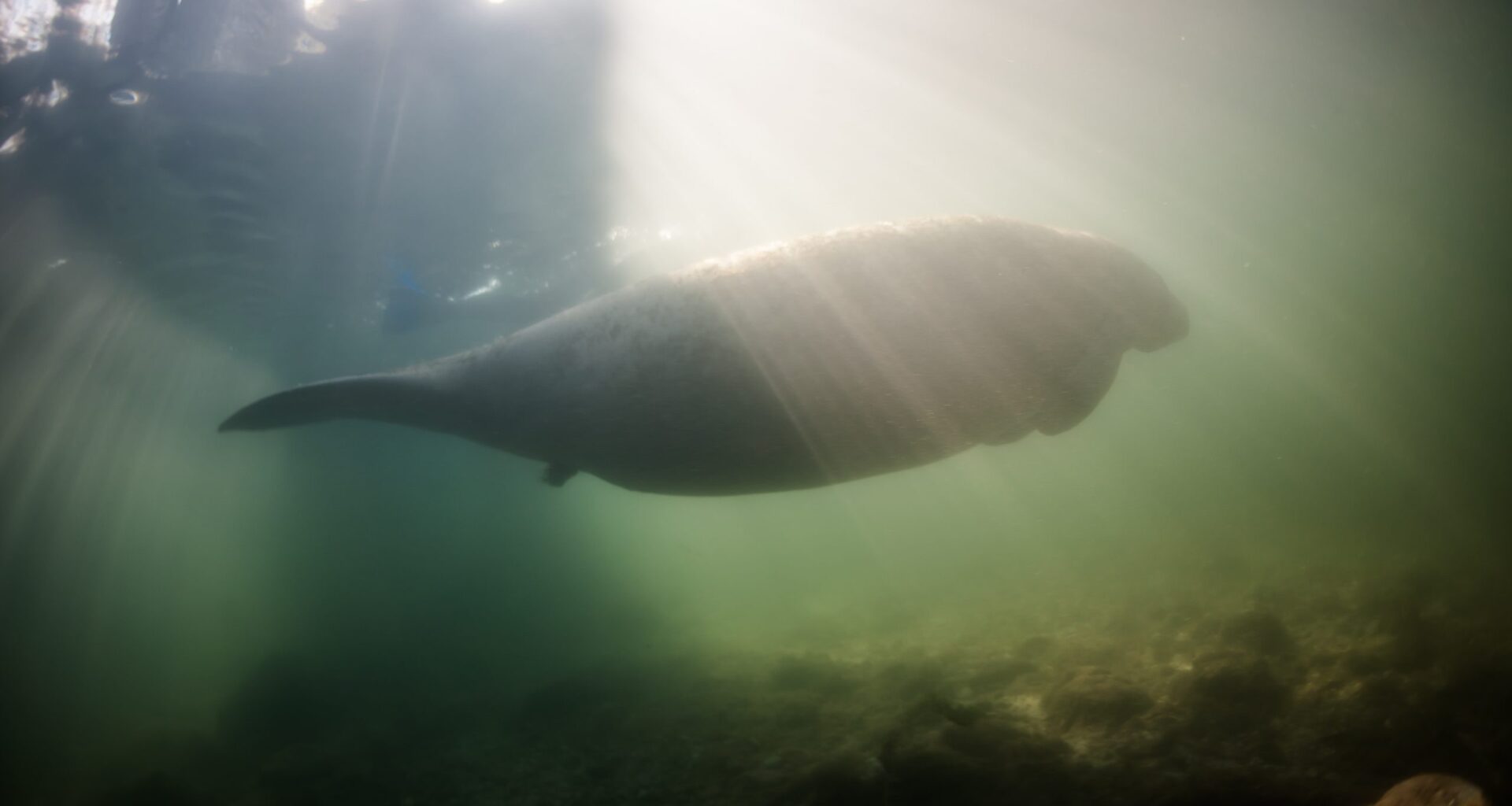
 Credit: Ethan Daniels/Shutterstock
Environmental advocates are asking the City of Clearwater to prioritize its water treatment infrastructure after a sewage spill contaminated a manatee protection zone last week.
A power failure at the Marshall Street Water Reclamation Facility caused sewage to back up and overflow through a nearby manhole early Saturday morning. Over the next 30 minutes, an estimated 35,686 gallons of sewage overflowed into the surrounding area.
That volume, which would fill 3.5 tanker trucks, was spilled about 300 feet from the shore of Stevenson Creek—the city’s newly-designated manatee protection zone is less than 2,000 feet downstream.
Hundreds of manatees rely on the aquatic grasses that grow in the creek. For years, local activists have fought to preserve the habitat while a developer seeks to build docks that would encroach on the feeding grounds.
Three weeks ago, those activists successfully lobbied Clearwater City Council to create protections for the manatees who graze in the estuary portion of the creek.
Michael Flanigan, director of Clearwater’s Public Works department, told Creative Loafing Tampa Bay that the sewage treatment plant is usually beneficial to those manatees because the discharged water keeps them warm during the winter months.
Flanigan was promoted to his role earlier this year, and he inherited one of many dilapidated wastewater systems across the country. The American Society of Civil Engineers gave America’s wastewater systems a “D+” grade last year because of the aging infrastructure.
“We want this controlled,” said Sherry Day, president of the Stevenson Creek Advocacy Group, who started the campaign for manatee protection in the estuary.
Day told CL the spill shows that Clearwater needs to prioritize its water treatment facilities. “There have been recurring events, mechanical failures, equipment failures that have occurred and nothing has been done about them.”
The Marshall Street plant has seen these incidents before, and this one was small in comparison. In 2023, an equipment malfunction led to 500,000 gallons of sewage being spilled.
During Tropical Storm Debby in 2024, rather than allow sewage to back up into homes and businesses by shutting down the plant, the city allowed the final stage of the treatment process to overflow, which resulted in a spill of over 18 million gallons of partially-treated sewage.
Weeks later, during Hurricane Milton, 25 million gallons spilled.
The troubled Marshall Street plant is set to be decommissioned, but as of now the timeline isn’t clear.
“They have told us for years and years that there is a plan to decommission this, but it is a huge endeavor to reroute all of the sewage to go to another plant and put this one in idle mode,” said Day. “And we see no real efforts in that direction. I want to see a plan, and I want to see action moving towards that.”
Flanigan told CL that it’s going to be a complicated process. Getting funding is the biggest challenge, followed by the slow nature of massive infrastructure projects.
In the meantime, they’re implementing solutions that will help prevent sewage from leaching into the creek when overflows occur, with some of those upgrades slated to be completed later this year.
“We’re not going to be able to prevent wastewater spills,” Flanigan said. “There aren’t communities out there that do. At the end of the day, we’re environmentalists. We’re trying to do the best we can.”
Flanigan said that every dollar the city allocates to upgrading its wastewater infrastructure will help reduce those spills.
Pitch in to help make the Tampa Bay Journalism Project a success.
Subscribe to Creative Loafing newsletters.
Follow us: Google News | NewsBreak | Reddit | Instagram | Facebook | BlueSky
This article appears in Sept. 17 – 23, 2026.
Related