
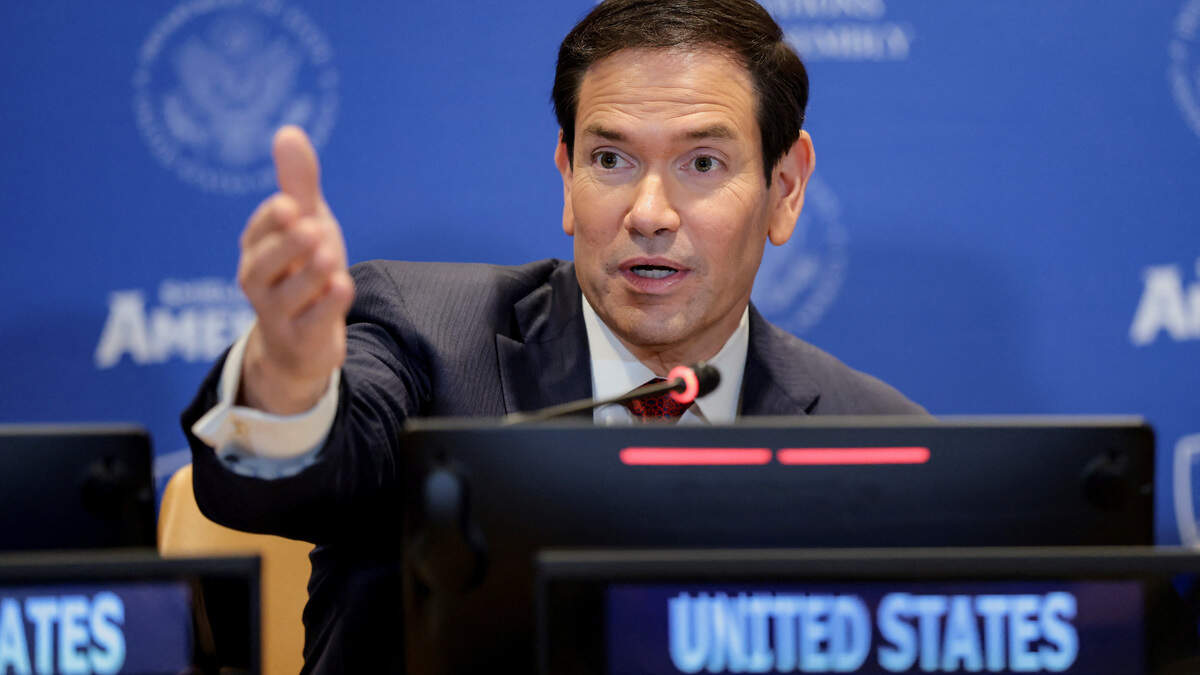
Secretary of State Marco Rubio participates in a Shield of the Americas event during the 81st United Nations General Assembly in New York City on Sept 22, 2026.
Kylie Cooper
REUTERS
The United States has invited Russian President Vladimir Putin to the G20 summit, a gathering of global powers that will be held in Miami in December, Secretary of State Marco Rubio told reporters in New York.
Asked whether President Donald Trump would meet Putin for talks about the war in Ukraine, Rubio said the president is willing to engage with anyone, including people he disagrees with.
“We’ve invited President Putin to the G20,” he said. “We think it’s an opportunity for him to engage not just with the president, but with other world leaders. We hope that’s an invitation he’ll accept. There’s an opportunity in December if that happens.”
Rubio said Trump has spoken dozens of times with Putin on the phone.
“We remain open to engaging,” he said. “Obviously, the ideal would be a meeting in which there will be a result, an outcome, and a lot of that means there has to be a lot of work that goes into it beforehand. But if not, maybe if President Putin attends the G20 in December that will certainly be an opportunity for them to interact and talk.”
In April the Kremlin said Putin might attend the summit in Miami after Trump said it could be useful, but the Russian government was non-committal. Putin last attended a G-20 summit in 2019 in Japan but skipped the subsequent ones due to the COVID pandemic and the backlash from his invasion of Ukraine.
Trump met Putin in Alaska in August 2025. It was the Russian leader’s first trip to the United States in a decade, and he was welcomed with a red carpet and a ride in Trump’s limousine. The talks lasted about three hours but yielded no ceasefire or agreement to end the war.
Rubio met with Russian Foreign Minister Sergey Lavrov on Wednesday morning on the sidelines of the United Nations General Assembly in New York. According to a two-sentence readout of the meeting put out by the State Department, the two “discussed the Russia-Ukraine war and the U.S.-Russia bilateral relationship”.
On Tuesday, Trump met with Ukrainian president Volodymyr Zelensky for 40 minutes in New York. Zelensky said they discussed a proposed ceasefire on energy infrastructure attacks and that Ukraine was ready to support the truce.
Asked about it, Rubio said the ceasefire agreement was difficult because it meant different things for the two sides.
“The Ukrainians are inflicting pain on the Russians by hitting their energy sector, which is a revenue source,” Rubio said. “The Russian side is inflicting pain on the Ukrainian side by targeting their electric grid, especially as we head into winter. The challenge is that both sides have identified energy as a strategic objective of their war aims, but it’s having a global impact, in the case of oil and gas, and it’s having a very real and immediate impact on life in Ukraine. So that’s why it’s not easy overnight to just say, let’s reach an agreement, but it’s something that I think is worth investing in, trying to make that happen because I think it would be beneficial to the world, and beneficial to both countries.”
The G20 includes the world’s largest economies, representing 85% of the global GDP and two-thirds of the world’s population. The group’s meeting will be held at Trump National Doral.
This story was originally published September 23, 2026 at 1:54 PM.
el Nuevo Herald
Nora Gámez Torres is the Cuba/U.S.-Latin American policy reporter for el Nuevo Herald and the Miami Herald. She studied journalism and media and communications in Havana and London. She holds a Ph.D. in sociology from City, University of London. Her work has won awards by the Florida Society of News Editors and the Society for Professional Journalists. For her “fair, accurate and groundbreaking journalism,” she was awarded the Maria Moors Cabot Prize in 2025 — the most prestigious award for coverage of the Americas.//Nora Gámez Torres estudió periodismo y comunicación en La Habana y Londres. Tiene un doctorado en sociología y desde el 2014 cubre temas cubanos para el Nuevo Herald y el Miami Herald. También reporta sobre la política de Estados Unidos hacia América Latina. Su trabajo ha sido reconocido con premios de Florida Society of News Editors y Society for Profesional Journalists. Por su “periodismo justo, certero e innovador”, fue galardonada con el Premio Maria Moors Cabot en 2025 —el premio más prestigioso a la cobertura de las Américas.