
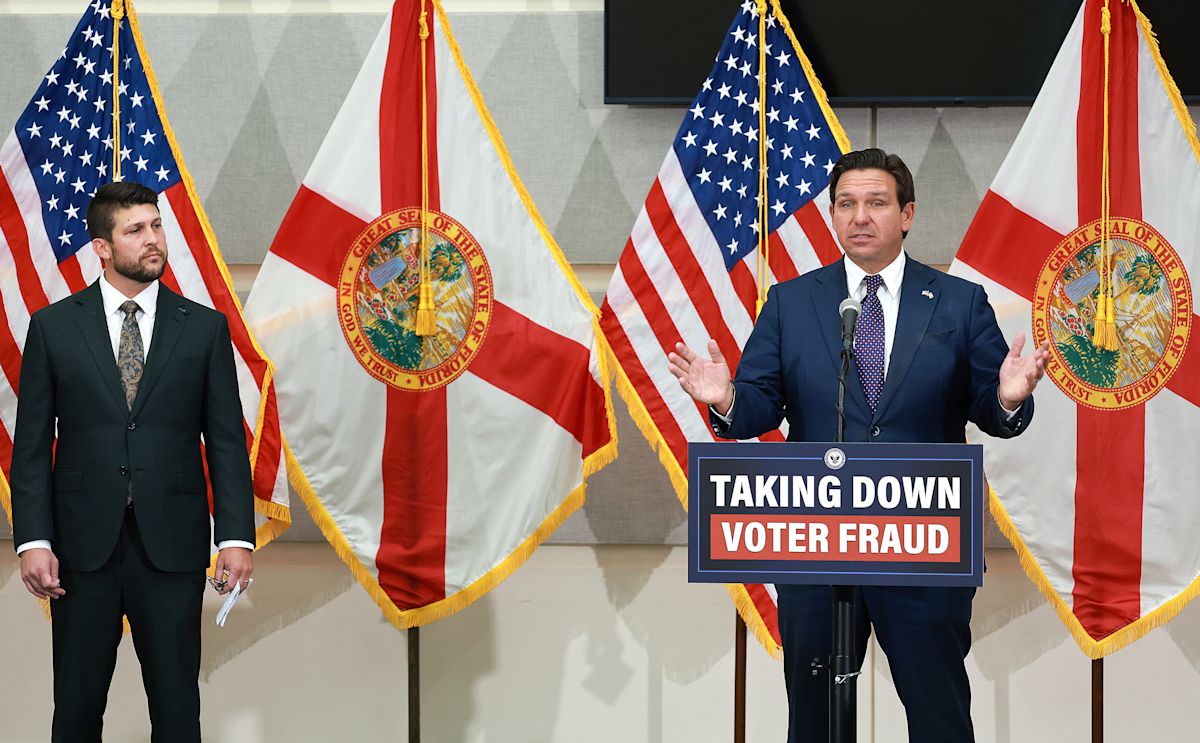
FORT LAUDERDALE, Fla. — Gov. Ron DeSantis and state officials announced Thursday the arrests and prosecutions of 20 people across Florida accused of voting illegally, adding to the efforts of the state Office of Election Crimes and Security that was established four years ago.
Thursday’s announcement in Lake Worth Beach comes weeks before the general election on Nov. 3 and nearly four years after DeSantis announced what he called in 2022 the “opening salvo” of voter fraud cases, when he publicized the arrests of 20 other people accused of voting illegally.
The new felony charges against 20 additional people brings the total number of arrests and prosecutions since the office’s creation to more than 100, Attorney General James Uthmeier said, and “dozens more investigations” are underway. Uthemeier said 12 of the 20 people had been arrested as of Thursday.
The majority of the people facing new charges are not U.S. citizens, in addition to four people who were convicted of felonies and allegedly voted while still on probation, according to a news release from Uthmeier’s office.
Florida voters passed Amendment 4 in 2018, which restored voting rights for people convicted of felonies, excluding those convicted of murder and sex-related offenses. There are eligibility requirements in order for rights to be restored, including completing all terms of their sentence or probation and full payments of fines, fees or restitution, among other requirements.
All but one of the 12 who were in custody as of Thursday are lawful permanent residents but are not U.S. citizens, and a few registered to vote decades ago when they allegedly falsely affirmed they were citizens.
The 12 who have been arrested so far are:
—Astrid Shamatu Navarrete Quintana, 24, of Fort Myers, a Mexican national.
—Selvin Uton Whilby, 74, of Tampa, a Jamaican national.
—Cyntia Vanessa Canales, 62, of Ocala, a Chilean national.
—Craig William Smith, 69, of Ocala, a Bahamian national.
—Tracey Sabrina Jones, 49, of Lakeland, a United Kingdom national.
—Kadian Gabrielle Amai Johnson, 29, of Lehigh Acres, a Jamaican national.
—Mei-Lin Johnston, 57, of Okeechobee, an Indonesian national.
—Alejandro Garcia Villegas, 65, of Lake City, a Mexican national.
—Manon M. Raux, 62, of Naples, a Canadian national.
—James Mark Hollingsworth, 62, of Lake Suzy, a Canadian national.
—Donta Ta White, 44, of Tampa, who was convicted of a felony and remains on probation until 2032 but allegedly voted in 2024.
—Giorgio Dominique Mucelli, 66, of Melbourne, a Canadian citizen.
When the Office of Election Crimes and Security was created at DeSantis’ request, it was praised by Republicans who saw election security as a pressing issue after Donald Trump’s false claims of voter fraud in the 2020 presidential election he lost.
DeSantis also announced Thursday that Florida is creating and will lead a new organization “dedicated to restoring trust in our electoral systems” called the Association of State and Local Election Officials which will be headed by Secretary of State Cord Byrd.
Byrd said the group will have state chapters to “train” local and state officials on “election integrity” with Florida as the “model for the nation.”
Nearly 3,500 complaints of alleged election crimes were reported to the state Office of Election Crimes and Security in 2025 alone, and 867 of them were referred to law enforcement, the office’s annual report released in January shows. Since the program’s creation, more than 8,700 complains have been sent to the office. The investigations involve citizenship and convicted felon statuses in addition to allegations of voting in multiple states, casting multiple ballots in an election and illegal petition circulation activity.
In a state with 13.5 million registered voters, critics view the small number of prosecutions and arrests as futile, but Byrd at the news conference countered that sentiment and said, “it is a big deal.”
Not long after the 20 initial arrests were announced years ago, circuit court judges started dismissing cases, ruling that the Office of Statewide Prosecution did not have jurisdiction to prosecute them. The Legislature in 2023 amended state law to “make abundantly clear” that they did, the state has said in court documents.
In South Florida, judges dismissed cases against at least four people who were part of the initial roundup. One of those cases, against Pompano Beach resident Terry Hubbard, is now before the state Supreme Court, which heard oral argument earlier this year.
Another of the earlier dismissed cases, against Miami resident Ronald Lee Miller, was reversed in the Third District Court of Appeal. Miller’s defense attorney Robert Barrar said on Thursday that his client’s case has not been rescheduled for trial “because everybody is waiting on the Florida Supreme Court.”
“This is, for me and the other lawyers, it’s incredibly frustrating,” he said. “It’s a waste of taxpayer dollars.”