
A new survey of two statewide races and November’s Amendment 3 shows Republicans in a stronger position than in other recent polling, while still raising doubts about the future of property tax reform.
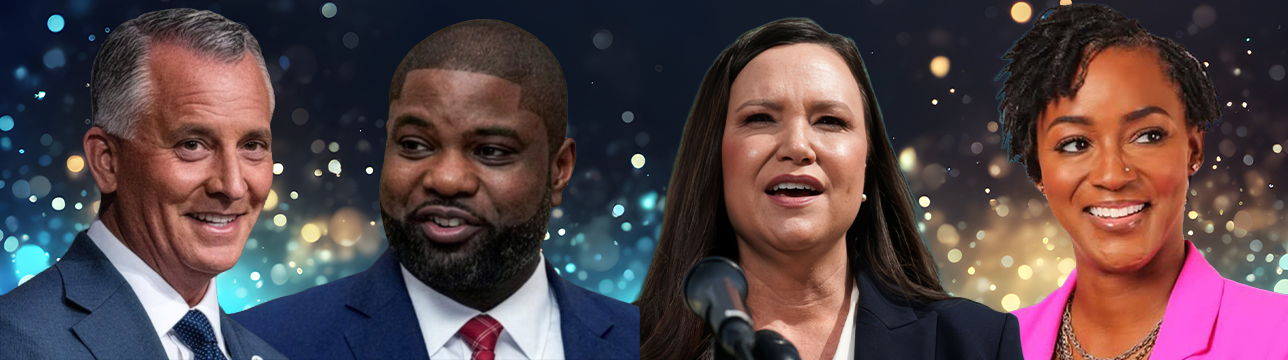
The poll from Stetson University’s Center for Public Opinion Research (CPOR) shows gubernatorial candidate Byron Donalds and U.S. Sen. Ashley Moody with majority support and double-digit leads among likely voters over Democratic opponents David Jolly and Angie Nixon.
Donalds has 51% support, 12 points ahead of Jolly. Moody also has 51%, with Nixon 11 points behind.
Tellingly, the poll suggests Republicans and Democrats have both begun to come home. None of the candidates has more than 7% support from voters in the other party, which benefits the GOP given its registration advantage and superior infrastructure. Independents are split, meanwhile. Jolly and Moody both have 5-point edges over their opponents with that group.
The Stetson poll suggests that part of the problem for Democratic candidates is that Black voters are more willing than in decades to support Republican candidates.

Donalds, the first Black Republican gubernatorial nominee, is said to be the choice of 25% of Black voters, denoting demographic difficulty for the Democratic candidate. Jolly has struggled to court Black voters, with some Democratic politicians crossing party lines to endorse his opponent.
While Nixon, a Democratic state Representative from Jacksonville, could be the first Black Senator from Florida, 20% of Black voters say they support Moody.
The poll provides possible explanations for that, as voters don’t know Nixon and generally approve of the job performance of Moody, a former Attorney General who was appointed to replace the current Secretary of State, Marco Rubio, last year.
Thirty-two percent of voters have never heard of Nixon; another 25% reject her, while 35% say they know her and could support her. Meanwhile, 47% of respondents know Moody and are open to voting for her.
That, coupled with Moody’s +18 favorability rating (50% approval vs. 32% disapproval), disadvantages Nixon, a populist candidate who hasn’t received resources or support from establishment Democrats the way candidates in other states have.

The survey suggests that voter behavior in 2022 and 2024 is predictive for this election as well.
“Eighty-five percent of 2022 (Ron) DeSantis voters back Donalds in 2026, and 85% of 2022 (Charlie) Crist voters back Jolly. On the Senate side, 86% of 2024 (Donald) Trump voters back Moody and 84% of 2024 (Kamala) Harris voters back Nixon,” the polling report reads.
While Donalds and Moody are well-positioned, the proposal to raise the homestead exemption for non-school taxes to $150,000 in 2027 and $250,000 in 2028 is not, even in a poll otherwise friendly to Republicans.
It has just 51% support, with 25% of survey participants against it and 24% on the fence. While 61% of Republicans support it, approval hovers in the low 40s among Democrats and voters not aligned with either major party.
Stetson polled 830 Floridians between Sept. 14 and Sept. 21 via an online non-probability panel administered by Qualtrics.
Jolly adviser Mark Riddle disputes the methodology of what he calls a “garbage poll.”
“They have 77% White. On the best day for GOP, it is 67% White. They have college-educated at 31, not 37. They have GOP weight at 50%, not 42. Do better in your reporting out.”
Perhaps consistent with that reading, the data for all three ballot questions diverge in favor of Republicans compared with a St. Pete Polls survey conducted this month for Florida Politics.
The races for Governor and U.S. Senate were dead heats in that survey, while Amendment 3 only had 45% support.