
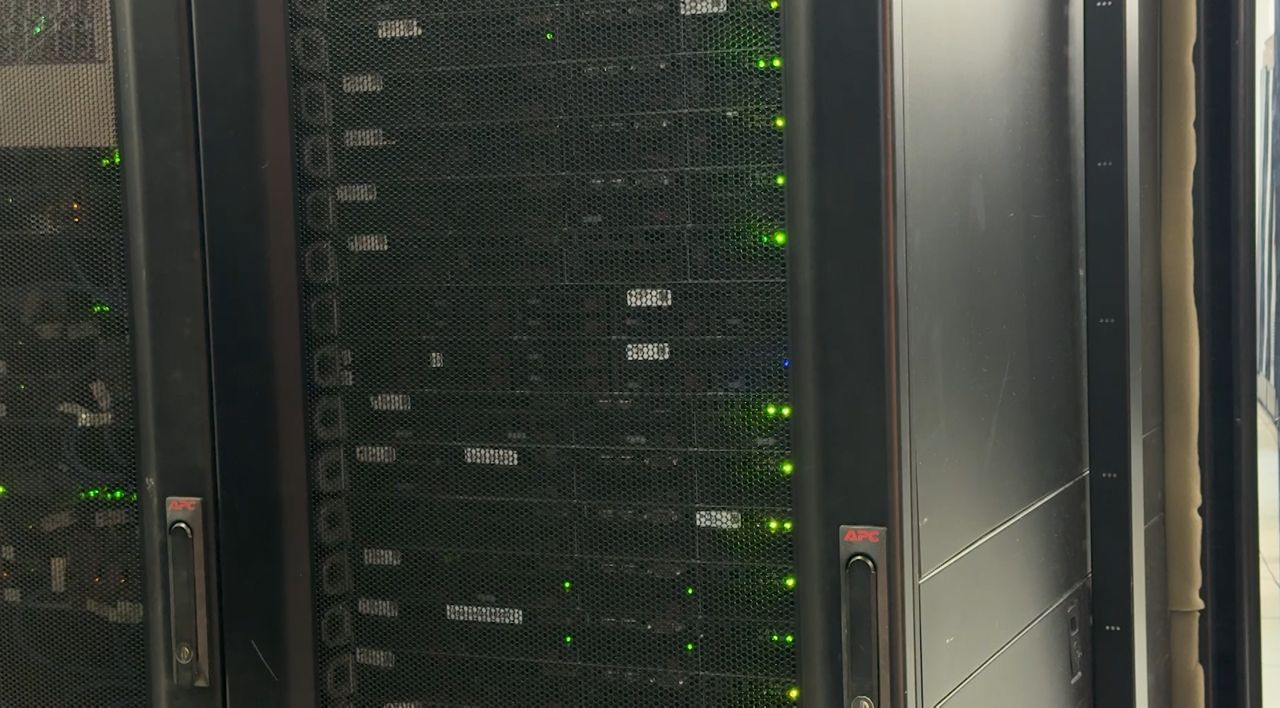
ORLANDO, Fla. — Data centers have existed for decades. Every text message you send, credit card you swipe, show you stream, and prescription you pick up involves a data center.
However, it’s the hyperscale data centers, more recently being developed to support AI, that are making headlines. In Florida, a large data center is defined as a facility with a peak load of 50 megawatts. For reference, the Nuclear Regulatory Division says one megawatt can power up to 1,000 homes.
The company HostDime is building a facility on the edge of Eatonville that will have 20 MW of power, nothing compared to the 900-megawatt-and-more facilities that states like Virginia have allowed.
Wilbert Woods grew up in Eatonville. He says one of the top concerns people have about a data center is their energy bill.
“It’s not that high, but now, with this big thing coming in the bill’s gonna go up,” he said.
Spectrum News 13 reached out to Florida’s major power companies. Florida Power and Light had 30 data centers on its grid by the end of 2025. Fewer than 10 of those facilities have electric demand greater than half a megawatt, with the largest facility having an approximate demand of 25 MW. FPL says it’s adjusted its rate structure so any large data center pays the cost of its energy use.
Duke Energy says it doesn’t serve any large data centers and is in line with Senate Bill 484, signed by Gov. Ron DeSantis in May, part of which requires large load customers to bear the costs of services.
Still, data center neighbors worry about the burden on the electric grid. Professor Issa Batarseh teaches electrical and computer engineering at UCF and spent years working on power supplies for data centers.
“When people demand, or submit requests, that galvanizes every tool available to AI to answer your questions, that’s a huge power pulse that could affect the grid,” he said.
However, Batarseh is confident other fixes are coming.
“They are pushing for that technology and you will see the press releases coming in,” he said of big tech companies.
TECfusions founder Simon Tusha owns and operates data centers in Arizona, Virginia, and Pennsylvania.
He adapts old industrial sites to build data centers and addresses the power grid issue with his own power generation.
“We make on-site power, so in the event that there’s a hurricane or whatever, we can export power back into the community,” he said.
Batarseh says this is not just a good idea, it’s a necessary solution to the power grid problem posed by large data centers. He said that if data centers can find ways to supply and store that power, it could even provide power to the surrounding community.
“We are not talking enough about it,” said Batarseh. “Renewable energy, especially solar and batteries, can solve the problem within the data center campus. That is really a real solution. The answer is it will not affect the grid, it will support the grid.”
Neighbors like Woods have other concerns, though. Data centers don’t offer many jobs. There are construction jobs as they’re built, and Tusha says TECfusions employs research and development personnel at their data centers, but Dr. Dan S. Myers at Rollins College says data centers are not a promising job source.
“An Amazon warehouse might be a good comparison. Those employ many hundreds of people from a local community,” Myers said. “A data center is not gonna do that. It’s going to be a small number of permanent employees focused on operations.”
The flip side, he said, is tax revenue.
“Data centers can be very good at generating tax revenue,” Myers said.
That tax revenue can be the draw for a community to welcome a data center. But for people living nearby, there are other worries.
“Water is going to be pulled,” said Woods, and he worries that will impact his community’s access to it.
Water is currently used to cool data centers. Spectrum News 13 reached out to water management districts, and none reported permit applications for a large data center. All say they would have to assess the availability and projected use.
Myers says a large data center uses about a million gallons a day or more.
“We have to put that in context,” he said. “An 18-hole golf course in Florida could easily use hundreds of thousands of gallons of water per day just to irrigate the grass.”
But he says the problem can lie in the way data centers use water. Agriculture uses a lot of water, but it’s seasonal. Data centers, he says, use that large amount of water every day of the year. The technology around cooling data centers is changing, though.
“Older data centers use evaporative cooling,” he said. “You essentially run the water through the pipes and let it evaporate. This is energy efficient, but when that water evaporates, it’s not going back into the place you drew it from. It’s going back into the atmosphere. Eventually it’ll cycle back into the earth, it’s not being destroyed, but you’re not putting it back in the same place so you can’t draw it back out again immediately. More modern data center designs use close-loop cooling, where you’re running essentially a contained cycle, you’re circulating the same water repeatedly and you’re cooling it down mechanically. That’s better from a water perspective, but you’re using more energy.”
Power, water, real estate values and more are the concerns that community leaders like Kelly Martinez Semrad hear from their constituents. The commissioner led the proposal for Orange County to temporarily ban data centers while staff research their impact.
“We see the concerns across the United States and in Florida where people are worried about a data center moving into their community, right next to their home, tanking their property values, sucking up their water, and increasing their utility bills,” she said.
But Tusha says communities that ban the development of data centers will pay the price.
“So as data centers become more and more scarce, access to them is going to become more and more scarce,” he said.
Eventually, he argues, this will lead to people paying for data center access the same way they pay for cable.
“So if you want to access your card, your ChatGPT, you’re going to be charged for it and you’re going to be charged dearly. Because what these people don’t realize is that they’re walking into a trap. You know, the more and more that they block data centers and remove data centers from their communities, their communities become weaker,” Tusha said. “There’s going to be less economic incentive. There’s going to be less educational opportunities. There’s going to be less vocational opportunities, because employers are going to want to make sure that their staff can be connected to the internet.”
Semrad argues that his thought process works both ways.
“Just like they can make information scarce, other industries can respond and retaliate in the same fashion,” she said, suggesting data centers and AI companies can be charged more and more for the resources they use. “If they want to sign up and live next to an AI data center, by all means.”
Myers suggests, while data centers may continue to take a toll, AI could bring vast benefits to the environment.
“So think about transportation logistics, shipping. If you could make all shipping 1% more efficient, the environmental impact of that would far dwarf any data center project,” he said.
The same, he says, goes for agriculture. However, that future isn’t promised.
“On the other hand, maybe AI actually incentivizes us to do even more shipping than we were previously doing,” Myers said. “In that case, it might even go the other way.”
Still, he says, when discussing the impact of data centers, it’s important to consider the impact of the thing they power: artificial intelligence.