
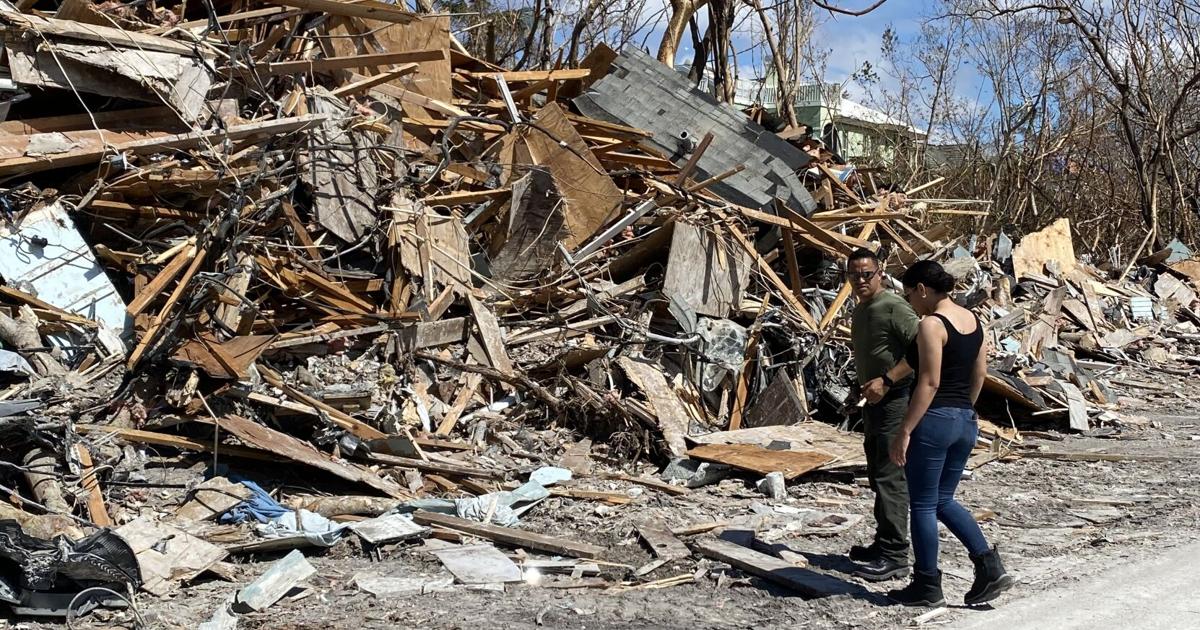
SANIBEL, Fla. (WINK) — Four years after Hurricane Ian devastated Sanibel Island, the former mayor who helped lead the community through its darkest days says she woke up Monday morning with a simple thought: “What a beautiful day it is today.”
Holly Smith went outside Monday morning, took a picture and reflected on how far Sanibel has come since Ian struck Southwest Florida on Sept. 28, 2022.
“We can live in the past, or we can be hopeful for the future,” she said. “What we’ve seen over the past four years has been incredible. It’s been incredibly hard as well.”
At the time of the storm, she was Sanibel’s mayor.
She joined us at WINK Listens and explained how she remembers leaving the island the night before Ian hit, believing she would be back within days.
Instead, the storm would fundamentally change the island — and the lives of the people who called it home.
“I could barely speak because I was seeing the devastation and the unknown of what we were going to be facing,” Smith said. “No one can be prepared for that. It was a war zone.”
But one image in particular changed everything. The causeway had been destroyed.
“That was a life-changing moment that I will, all of us will always live with,” she said. “All of a sudden, the whole world changed.”

The concern wasn’t only how Sanibel would reconnect with the mainland as people were still on the island and needed to be rescued.
She explained she had begged people to evacuate before the storm, but after Ian, she didn’t know exactly how many people remained or whether they were safe.
“I begged people to leave the island. I begged people at 4 o’clock in the morning to get off the island,” Smith said. “This was absolutely the perfect storm.”
The former mayor soon had an opportunity to show the devastation firsthand to Gov. Ron DeSantis. The governor flew over Sanibel with her in a Chinook helicopter.
“We had no infrastructure on the island,” she said.
She remembers the governor’s response as they prepared to leave.
“He said we’re going to get that bridge built.”
Work began just days later.
Within 19 days, Sanibel residents were able to cross the causeway again.
“That was a miracle,” Smith said.
She said the rapid reconstruction showed what could happen when bureaucracy was pushed aside and the focus became getting the community back together.
“You usually don’t build a bridge in 19 days,” she said.
While the causeway was gone, people remained on Sanibel.
The former mayor said the city eventually documented more than 1,000 people who stayed on the island through the storm.
She remembers seeing residents returning by boat in the days afterward. One woman she knew arrived wearing a man’s shoes because she had evacuated to someone’s home to stay safe.
“They just looked so shocked,” she said.
For days, there was limited communication. Families didn’t know whether friends and neighbors had survived.
She said people sent her lists of names of people they believed were still on the island, and officials worked to determine who had gotten off and who remained.
“That was the toughest time of life I think that I will ever endure,” Smith said. “You can never be prepared. There’s no playbook that gets you ready for an entire city being wiped out.”
City leaders held meetings nearly every day as they worked through the recovery. Smith also began holding Facebook Live updates every night to keep residents and businesses informed about what was happening.
“We started public-facing communications through Facebook on Friday after the storm, and we had Facebook Live every single night,” she said.
The former mayor said residents helped shape the city’s decisions as officials worked through the rebuilding process.
As Sanibel rebuilt, city leaders also faced another question: How do you make the island more resilient without losing what makes Sanibel unique?
Sanibel has significant conservation land and restrictions on building height, and she said leaders wanted to preserve the character people valued while helping residents return home.
One of the challenges was helping homeowners — including middle-class and generational homeowners — rebuild without forcing them to completely replace their properties.
The city changed ordinances to allow some single-family homes to be elevated.
“We knew it was important that the homeowners didn’t lose their home,” she said.
The goal was to make properties more resilient while allowing families to rebuild what they had before Ian. She said the approach became a model beyond Sanibel.
“We are open, we are ready,” she said. “We are not 100% but we are 100% ready for people to come here.”
She said one of the most meaningful signs of recovery is hearing from people who decided to buy homes on Sanibel after Ian.
To her, that is a testament to the community that came together after the storm.
“I saw the best of people, ordinary people doing extraordinary things,” she said.
People who didn’t know each other became friends, she said, and people around the world watched Sanibel recover.
“We can go back and we can look at what it was and how horrific it was,” she said. “But the most important message is this community. Through the greatest adversity, we see the best in who we are as a community,” she said. “And that’s what Sanibel has shown the world.”