
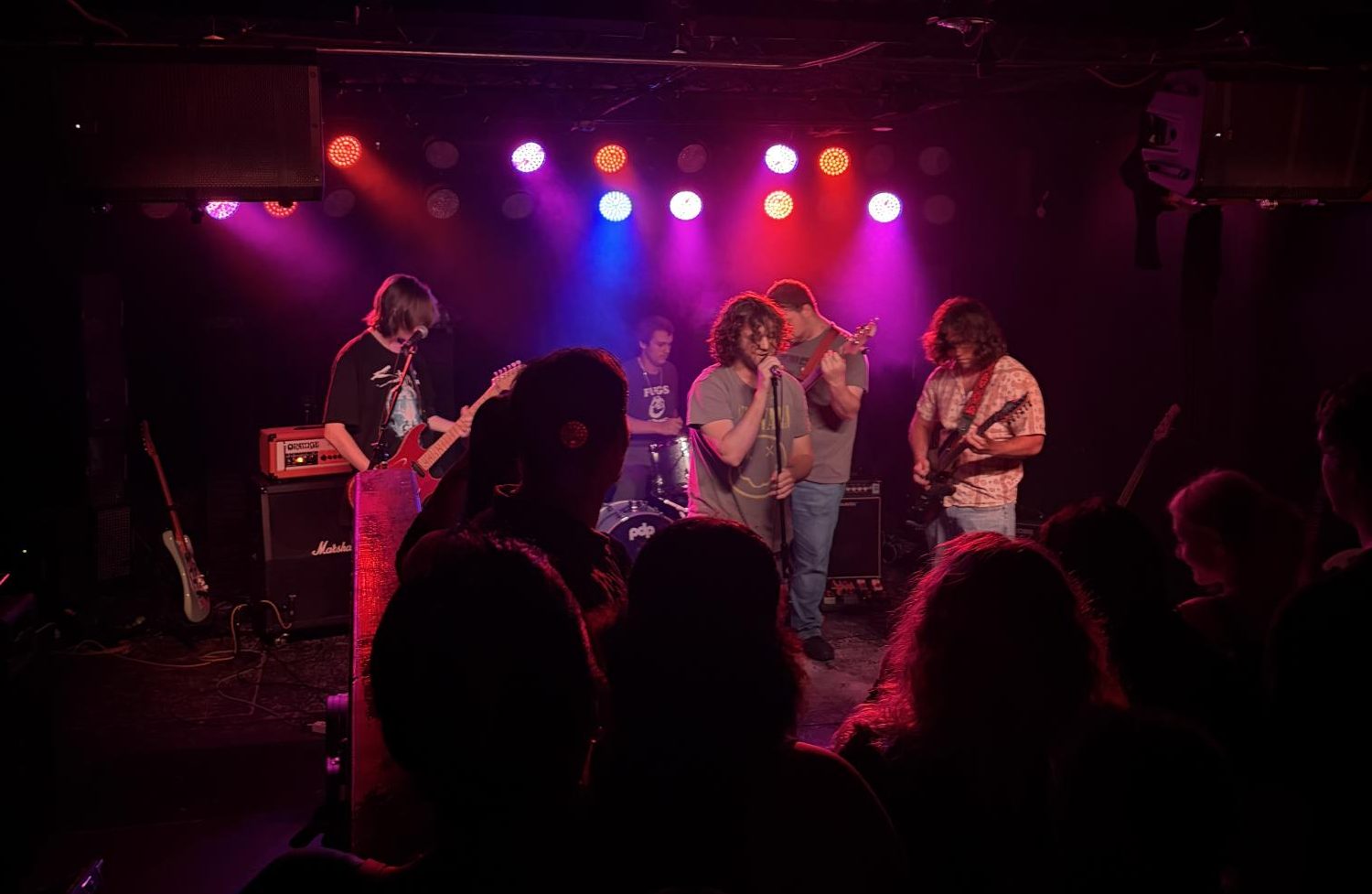
College students across the country are trading typical happy hours for places focused on community and connection.
For a growing number of Gen Z, a night out isn’t just about the drink in hand anymore. Bars like The Walrus are offering something closer to a hangout, known for their live music, burlesque shows, and community, functioning less like your typical collegiate watering hole and more like the “third places” that many Gen-Zers claim aren’t available anymore.
A 2022 Harvard study found that a third of Americans aged 18 to 25 report feeling lonely, and a 2024 report revealed that 74% of people with a “third space” still feel something is missing. In Jacksonville, that national search for belonging lands directly at a Murray Hill bar.
Welcome to The Walrus
 Maui Fili
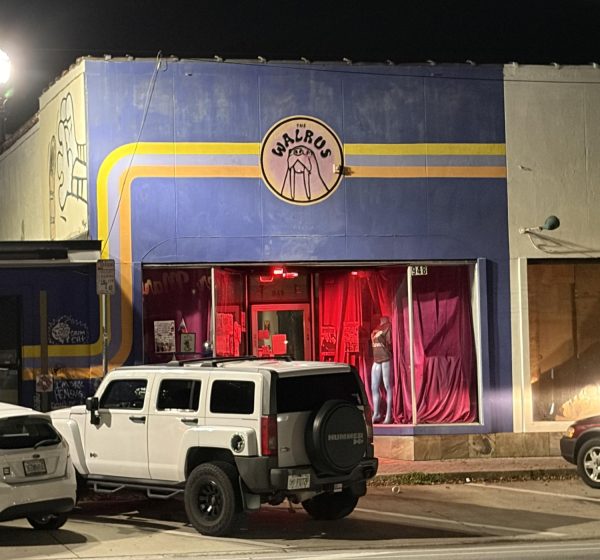
The Walrus in Jacksonville’s Murray Hill neighborhood officially opened on August 28, 2021.
Even on a school night, The Walrus is packed with college students, clad in their finest fishnets, tank tops, and eyeliner. My Chemical Romance blares from the back room onto the street in the otherwise quiet Murray Hill neighborhood.
The term “third space” is a sociological term coined back in the 80s to describe a place separate from the household and work that acts as a “space for informal, free social interaction, essential to democracy”, according to American sociologist Ray Oldenburg.
It doesn’t matter that class starts at 9 a.m. the next morning. Students hang out in the parking lot before the events start, then drift in and out all night as friends sign up to sing karaoke. Some are holding a beer. Just as many are holding a smoothie.
Owner Alexander Eli Michael mans the bar himself, crafting vegan sandwiches and smoothies. In the room adjacent, local and student bands play, and campus organizations hold benefit shows.
“I feel very comfortable there. I feel at home,” said Quinn Gomez, a third-year Information Science major at the University of North Florida. According to Gomez, The Walrus serves as a usual hangout spot for her and her friends. “I wish I had known about it sooner.”
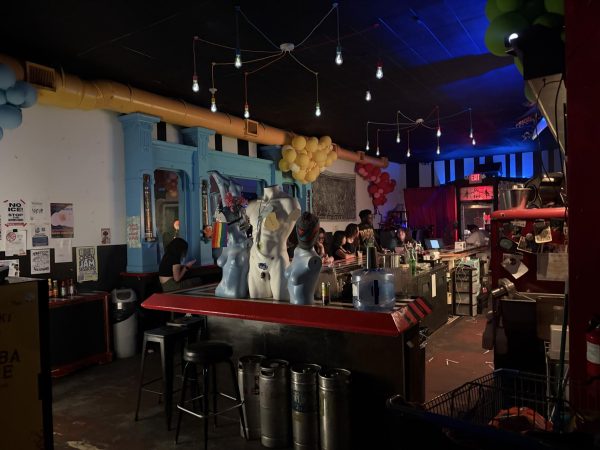
Inside, the bar is dimly lit and strung with balloon clusters, with a large papier-mâché sandworm modeled from the “Beetlejuice” movie mounted on the wall above the bar, greeting patrons with its paper fangs.
Near the front door, a small bookshelf is stocked with queer media and literature, available for anyone to browse or borrow.
In the back, a large courtyard is bathed in blue and purple light, with a cluster of mismatched chairs and tables giving strangers somewhere to sit and talk. The walls surrounding the space are painted with murals, with depictions ranging from galaxies and the cosmos to Bart Simpson mooning passersby.
Students taking the stage
So far Gomez performed at The Walrus three times with her band, Cult Daughter, including at an SDS benefit show on September 13 that she organized. Michael said most student programming is student-run.
“They organize themselves,” he said. “I give everybody the same room deal, and I pay it a lot more forward if it’s for a community type of event.”
Michael themself had performed professionally in bands, notably a band called Tomboy, for over eleven years, and experienced life on the road as a transgender band in a world that often viewed him as an outsider.
“Tomboy was really the first band that I was like, no, I’m gonna be in an unapologetically queer band, and I really want there to be a queer scene in Jacksonville,” Michael said. “I want to make a bunch of gay ass music about being super gay and super trans, and I want to do it in a way where we carve out little queer spaces in these clubs for a bunch of our weirdo friends.”
 Maui Fili
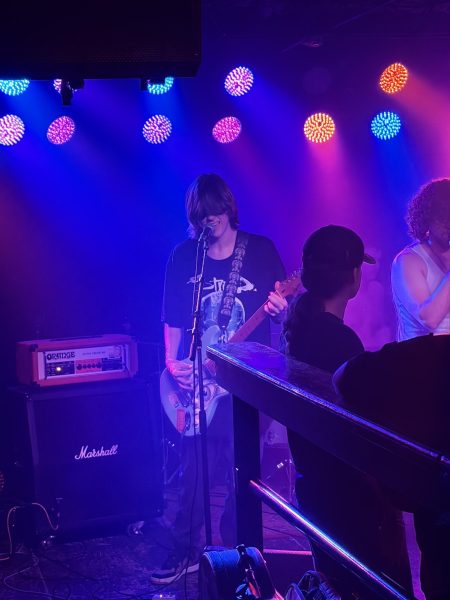
Spencer Castleman, a UNF sophomore, plays with “Strung” (formerly known as Quarter Life Crisis) at the Jacksonville SDS Fundraiser.
Michael said that background shaped the Walrus bar from its earliest days.
“Live music’s been here since the beginning,” he said. “When we first started doing shows, it was on the floor. I was bringing my home PA system to make it happen.”
Over time, Michael booked bigger touring acts and pushed the bar to build an actual stage and sound system.
“We’re all just a bunch of production nerds, and we just want it to be good,” Michael said. “There’s a realness of being trans, being queer in the South, and wanting to do something as excellent as we can with no money on a DIY budget.”
Gomez said the venue’s queer-friendly reputation is part of why bands like hers gravitate there over other Jacksonville venues, “especially in the South,” where, she said, queer-led or all-female bands often “get more judgment from outsiders” elsewhere.
“There’s not really other places for them to play other than the ones” like The Walrus, she said.
Robert Kuropkat, a sophomore English and philosophy major at UNF, got his band’s first show at The Walrus through a connection his bandmate has with Gomez. For a newer college band still finding its footing, Strung’s lead singer said just getting booked for a show meant something.
“It was really cool to get up there and actually play with some legit bands there,” Kuropkat said. “Even just being allowed to get on a stage, five morons going out there playing some music that we made in a parking garage.”
Kuropkat said many of the bands that influenced him got their start in bars like the Walrus.
“A lot of my idols, Alice in Chains, Soundgarden, Nirvana, the Seattle grunge groups, they all started in bars and nightclubs,” he said. “It’s all of those fun things. A bar, a slightly disorganized place. And it kind of feels like I’m actually becoming a musician. I’m actually getting out there and doing stuff…”
According to Kuropkat, most Jacksonville bars are “very cover oriented,” Kuropkat said, wanting familiar songs over performers’ original material. The Walrus was one of the few places built to let a band like him actually experiment.
“They don’t vet us and really check and be like, ‘What exactly are your lyrics?’ They kind of just let us go up there and put some art on display,” said Kuropkat.
Creating a “third space”
Driven by a severe loneliness epidemic, Gen Z are going offline and seeking physical spaces to rebuild face-to-face communities. They are simultaneously fighting a “pay-to-exist” dilemma, demanding accessible spots where they can gather without the pressure of spending money just to sit down.
Michael, who has run The Walrus for nearly five years, says creating that environment goes into every event, smoothie, vegan sandwich, and bowl of boiled peanuts he serves behind the bar counter.
“I want you to be like a young person experiencing a live band, even if you can’t afford it. But if you can’t afford it, you should afford it,” Michael said.
Michael said he’d rather hand a broke college kid a free bowl of the bar’s famous boiled peanuts than watch them go without.
“If all you can afford is the free water out of the cooler all night, you can come and hang out here and no one’s gonna bother you about it,” he said.
For some students, the bar means more than a good hangout. Michael, who is transgender, said young queer and trans students come to The Walrus to “find and figure themselves out”, sometimes for the first time, and that the bar hosts burlesque and drag nights alongside karaoke and art builds outside.
 Maui Fili
The Walrus often hosts student events, according to owner Alexander Eli Michael.
“There are a ton of queer and young people that are at the Walrus,” Gomez said, which helps create a safe environment for a community that often feels out of place. “There are no people staring at you and making you feel like you’re an outsider. It just feels a lot safer, being queer. It’s a great place for your people.”
Some students have used the bathroom to change into gender confirming clothes for the first time before heading out for the night, according to Michael.
“I’ve met so many young trans people that come here, and they’re like, this is my first time dressing like this, or they’ll get ready in the bathroom,” Michael said.
For many younger patrons, the Walrus is their first time entering a queer space. Michael described it as “cracking eggs,” watching patrons come out in real time.
“I say, for a gay bar, we are cracking more eggs, really, than you would believe,” Michael said. “People ask me if I’ll be their queer dad, which is really funny to me.”
For many students, the venue offers a rare sense of safety and community. Michael said that young queer students frequently visit The Walrus to explore their identities in an affirming environment.
“We are this, like, mutual aid spot in this very real way for the city because those resources are limited, and they’re even more limited because of DEI cuts,” said Michael.
“The value of a third space is important. And the value of being like, you can be here without being [drunk], and that’s okay,” Michael said.
Whether attending a show, grabbing a bite, or simply finding a place to sit, students rely on the venue as a dependable haven. Gomez described the bar as a guaranteed hangout when nothing else is happening. “It’s a place where it’s guaranteed that you have a place to go,” she said.
For Michael, the resident “gay dad” of the bar’s patrons, that role is a point of pride.
“I feel a sense of pride in knowing that people feel safe coming here and they feel safe to interact with me like that,” Michael said. “We love you. We want you to be who you are. You don’t owe anybody an explanation. It’s your body.”
Students still searching for their community, or even just a place to sing karaoke on a Tuesday night, are always welcome at the Walrus, Michael said.
“We want you to be who you are,” Michael said. “Joy is important, and everyone deserves to feel safe and welcome in their community.”
And for students heading out for the first time, his message is simple: “Please get home safe,” he said with a chuckle.
For more information or news tips, or if you see an error in this story or have any compliments or concerns, contact [email protected].