
LEE COUNTY, Fla. (WINK) — Agencies from across Florida are responding to the largest dengue fever outbreak in modern state history.
The Lee County Mosquito Control District arrived in Hillsborough County on Wednesday, which is the epicenter of cases around the Tampa area. Hillsborough County recorded 170 locally-acquired dengue cases through Sept. 19, according to the Florida Department of Health.

Florida has dengue cases almost every year, said Dr. Jay Gupta, an infectious disease researcher at Florida Gulf Coast University. Usually it’s imported by people who travel overseas.
That’s what makes the Hillsborough County situation unusual. Health officials said the cases have come from local mosquitoes.
“So that has been a shift,” Gupta said. “And of course, the mosquitoes thrive in the warm and hot and humid climate of Florida.”
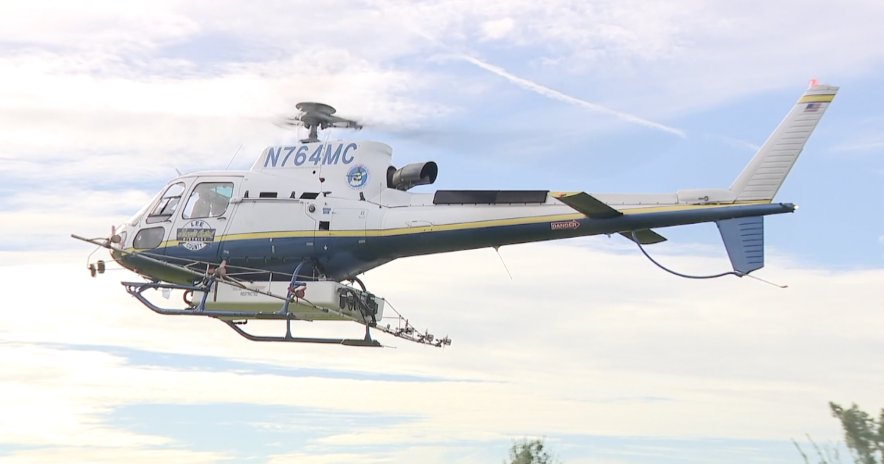
Lee County helicopters took off from Tampa Executive Airport Wednesday to spray larvicide over hot spot areas. The spray targets mosquito larvae before they grow into biting adults. Pilots covered about 7,000 acres of land during the operation.
Lee County has the largest mosquito control district in the country, according to Jenifer McBride, communications director for the district. It boasts a fleet of seven helicopters and multiple planes that operate from Buckingham Field.
“We’re adding that resource of extra aerial help,” McBride said. “Which is what it really takes when you have localized cases to knock down the virus.”
Three counties in the Tampa area have declared a state of emergency, according to our partners at FOX 13. That includes Hillsborough County (170 cases), Pinellas County (7 cases), and Pasco County (2 cases).
80% of people who catch the virus never develop symptoms, Gupta said. But it can lead to body aches, muscle pain, and in severe cases, death. The last major dengue outbreak in Florida occurred in Monroe County in 2020, WUSF reports, with 72 locally acquired cases.
That’s where dengue returned to Florida in the 21st century. In 2009, Key West recorded the first local cases of dengue in Florida since 1934, according to the Centers for Disease Control and Prevention (CDC).
That led the Florida Keys Mosquito Control District to develop new strategies, executive director Andrea Leal told WINK News. It is working to release male mosquitos infested with Wolbachia. That is a naturally-occurring bacteria that kills the offspring of female mosquitoes.
The program targets Aedes aegypti mosquitoes – also known as the backyard mosquito.
“She breeds around people’s homes,” Leal said. “She’s very difficult to control and has also shown resistance to a lot of our normal control techniques. So because of all of that, we really have tried to look outside the box.”
The district started trials in 2017. Two years ago, the district said it registered the product with state and federal agencies. Leal said it has helped reduce mosquito populations in some areas, although numbers were not immediately available.
The district said it’s continuing to study the Wolbachia method and more information should be released in the coming months.
“I think those really can be a game changer,” Leal said.
Hillsborough, Pasco and Pinellas leaders declared local states of emergency to combat dengue fever as rising mosquito-borne infections and a confirmed death impact the Tampa Bay region.