
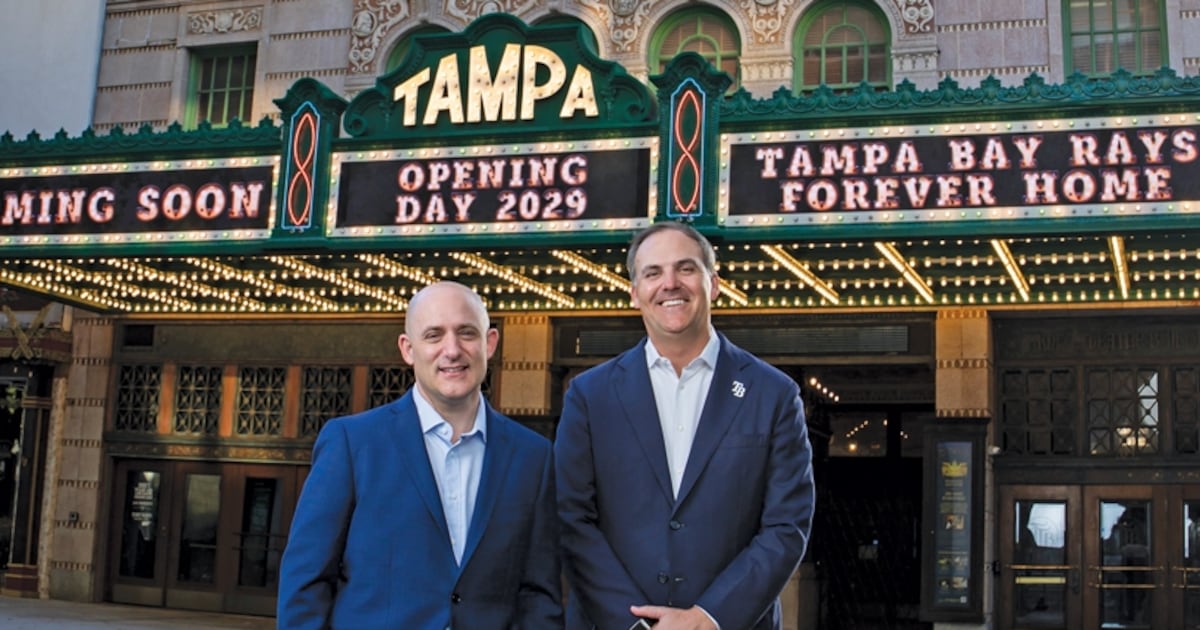
Patrick Zalupski, Ken Babby and their partners knew exactly what they were getting into in September 2025 when they purchased the Tampa Bay Rays.
“We bought a baseball team with no current home, no future home and paid $1.7 billion,” Babby said. “Folks asked me all the time: ‘Were you terrified?’ And I’d say, ‘Absolutely.’”
Hurricane Milton had ripped apart Tropicana Field’s roof in October 2024, forcing the team to spend the 2025 season at Steinbrenner Field while St. Petersburg undertook a $59.7 million repair.
“People did not think The Trop was going to be open for 2026,” said Zalupski, 45, the team’s principal owner. “Ken wouldn’t even let me visit before we purchased the team, because he thought if I saw it, I wouldn’t go through with the deal.”
There was no long-term solution, either. Nearly two decades of efforts to build a ballpark on either side of Tampa Bay had collapsed amid disputes over location, financing and politics.
Yet, one week after taking control, Zalupski stood alongside Babby and co-chair Bill Cosgrove and publicly set a bold deadline: The Rays intended to open a new ballpark, surrounded by mixed-use development, in time for the 2029 season.
“Delivering on that objective will be our first priority,” Zalupski said that day. “We acknowledge this is aggressive and perhaps audacious, but time is of the essence.”
Eleven months later, they had done what had eluded the franchise for nearly two decades.
In late August, Tampa and Hillsborough County approved a $2.36 billion, 31,000-seat ballpark on the campus of Hillsborough College, with the Rays committing $1.37 billion plus cost overruns. Surrounding it would be an even bigger wager: an $8 billion-to-$10 billion privately financed, mixed-use development spanning 130 acres.
For a franchise among MLB’s bottom three in attendance and revenue this season, the ambition extends beyond finally securing a new ballpark. The owners’ goal is to turn the Rays into a top-15 revenue club capable of supporting a top-15 payroll.
Since 2008, the Rays have accumulated the third-most regular-season wins in MLB, trailing only the Dodgers and Yankees. Now, as Zalupski and Babby try to build a business capable of matching that success, the Rays enter the American League playoffs with the league’s best record and No. 1 seed.
How Zalupski, Babby and their partners got there in 11 months — through an unlikely college campus, deep Florida relationships, a governor opposed to public stadium funding and a decisive city councilman who once said he was “99.9%” certain to vote no — is the story of how one of baseball’s longest-running stadium problems finally found a solution.
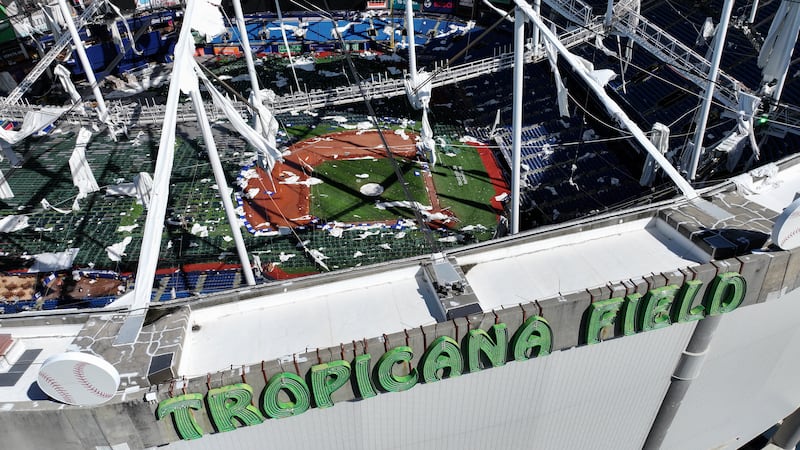 Hurricane Milton shredded Tropicana Field’s roof in October 2024, leaving the Rays without a home for the 2025 season and adding another layer of uncertainty for the ownership group that would buy the franchise for $1.7 billion the following year. Getty Images Building the Group
Before they could solve the Rays’ stadium problem, Babby and Zalupski first had to put together a group capable of buying the team.
Babby had spent much of his life around baseball. His father, Lon, was a longtime general counsel of the Baltimore Orioles, and Babby went on to own and operate successful minor-league franchises in Akron and Jacksonville. He had explored other paths into Major League Baseball before making an out-of-the-blue call to Zalupski in the summer of 2024.
In Zalupski, Babby saw a potential lead investor who brought a very different résumé. The Jacksonville entrepreneur had founded Dream Finders Homes and built it into one of the nation’s largest homebuilders. He had never owned a professional sports franchise, but Zalupski understood large-scale development, had deep relationships across the state and the financial capacity — Forbes estimated his net worth as $1.1 billion in March — to anchor the group.
Zalupski first checked out Babby through his friend Pat Battle, executive chairman of Diamond Baseball Holdings. Battle gave Babby a ringing endorsement, emphasizing his work ethic and attention to detail — traits Zalupski would later see firsthand when Babby helped oversee the around-the-clock repair of Tropicana Field, at times sleeping in his office as Opening Day approached.
Before moving forward, Zalupski wanted to know whether three key Tampa-area figures — DEX Imaging CEO Dan Doyle Jr., attorney Fred Ridley and former Florida House Speaker Will Weatherford — would support his involvement.
Babby and Zalupski had the baseball, capital and development pieces. What they needed was Tampa — and Doyle, Ridley and Weatherford had spent years navigating its business, political and stadium landscape.
They also brought an idea.
It was a college campus.
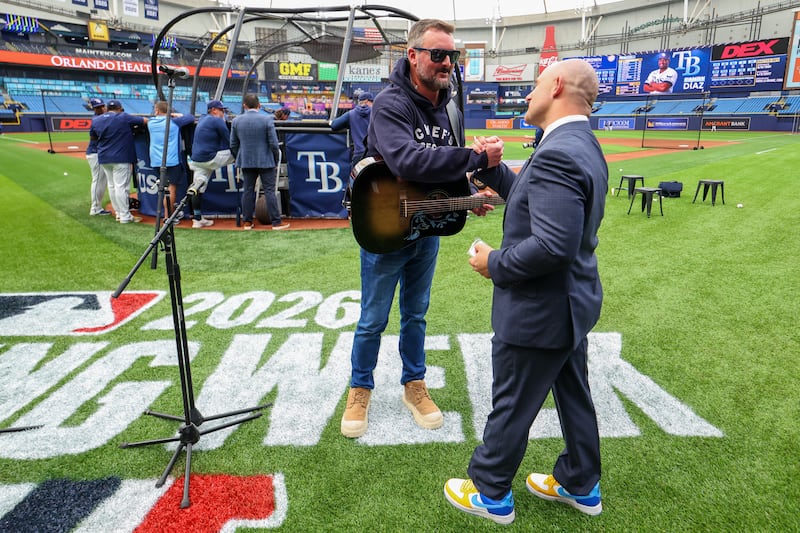 Rays co-Chair Ken Babby, right, helped oversee the around-the-clock restoration of Tropicana Field, at times sleeping in his office as crews raced to have the ballpark ready for Opening Day. MLB Photos via Getty Images The Site Nobody Expected
It was Doyle who introduced the idea of Hillsborough College, a largely underutilized parcel in a prime location near Tampa International Airport and downtown, during the summer of 2025. The site was not thought to be on Zalupski and Babby’s radar — or, at the very least, not at the top of the list — when they shook hands with then-Rays owner Stuart Sternberg at Steinbrenner Field on Easter 2025.
Four years earlier, while Doyle and Ridley were part of another group trying to buy the Rays, they and developer Chad Harrod reviewed aerial maps in Harrod’s office while considering potential ballpark sites. The Hillsborough College campus caught their attention.
The idea had stayed with Doyle.
“I told them, ‘Let’s get in the car,’ and we all drove there. I said, ‘Guys, this is your site.’ And they loved it,” Doyle told the Tampa Bay Times.
The process, admittedly, was more complicated than that.
Zalupski had already concluded that a new ballpark alone would not be enough to create a more sustainable economic trajectory for the Rays. During the sale process, he had talked with Braves Chairman Terry McGuirk about the success of The Battery Atlanta, and came away convinced the Rays would need a mixed-use development district of their own.
“It’s what you have to have in today’s MLB to be successful,” Zalupski said. “Without that revenue generation, it’s going to be really, really challenging or nearly impossible to compete with the major markets.”
McGuirk provided some simple advice. If he had a do-over, he would acquire “land, land and more land.”
That led the Rays to seriously consider the Florida State Fairgrounds, which could have provided 300 to potentially 500 acres, and the 180-acre Rocky Point.
But Zalupski considered the 130-acre Hillsborough College, along Dale Mabry Highway across from Raymond James Stadium and adjacent to Steinbrenner Field, “the A+ location.”
Still, the college had a problem of its own: a campus facing $60 million to $70 million in deferred maintenance costs.
Ken Atwater, the college’s president, was intrigued by the concept when he met with Rays officials, allowing them to take the next step.
“This is the first time ever, I think you’ll find, in the country a professional sports team that has a college as one of their anchors for their site development plans,” Atwater said.
Federal Aviation Administration checks ultimately determined that the site could accommodate a full roof structure for the ballpark and 18- to 20-story buildings as part of adjacent mixed-use development.
In January, the college’s board of trustees and the Rays reached a non-binding memorandum of understanding to explore the site’s “live/work/learn/play” redevelopment.
They had found their site. Getting it built would require an entirely different kind of work.
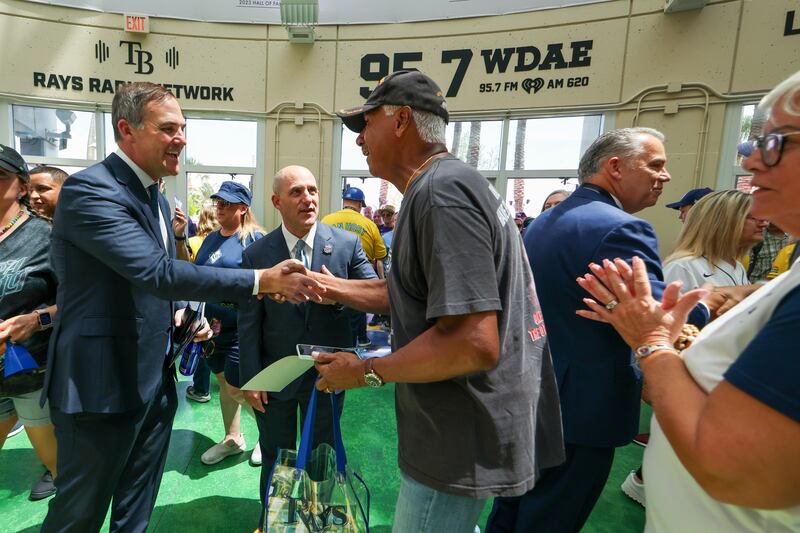 Rays owner Patrick Zalupski, left, and CEO Ken Babby brought different backgrounds to the franchise — Zalupski in development and Florida business, Babby in baseball — as they took on the Rays’ long-running stadium challenge. MLB Photos via Getty Images The Political Path
There was another complication. Under their terms of engagement with Sternberg during the sale process, Zalupski and his group were prohibited from reaching out to local officials. Once the sale closed, they had to make up for lost time.
They found willing partners in Hillsborough County Commissioner Ken Hagan, a longtime advocate of keeping MLB in the region, and Tampa City Councilman Alan Clendenin.
“They hit the ground running, and led from the front,” Hagan said.
But the Rays and local government were operating on very different clocks.
“We came in and said, ‘Hey, we want to build a stadium yesterday,’” Zalupski said. “And they’re like, ‘No, wait a minute, we thought this would be two, three, four years.’ And we’re like, ‘Guys, this has been 20 years in the making. There is no more time. We’ve got to move now.’”
From approval to Opening Day 2029
With approvals secured, the Rays are moving into the next phase of their $2.36 billion ballpark and adjacent $8 billion-to-$10 billion mixed-use development at Hillsborough College. Here’s what comes next:
Build ‘The Nest’: Work is expected to begin within weeks on a temporary campus that will allow Hillsborough College to operate while its campus is reimagined. The broader campus project is expected to cost about $215 million, with the state contributing at least $150 million.
Validate the Bonds:
The next major milestone is bond validation for the public money committed to the ballpark, including $796 million from Hillsborough County and $80 million from Tampa. The process has no firm completion date and could take several months.
Break Ground: Once bond validation is complete, the Rays can formally break ground on the 31,000-seat, fixed-roof ballpark. AECOM Hunt/Turner, the project’s construction joint venture, is already deep into pre-construction work.
Start Selling: Legends is serving as the Rays owners’ representative and marketing and sales partner, with an initial focus on premium and sponsorships. The Rays said in July that Fortune 500 companies have expressed interest in the mixed-development.
Establish a Tampa Presence: The Rays plan to open an experience center — their first brick-and-mortar location in Tampa — featuring retail, development and interactive models. The team describes it as a “short fly ball from home plate” of the future ballpark.
Opening Day 2029: The ballpark is scheduled to be completed for the 2029 season, giving the Rays a target date after two decades of uncertainty over their long-term home.
Babby set about trying to accelerate that timetable, meeting with each Tampa City Council member and Hillsborough County commissioner at least five times, Zalupski estimates.
Babby quickly discovered that the challenge wasn’t simply getting everyone up to speed. Some elected officials were philosophically opposed to using public money for a sports venue.
“I’d have people look at me and say, ‘I’m a ‘no’ vote no matter what you say,’” Zalupski said. “I’m like, ‘You haven’t even heard what I’m going to say yet.’”
There was a separate challenge at the state level. Florida Gov. Ron DeSantis had consistently opposed using taxpayer money to fund sports stadiums.
Yet Clendenin believes DeSantis ultimately became essential to making the Hillsborough College plan work.
“This project never would’ve gotten off the ground without Gov. DeSantis,” he said.
Zalupski already had ties to DeSantis.
In 2023, DeSantis appointed him to the University of Florida’s board of trustees. Zalupski’s company later donated $250,000 to a super PAC supporting DeSantis’ 2024 presidential campaign.
DeSantis publicly backed the proposal at a February news conference, with MLB Commissioner Rob Manfred sitting in the front row.
“Baseball belongs in Tampa Bay. Baseball can succeed in Tampa Bay,” DeSantis said.
But the state’s support stopped short of putting money directly into the ballpark. Instead, Hillsborough College provided another path.
Later that month, DeSantis and the Florida Cabinet approved the transfer of 22 acres of state-owned land to the college for the project. And in May, legislators included $50 million in the state budget for improvements to the college campus.
“The governor made very clear that the state wasn’t able to help in terms of putting money into the ballpark, but he was able to be helpful in terms of finding money for the college,” Babby said. “And by investing in the college, that really unlocked the opportunity for the team to secure the site.”
DeSantis also raised the possibility of the Rays moving to Orlando if a deal could not be completed in Tampa Bay.
“Even just politically, [the governor] coming out and saying, ‘Hey, I want Tampa Bay to step up or Orlando might step up,’ that was valuable to us,” Zalupski said.
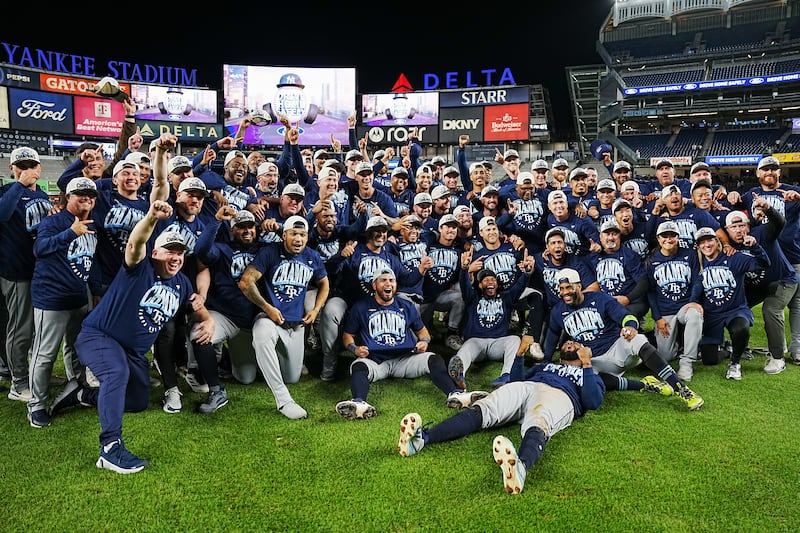 The Rays enter the postseason as the American League’s No. 1 seed, adding on-field momentum to the new owners’ plans for the franchise. Tampa Bay has accumulated the third-most regular-season wins in MLB since 2008, trailing only the Dodgers and Yankees. MLB Photos via Getty Images Getting to Four
State support helped secure the site. The Rays still needed hundreds of millions of dollars from Tampa and Hillsborough County — and the votes to approve it. On Tampa’s seven-member city council, the decisive fourth vote ultimately belonged to Bill Carlson.
Carlson had voted “yes” in late May on a nonbinding agreement outlining the framework of the deal. But he made clear that vote should not be mistaken for support of the final deal.
“When this comes back to us, I’m 99.9% sure that I’m going to vote ‘no,’” Carlson said at the time. “But today, because the Rays asked only in regard to their ability to get state funding, I’m going to reluctantly vote ‘yes.’”
That left the door ajar.
By the time the deal returned for a final vote in August, its financing had changed significantly. The Rays agreed to take on approximately 60% of the project, while the public share decreased by $100 million. The agreement also included a 35-year initial term and non-relocation agreement.
Tampa’s commitment fell from a proposed $180 million to $80 million. A planned $100 million contribution from the Tampa Community Redevelopment Agency (CRA) was replaced by $100 million in privately placed debt through a new Community Development District.
Other priorities important to Carlson also became part of the broader agreement. Babby said the Rays project helped make possible an extension of the East Tampa CRA, additional community programs and a downtown infrastructure investment fund — changes that ultimately helped secure Carlson’s support.
Carlson wasn’t in the negotiating room, but Babby said he was brought into discussions as the deal evolved.
“I didn’t change my mind. The deal changed,” Carlson said in late August. “The only thing that changed is I’m representing the people of this city, and I want to get what’s in the best interest of the city.”
Carlson voted “yes.” The measure passed 4-3.
The next day, Hillsborough County commissioners approved their portion of the agreement, 5-2.
Commissioner Joshua Wostal remained opposed throughout. Most of the county’s $796 million commitment will come from its Community Investment Tax (about $360 million) and Tourist Development Tax (about $303 million).
“This deal is an albatross,” Wostal said. “It is extremely one-sided to the unincorporated residents of Hillsborough County.”
Clendenin saw the investment very differently, comparing the opposition to the skepticism that once surrounded other major Tampa civic projects.
“Our performing arts center, our aquarium and Benchmark Arena all had their naysayers,” Clendenin said. “Now every single one of them is considered a crown jewel in the city of Tampa.”
“I wouldn’t be surprised if this is a movie one day, honestly,” Zalupski said with a laugh. “This thing was on life support 10 times, honestly. It took real leadership from the individuals who voted in favor. It took real leadership from our partners. And it took a lot of faith from Ken and me not to get too dejected along the way, because this was the most challenging process I’ve ever been through.”
Manfred saw the ownership change itself as part of the breakthrough.
“They came with a lot of enthusiasm and showed a real commitment to staying in the Tampa Bay region,” Manfred said. “They were effective in terms of their interactions with various governmental entities.”
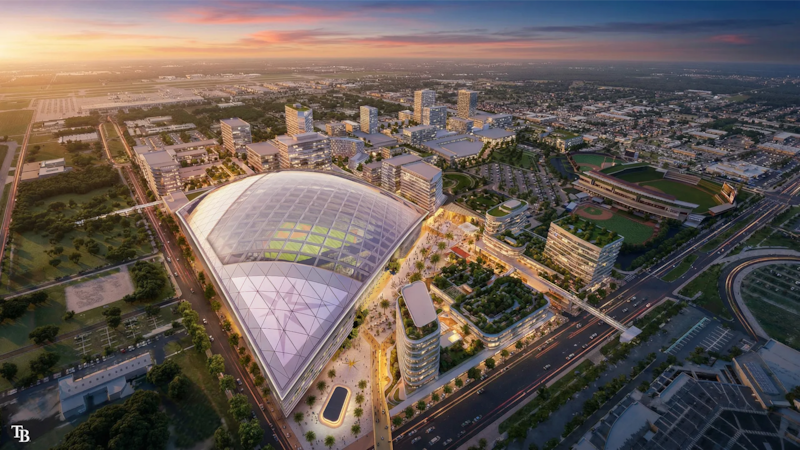 The Rays’ planned $2.36 billion stadium would anchor an $8 billion-to-$10 billion redevelopment of the Hillsborough College campus, a 130-acre district central to the new owners’ plan to transform the franchise’s economics. Tampa Bay Rays The Bigger Bet
With the stadium question answered, Zalupski and Babby can turn to the larger ambition they laid out when they bought the team: transforming one of MLB’s bottom-three revenue clubs into a top-15 business capable of supporting a top-15 payroll.
Getting there will require more than a new place to play. The hope is that delivering a great product on and off the field for fans and the community will be paid back in the form of increased ticket sales and corporate sponsorships. Beyond baseball, the development will feature a renovated college campus, office space, retail and dining, hospitality, residential offerings, year-round activations and public spaces across 8 million square feet.
It is an enormous bet — and one Zalupski acknowledges is far from guaranteed to pay off for the ownership group and its partners.
“People love to tell us we’re going to do great on this, but the reality is we don’t know,” Zalupski said.