
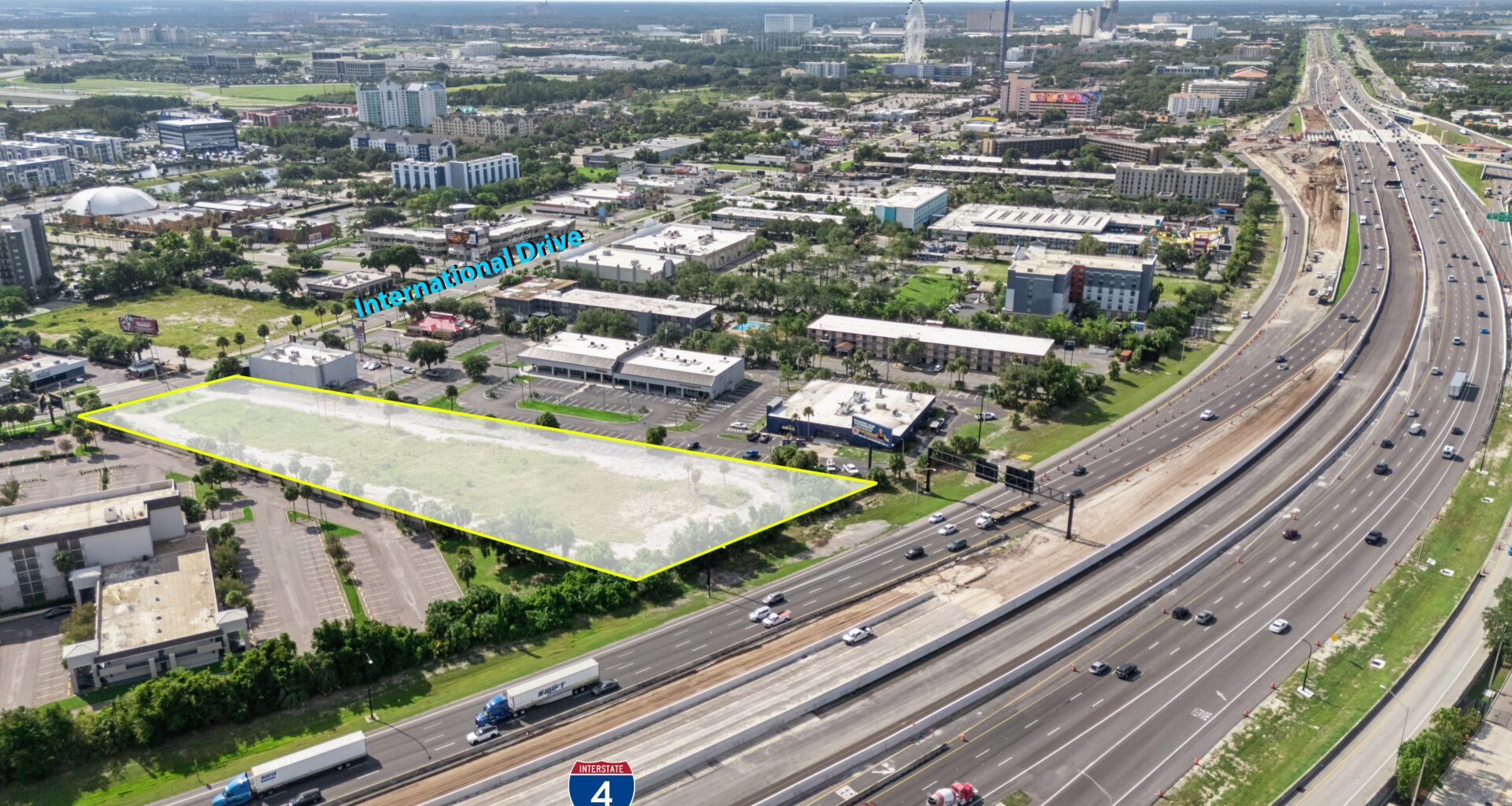
An International Drive site approved for a mixed-use project with 269 multifamily units and 14,000 square feet of retail space is headed to bankruptcy auction Oct. 21, putting a rare cleared parcel beside I-4 back on the market at a time when development economics are complicating what buyers might actually build there.
Fisher Auction Company, which is based in Pompano Beach, is marketing the roughly 3-acre property at 6603, 6617 and 6631 I-Drive for a live Zoom auction. The site has about 150 feet of frontage on I-Drive and another 249 feet of visibility along I-4, although there is no interstate access.
SLX – I Drive LLC filed for Chapter 11 bankruptcy protection April 28 in U.S. Bankruptcy Court for the Middle District of Florida, Orlando Division. The property owner is tied to Winter Park-based Del American Real Estate Group. Anthony DelGuidice is president and managing director of Del American, a longtime multifamily developer that says it has developed more than 10,000 residences.
Qualified bidders must submit their paperwork, proof of funds and a $100,000 initial escrow deposit by 11 a.m. Oct. 19. The auction begins at 11 a.m. Oct. 21, with the winning sale subject to Bankruptcy Court approval.
The auction company is pitching the entitlements as a head start for the next owner. But two longtime I-Drive real estate players told GrowthSpotter the parcel’s dimensions and current development costs may make its eventual use less straightforward.
A site that has changed with I-Drive
The property was first home to a Howard Johnson, built in 1972 during I-Drive’s first wave of toursim development. Later, it was replaced by the M Hotel. The building has since been demolished, leaving the long, narrow tract between I-Drive and I-4 vacant.
City records show the redevelopment concept, previously led by Del American, has changed along the way. A 2022 application proposed an eight-story luxury apartment building with internal structured parking, retail on the lower levels and apartments above. The city initially approved 328 residential units before the plan was amended to 269 units in 2023.
What the next owner does with those approvals, however, could depend as much on the parcel itself as on the zoning.
Paul Sexton, managing director of HREC Investment Advisors in Orlando, said the location traditionally would have been suited to a select-service hotel. But today’s economics make that difficult.
“Hotel development parcels in Orlando’s tourism zones are no longer penciling out the way they once did,” Sexton told GrowthSpotter.
He sees similar obstacles for apartments on only 3 acres.
“Seems small, so one would have to do structured parking which is expensive … especially when rents are soft and interest rates are going higher,” he said. “The parcel may ultimately make more sense for one of the neighboring property owners or for a destination restaurant.”
Joshua Wallack, CEO of Wallack Holdings and owner of Mango’s Tropical Cafe on I-Drive, also sees the site’s narrow configuration as the limiting factor.
“I believe a master developer should pick it up and also acquire the motel to the north of it as well to put together a wider master site,” Wallack told GrowthSpotter. “This piece has great depth, but some width issues. This is one of those properties that has to be assembled with a contiguous property in order to really unlock the value of the site.”
Financing adds a hurdle
Sexton’s concerns about the economics of apartment development come as multifamily projects face a more selective financing environment.
During a Sept. 28 Capital Markets Update panel at the 2026 CREDA Statewide Conference in Orlando, panelists said volatility in Treasury rates has complicated property valuations and financing, particularly for asset classes such as multifamily that entered the current cycle with relatively tight capitalization rates. They said institutional investors still have money to deploy but have become much more selective about projects, locations and sponsors as they contend with uncertainty over interest rates, future property values and the pace at which newly built apartments are being absorbed.
Panelists also described a capital stack that increasingly requires developers to piece together financing from different sources. Banks have shown renewed interest in construction lending, they said, but lower leverage can require developers to contribute more equity or turn to private credit, preferred equity and family-office capital to make projects work. For large multifamily developments in particular, the amount of equity required has grown substantially as overall project costs have risen.
The panel also put Orlando’s apartment pipeline in perspective. Participants said multifamily deliveries in the market have fallen substantially from their recent peak, while development continues at a level they characterized as stronger than in many other markets.
For the I-Drive parcel, that leaves buyers with something increasingly valuable but not necessarily simple: a cleared site with residential entitlements in one of Orlando’s most visible tourism corridors, but on a footprint that local real estate veterans say may work better as part of something larger.
The Oct. 21 auction will provide a market test of how much value buyers place on the approvals, the location and the possibility of a future assemblage.
Have a tip about Central Florida development? Contact me at SKinbar@GrowthSpotter.com or (407) 420-5246. Follow GrowthSpotter on Facebook and LinkedIn.