
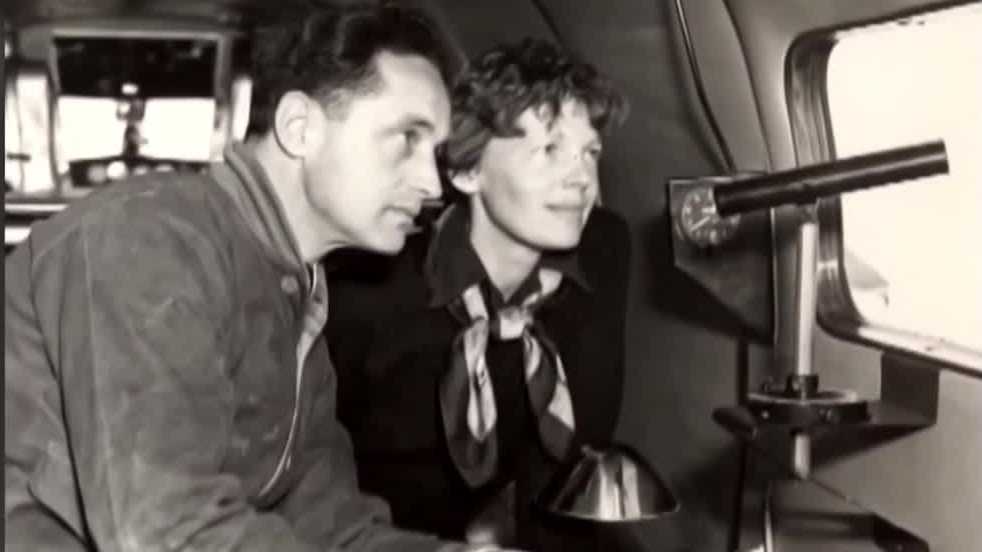
Central Florida man joins mission to find Amelia Earhart wreckage

For nearly 90 years, the world has wondered what happened to Amelia Earhart and her navigator Fred Noonan.
Now a team of 17 will fly across the world to see if this image is Earhart’s plane.
“We have to identify it,” said archeologist Rick Pettigrew. “We have to confirm the hypothesis that it is, in fact, the wreckage of the Electra aircraft.”
Pettigrew is on a mission to find the wreckage.
“Well, there’s something in the lagoon that shouldn’t be there, and we see this in satellite imagery,” he said.
This satellite photo was snapped in 2015, after a huge tropical storm shifted the sand, potentially revealing the plane.
Pettigrew brought the image to Purdue University, where Earhart once taught, and which provided her famous Lockheed 10E Electra.
Pettigrew will lead the expedition, which departs Saturday.
One Central Florida man and Purdue alum is a part of this mission.
Marc Hagle will one of the scuba divers.
“I am actually going to be going down in the water and be one of the first people to touch it,” he said on a recent visit to WESH 2.
“If we find it – oh my gosh, look at what we have done.
“If we don’t find it – it is still a mission of Purdue University to investigate – take it to the end of the road and know the answer,” Hagle said.
They will fly to Nikumaroro Island in the Pacific, travel by boat for six days and then cut their way through the jungle to find the lagoon.
The experts think this is where Earhart radioed for help.
“The airplane probably landed on the coral reef,” Hagle said. “There were 5 broadcasts, and if you triangulate, they come to this point.”