
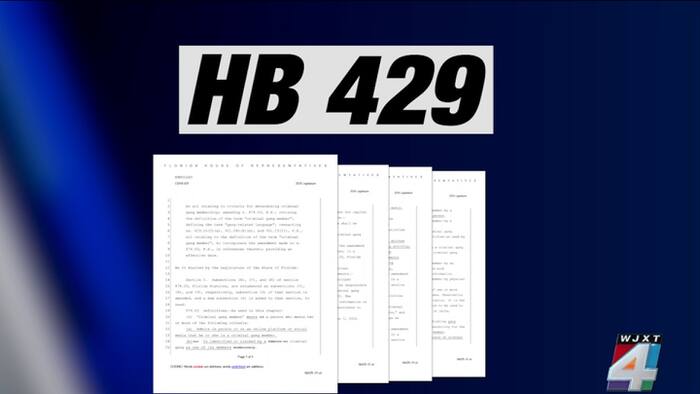
JACKSONVILLE, Fla. – A new Florida law that took effect Oct. 1 expands how police can use social media posts as evidence against criminal gang members in Florida.
The law is known as House Bill 429, and a new social criteria added to it was created by Rep. Jessica Baker. She said it’s to modernize the statute.
“Today, gangs recruit, they organize, and they promote criminal activity openly and intentionally on social media,” Baker said.
The law also lowers the threshold for determining gang association. Under the previous law, someone had to be seen with a known gang member four times. The new law reduces that number to two.
According to the Jacksonville Sheriff’s Office, there are currently 26 active gangs operating in Jacksonville with 536 identified members and associates. Of those, 347 are considered active, 47 are awaiting trial and 140 are currently in prison.
Jose Cheeseborough, Commander of the Specialized Investigation Section for the Jacksonville Sheriff’s Office, explained what evidence police can use to determine if a post is connected to a gang criminal investigation and who decides what counts.
He said investigators look at the totality of the circumstances rather than a single post.
“They have a common language, they have codes that they use, and we decipher that stuff and put it to certain groups,” he said. “It is not a crime just to be a member of a gang. However, if you are committing crimes in the furtherance of that gang, that is illegal.”
Throwing up gang signs, flashing weapons, or using certain emojis tied to criminal activity on social media or music videos can be used against you.
In the Julio Foolio murder trial, social media activity was used in court to prove premeditation, tracking, and gang-related coordination.
But there could be some concerns with this law if someone believes they were wrongly convicted in a gang criminal investigation.
“If the wrong people are committing crimes and you get associated with committing that crime with that individual and they are a member of a gang,” Gene Nichols, defense attorney said. “Then it absolutely enhances the punishment that you can receive.”
Cheeseborough said the law should serve as a reminder that online activity and personal associations can carry consequences.
“Unfortunately, it can cost you,” he said. “Either you can be an associate of whatever crime is being committed, or you could be a victim of a crime if someone is targeting them. So just be careful who you’re hanging out with, and choose the right path.”
Copyright 2026 by WJXT News4JAX – All rights reserved.