
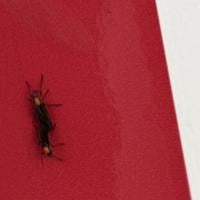

A lovebug pair sits on a WAWA gas pump on Sept. 22. Lovebugs are going through a population boom, as they are seen flying around in pairs at the University of Central Florida’s campus.
Izabella Siwik
Students noticed them flying around in parking garages, in buildings, and squashed on cars. Lovebugs have arrived at UCF.
Lovebugs, scientifically known as Plecia nearctica, are a type of fly that typically appears in large numbers during certain times of the year. Their populations fluctuate, meaning some seasons can bring noticeably more lovebugs than others.
“Most likely, their population fluctuates like most species, and right now they are enjoying a population boom,” Dr. Barbara Sharanowski, a UCF biology professor and director of the UCF Collection of Arthropods, said about their recent appearance.
Lovebugs spend much of their adult lives reproducing. Males remain attached to females during mating, sometimes for up to two days. Sharanowski said this is a reproductive strategy because females can store sperm from multiple males and later choose which sperm to use to fertilize their eggs.
For senior biology major Sadhuvasi Kitsikis, the scientific explanation is accompanied by a change in how frequently the insects appear on campus.
“I don’t notice them on campus as much as I did a little bit ago,” Kitsikis said. “It’s probably because it’s towards the end of their mating season.”
Although lovebugs can appear in enormous numbers, their presence does not necessarily indicate an infestation.
Dr. Joshua King, a UCF ecology professor, said fluctuations in lovebug populations are normal.
“They are here to stay; they migrated on their own into the southeastern United States,” King said.
Lovebugs are native to Central America and eventually spread into the southeastern United States. King said they were present in areas such as Louisiana and Texas as early as the 1900s and likely spread throughout other southern states, including Florida, between 1950 and 1990.
The exact reasons for fluctuations in lovebug populations are not completely known, although climate and other environmental factors may play a role. Their spread may have been helped by roads and roadside mowing. Lovebug larvae feed on decaying vegetation, meaning grass clippings can provide a food source.
The insects may also be more noticeable because of their attraction to vehicles. King said lovebugs may be attracted to cars by visual cues and gases such as carbon dioxide and methane, which can also be produced by rotting vegetation.
Kitsikis said lovebugs are not particularly bothersome to him, aside from the insects getting stuck to his car.
A common misconception surrounding lovebugs is the University of Florida laboratory myth, which claims researchers created the insects in a laboratory.
King, who earned his Ph.D. in entomology from the University of Florida, said the myth was already well known when he attended the university in the early 2000s.
King suspects the myth may have developed from confusion surrounding mosquitoes and lovebugs, since both are types of flies. The rumor claims that scientists altered mosquito DNA, accidentally created lovebugs and somehow allowed them to escape from a laboratory.
“This is beyond absurd,” King said.
Lovebugs are also known for gathering around roads and vehicles, where their remains can create cleaning challenges for drivers.
King said lovebugs have a reputation for damaging car paint. However, modern vehicle paint coatings have reduced the problem. Their remains can still be difficult to clean if left on vehicles in the sun for several days.
Lovebugs are part of Florida’s ecosystem, and their seasonal appearances are expected to continue as their populations fluctuate.
As lovebug activity continues around campus, King pointed to mosquito-borne illnesses, including dengue, as a more significant reason for students to use insect repellent and protect themselves outdoors.
“Mosquitoes are one of the most dangerous animals in the world.”
Although lovebug numbers may temporarily increase, King said there is no reason to attempt to eliminate them.
“There is absolutely no reason whatsoever to attempt to ‘manage’ them, and it’s not even clear that would be possible,” King said.