
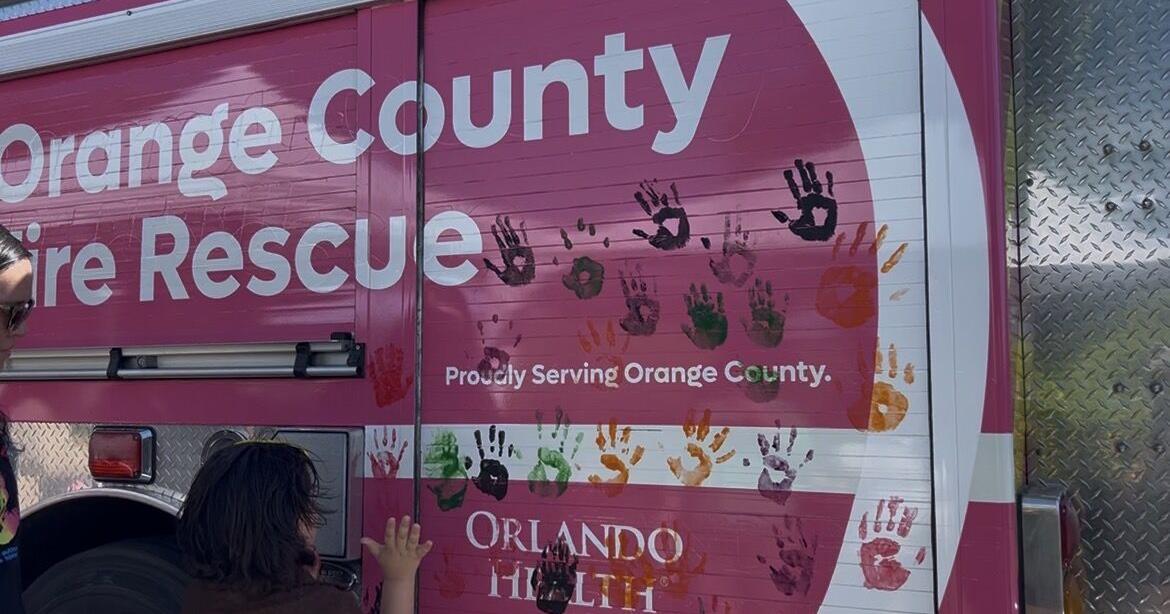

At the Children’s Village Safety day on Saturday, Orange County Fire Rescue allow the children in attendance to leave handprints on their pink firetruck.
Kathleen Moore
The children’s excitement and laughter filled the air on Saturday as they met a therapy dog and climbed into a fire engine.
The UCF Center for Autism and Related Disabilities partnered with Providing Autism Links & Support to host Safety Day at the Children’s Safety Village to address the challenges families face when raising neurodivergent children.
From simulated firehouses, working traffic lights, stop signs, railroad crossings and accessible bounce houses, Children’s Safety Village pushed to improve the lives of families affected by autism spectrum disorder.
For parents within the UCF CARD/PALS network like Barrie Brown-Martínez, safety is a concern when navigating autism spectrum disorder, particularly regarding high-risk situations like wandering or elopement.
“It’s not just a show-up-at-something; it’s about building that relationship year-round,” PALS Executive Director Kaileigh Anne Tayek said. “Our vendors show our folks with ASD the kind of services and products that they might need.”
The goal of Safety Day wasn’t about selling something, Tayek said.
“It’s about equipping our families with both the safety information and materials they may need,” Tayek said. “As well as making connections with first responder partners that they would meet in not the best of situations.”
Held at the Children’s Safety Village for the second year, the event utilized a mini-city environment featuring miniature buildings, paved streets and realistic traffic signals. The mini-city included safety stations throughout the day focused on life skills and emergency preparedness.
Children’s Safety Village Director Brent Moore’s favorite feature was the realistic fire house.
“Students come in, and they learn about dangers in their household. Everything from candles to curling irons to coffee pots,” Moore said. “Then, they get to go upstairs to a big bedroom, and what they will do is practice stop, drop and roll.”
Interactive stations such as this one allowed participants to practice fire evacuation procedures at their own pace without overwhelming sensory triggers. Experiencing a simulated home fire ensured neurodivergent youth knew exactly how to react safely during a real-world emergency.
Families participated in a scavenger hunt that encouraged them to go to each station to spell out the word “SAFETY.” Each letter represented a new way for students and families to teach safety procedures.
“It was not only a great family outing,” Brown-Martínez said. “But it was a community experience in which we all were educated with awareness to the safety needs of our autistic child.”
Tayek said that bridging the gap between families, specialized service providers and first responders fosters a collaborative network that enhances safety and inclusion throughout the broader community.
Through continuous collaboration, events like Safety Day empowered households, like Brown-Martínez’s family, with actionable strategies and long-term resources.
“Safety Day was an empowering day for our child,” Brown-Martínez said. “This event is a definite must for every family with an ASD child.”
UCF CARD also provides family support, technical assistance and professional training as well as educator resources.
The main service UCF CARD provides is to individuals in Central Florida with autism or related disabilities, according to their website. UCF CARD Director Terri Daly said they support around 26,000 families and children with autism.
“We are constantly looking for people who want to get involved and donate their time their funds to support these kinds of initiatives,” Daly said.