
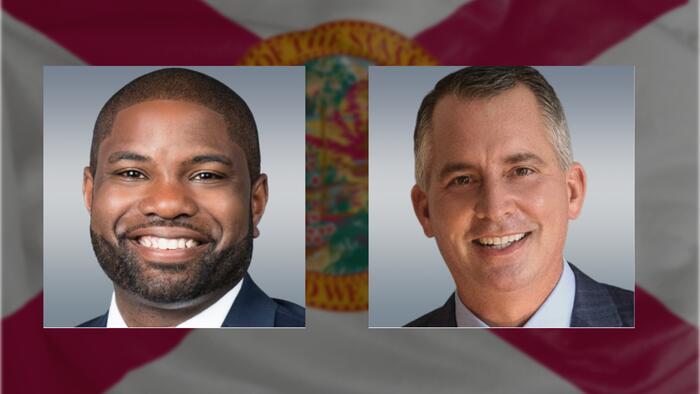
FLORIDA – The race for Florida governor is drawing sharp contrasts on some of the state’s most pressing issues. Democratic candidate David Jolly and Republican Rep. Byron Donalds sat down separately this week to answer questions on artificial intelligence, hyperscale data centers and Amendment 3, a property tax relief measure heading to voters next month.
Here is where each candidate stands:
AI Data Centers
Jolly said he would issue a moratorium on hyperscale data centers on his first day in office, arguing the industry is rushing into a state with a favorable regulatory and campaign finance environment before the public health and environmental questions have been answered.
“This is moving too quickly,” Jolly said. “Big tech and big data are rushing into a relatively unregulated or favorably regulated environment.”
Jolly pointed to a data center community in Northern Virginia where, he said, four children had been treated for respiratory conditions, one had been hospitalized, and several had been treated for hearing conditions. He said nearly 75% of Florida voters oppose the facilities.
“Florida’s voters are saying, don’t do this. And I’ve said, I’ll issue a moratorium on my very first day in office,” Jolly said.
Donalds took a different approach, saying the decision belongs to local governments — not the state.
“County commissioners issue building permits, not governors,” Donalds said. “Local communities do.”
Donalds said state law, signed by Gov. Ron DeSantis, already puts siting decisions in the hands of local communities. At the state level, he said his administration would focus on two guarantees: utility bills would not increase because of data centers, and fresh water would be protected through existing water use permit requirements administered by water management districts.
Donalds also noted a study commissioned by the state is due back June 1, 2027, and said he would release it publicly.
“We are going to maintain that,” Donalds said of the existing permitting framework. “This is not a new phenomenon.”
Artificial Intelligence
Jolly called himself an AI optimist but said the technology’s integration — not its promise — is the critical issue. He cited concerns about job displacement, children’s privacy and the role of AI in classrooms, arguing teachers should use AI as a tool, not be replaced by it.
“AI should not replace a teacher,” Jolly said. “But I think teachers could benefit from AI.”
He also cited what he described as a corrupt campaign finance system quieting public concerns. “The public is saying, hey, pump the brakes, slow down. Even the inventors of AI at times are saying, slow it down,” Jolly said.
On job displacement, Jolly drew a comparison to trade adjustment assistance programs created during NAFTA and CAFTA, saying Florida may need a similar retraining and assistance framework if the federal government fails to act.
Donalds said AI is already embedded in everyday life and cannot be put back in a box.
“If you got rid of the models at the top four or five companies, there’s probably 500 young computer scientists and engineers who are already making up their own model,” Donalds said.
He said Florida should focus on protecting children, safeguarding name, image and likeness rights, and empowering parents. He also pointed to commercial space development on the Space Coast as an example of AI-powered economic opportunity, calling it a potential $1 trillion industry generating high-paying jobs across multiple fields.
“The question is, how do we protect families? How do we protect communities and how do we protect children?” Donalds said.
Amendment 3
Both candidates acknowledged the property tax burden on Florida residents, but they land on opposite sides of the measure.
Jolly said he anticipates voting no on Amendment 3, aligning with sheriffs and law enforcement groups who have warned the measure would cut funding for public safety services.
“That’s essentially what Amendment 3 is gonna do. It’s gonna defund law enforcement along with critical services that communities need,” Jolly said.
He said the measure was rushed through without a sufficient funding backstop and noted that Gov. DeSantis, who initially proposed a version of the idea, is not actively campaigning for it. Jolly said he would instead pursue targeted relief — a homestead exemption of up to $250,000 for first-time homebuyers, income-based relief for seniors, and returning expanded exemption authority to local governments.
“Let’s target first-time homebuying tax relief,” Jolly said, noting the average age of a first-time homebuyer in Florida has risen from 28 to roughly 40 or 41 years old.
Donalds said he supports Amendment 3, arguing property taxes on Florida residents have effectively doubled over the past seven years.
“It’s not our money. It belongs to the citizen. It belongs to the taxpayer,” Donalds said.
He said the amendment’s language requires public safety to be funded first before any cuts take effect. For fiscally constrained counties, he proposed a dedicated funding formula so those governments would not need to lobby Tallahassee for help. He also argued larger counties had the option to roll back tax rates as property values rose over the past six years and chose not to.
“Local governments have to live within their means, the same way the state government has to live within our means,” Donalds said.
Copyright 2026 by WJXT News4JAX – All rights reserved.