
Two Florida women are facing charges for attempting to kill their special needs family members — cases that are drawing renewed attention to a long-standing crisis facing families who care for medically fragile children in the state.
According to the Osceola County Sheriff’s Office, Marilyn Therrell, 68, admitted to deputies that after her husband died last year, it became harder to care for her two autistic adult sons. Therrell is accused of trying to kill both sons before attempting to take her own life.
In a separate case, Deborah Collier, 70, of Volusia County, is facing charges for allegedly attempting to kill her disabled great-granddaughter — a 13-year-old in her custody — before trying to take her own life.
In an arrest affidavit, Collier told investigators she could not care for the child and feared placing her in an assisted living facility.
News 6 previously spoke with Collier’s attorney, who said family members were looking for help and care for the girl but struggling to find something they could afford or that was adequate for someone who needs 24-hour care.
[WATCH: Florida families caring for medically fragile children say system is failing them]
A crisis years in the making
These cases are not isolated incidents. They reflect a much deeper, systemic problem — one that thousands of Florida families are living every day.
Both cases are shining a spotlight on a long-standing crisis for Florida families caring for medically fragile children — defined as children who require a skilled nurse around the clock.
There are between 7,000 and 10,000 medically complex children in Florida, according to Matt Dietz, a disability rights expert.
“Very few of them get 100% of the care that they need,” said Dietz.
One family’s story
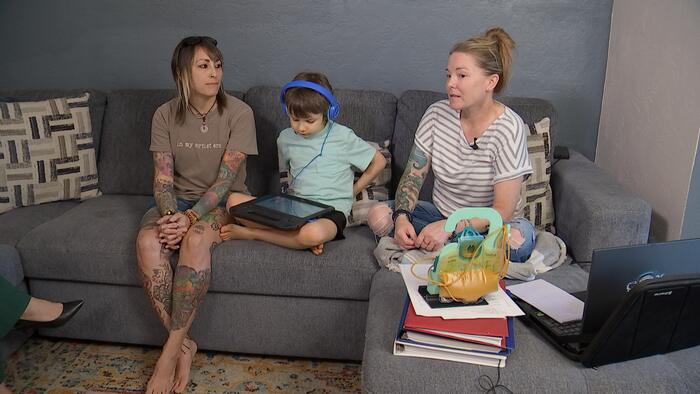
Tricia Rafeedie and her family are moving out of Florida to get better care for 6-year-old Noah, whom they adopted through foster care when he was 1.
“He is cognitively still maybe two years old,” Rafeedie told News 6.
Noah has about 20 diagnoses, ranging from autism and fetal alcohol syndrome to severe brain damage. He also uses a feeding tube.
Rafeedie said she had to leave her job as a child protection investigator to stay home and care for Noah full time.
“We were told to apply for private duty nursing. That was denied. We were denied home health aide. We were denied paid parent caregiving,” she said.
[RELATED: US is in dire need of home health aides. Florida ranks dead last in availability]
Navigating a maze of programs
For families like Rafeedie’s, navigating Florida’s care system means wading through a maze of programs.
According to the Florida Agency for Health Care Administration — also known as AHCA — which oversees Florida Medicaid, Private Duty Nursing, or PDN, is designed for children whose medical conditions require skilled nursing care in the home or community, rather than just help with everyday tasks like bathing or eating.
A home health aide takes a different approach, providing hands-on assistance with daily living activities and personal care needs — things like mobility, grooming and medication reminders.
For families who want to take a more active role, Florida created the Family Home Health Aide Program. It allows an eligible family member, legal guardian or caretaker relative to be trained and employed by a participating home health agency to provide those same home health aide services directly to a medically fragile child — essentially putting parents and guardians on the payroll to do what many are already doing for free.
Despite these programs existing on paper, Rafeedie said her family was turned away at every turn.
“The system has failed him,” Rafeedie said. “When I started to stall out, I started to look into the community, that’s when I realized, oh my God, this is state level. These are large agencies that aren’t holding accountability.”
A decade-long legal battle
The struggle families like Rafeedie’s face didn’t happen overnight — and neither did the legal fight to address it.
In 2013, the Department of Justice sued the state of Florida for violating the Americans with Disabilities Act, claiming the state was placing medically fragile children in nursing homes unnecessarily. The DOJ accused Florida of failing to provide adequate in-home nursing and community services to help families avoid placing children in these facilities.
“They were sued under Olmstead, which is a Supreme Court decision implementing part of the Americans with Disabilities Act saying that there’s a requirement in the law to have an integrated environment, so you don’t isolate people with disabilities,” said Dietz.
In 2023, a federal judge found the state violated Title II of the ADA, which prohibits disability discrimination by state and local governments and requires them to make programs, services and activities accessible to people with disabilities.
The court ordered Florida to make PDN reliable enough that children who need it can live at home. In practical terms, that means the state must ensure each child receiving PDN gets at least 90% of their authorized nursing hours, collect and report nurse-availability data and take concrete steps toward compliance.
Federal rollback raises new fears
Just when families thought the legal system was working in their favor, the ground shifted again.
In July 2026, the DOJ said Olmstead Guidance has no force of law and that it will not rely on the guidance in enforcing Title II of the ADA going forward.
Then, in August 2026, the DOJ filed a motion asking the 11th U.S. Circuit Court of Appeals to throw out the ruling in United States v. Florida and send the case to a lower court for reconsideration.
“The United States has advised the court that it no longer intends to uphold the integration mandate of the ADA, which requires people, children, adults, to receive services in the most integrated, community-based areas possible,” said Dietz.
Dietz has been part of the case for 13 years. He says the decision impacts more than 3,000 families in Florida. Some of those families are now writing to the court, asking it to keep the injunction in place, fearing they could lose even more services.
Families speak out
Kayla Webb is one of those families. She previously spoke with News 6 about her son Dylan’s nursing hours being cut — hours her family depends on every week.
“We’re probably short 20 hours a week,” Webb said.
Webb recently filed an affidavit with the court, writing: “We try to help him (Dylan) have a typical childhood and he enjoys his school and community. To remove him from his home, his school, his community would be detrimental to him.”
News 6 also obtained a letter from another mother who wrote to the court stating: “Parental devotion should not be used as evidence that professional services are unnecessary.”
For Dietz, the letters pouring in from families represent something much bigger than a legal filing — they are a desperate plea to be seen and heard.
“These are the Whos in ‘Horton Hears a Who’ who’s going ‘we are here, we are here, we are here. Listen to us,’” he said.
The Department of Justice did not respond to News 6’s request for comment. The Florida Agency for Health Care Administration also did not respond to an inquiry.
Copyright 2026 by WKMG ClickOrlando – All rights reserved.