
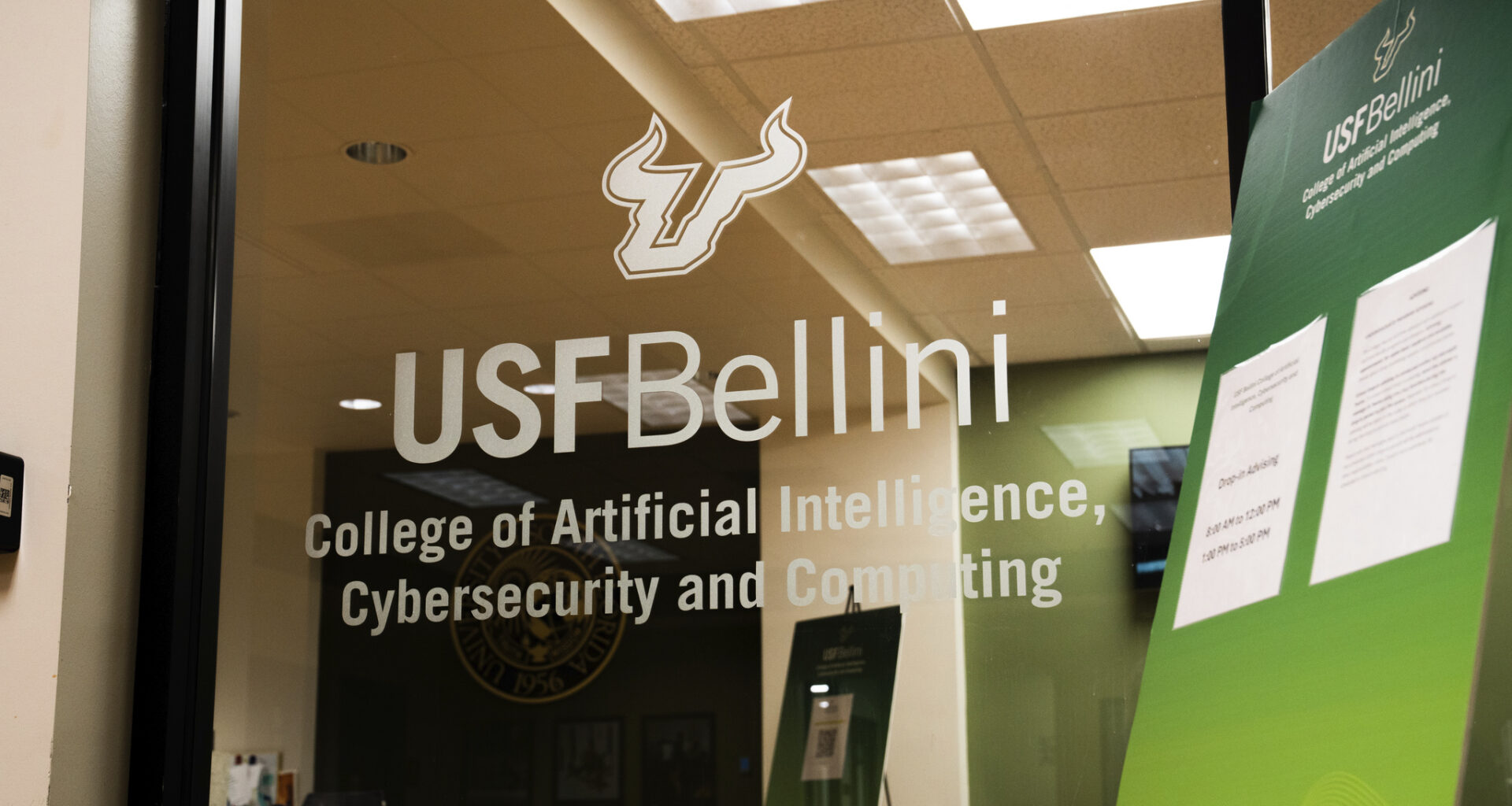
 USF is planning a dedicated building for the Bellini College of Artificial Intelligence, Cybersecurity and Computing at the Tampa campus main entrance. ORACLE PHOTO/THOMAS MARRS
The University of South Florida is planning a new building for the Bellini College of Artificial Intelligence, Cybersecurity and Computing.
USF plans to put the building at the Tampa campus’s main entrance, where LeRoy Collins Boulevard meets USF Alumni Drive, according to the university.
The state has committed $35 million to the project, and private donors have contributed millions more, according to USF.
USF spokesperson Althea Johnson said the university has not set a construction start date or a groundbreaking date.
Currently, the college’s classes are held in buildings across campus that are not dedicated to Bellini programs.
Students said the new building would let them take all their classes in one place.
Sarrat Afzal, a junior majoring in computer science, said a dedicated building will do more than house classrooms, creating a hub where students and faculty can interact.
“Having a dedicated building is an incredible milestone for our college,” Afzal said. “It gives computing, artificial intelligence, and cybersecurity students a shared identity and a physical anchor on campus.”
Related: USF Bellini College of AI to get dedicated facility by 2028
The Bellini College was established in 2024 and opened in 2025 after Arnie and Lauren Bellini gave the university a $40 million gift, according to USF.
The college has more than 3,000 students and faculty across 17 degree programs and certificates.
Afzal said she believes the new building could provide more resources for students.
“A dedicated facility significantly elevates the profile of our programs on both a regional and national level,” Afzal said. “In terms of resources, it means expanded specialized labs, modern hardware testing environments, and collaborative study spaces.”
Afzal said her classes are typically held in CW Bill Young Hall, the Chemistry building and Engineering II building, and that it is too early to say whether her classes will move to the new building once it is built.
“It would likely depend on the overall layout, classroom capacities, and how the university balances specialized technical coursework with general university lecture needs,” she said.
Gracie Brunelle, a junior majoring in cybersecurity, also takes classes across campus, including in the Muma College of Business, University Lecture Hall and the engineering buildings.
She said she believes having all her classes in one building would make it easier to get between them.
“As of right now, I’m sort of flip flopping through buildings,” Brunelle said. “I’m trying to rush over so I’m not late to my class, just having everything in one space would just be a lot easier.”
Brunelle said having her classes spread across campus makes her feel isolated and that the new building is necessary for the happiness of faculty and students.
“It’s kind of hard to really gauge your identity as being a student of Bellini, since we don’t have a dedicated building and we’re kind of all over the place right now,” Brunelle said.
Brunelle said she is excited about the building and expects Bellini College students to use it to hang out and study.
“There will be a lot more opportunities to meet other people in your major as well,” Brunelle said.
Faculty members are also looking forward to the addition.
Karni Chagal-Feferkorn, an assistant professor in the Bellini College, said the new building will encourage collaboration among faculty, students and staff.
“The building will bring everyone together, allowing an enhanced sense of community within the college,” Chagal-Feferkorn said.
Chagal-Feferkorn said the building will also help knowledge spread across the college.
“When there’s a common space for everyone, access to people, resources, and facilities becomes quicker and involves less friction,” Chagal-Feferkorn said.
She said she is looking forward to the new building.
“Having a Bellini building will be another milestone in the rapid development of the College,” Chagal-Feferkorn said. “I’m sure it will become one of our symbols.”