

Fairwinds Alumni Center sits near Memory Mall as one of the meeting places for the Board of Trustees. The Board of Trustees met here on Thursday, Sept. 23, to discuss its September agenda.
Paige Bright
Two UCF students and one Valencia College student took to social media after they were denied a public comment at the Board of Trustees meeting on Sept. 24 after the meeting was adjourned early.
The students planned to use the public comment section of the BOT meeting to address three different dockets featured in the meeting, including GOVC-3, AESC-3 and BUDC-1, involving raises for faculty and staff, allocation of student resources and budgeting for the college.
Tryphon Mazu, Marik Ahmed and Nelson Chapiro gathered at 3:42 p.m. to sign in at the Fairwinds Trade Center, three minutes before the cut-off, to speak at 4 p.m., Ahmed said.
Marik Ahmed, junior Valencia student incoming to UCF studying plant biology, said they were informed the meeting had adjourned early and would need to come to the next meeting. Ahmed said the Board of Trustees representatives explained they had sent an email about the shift change in meeting schedule.
All three students said they did not receive the email or follow-up regarding the schedule change.
Courtney Gilmartin, UCF’s Chief Communications Officer, told The Charge in an email that in accordance with the Board’s meeting procedures, the meeting ended within jurisdiction.
“Under the Board’s meeting procedures, when meetings are scheduled consecutively, the following meeting begins upon adjournment of the previous meeting,” Gilmartin said in an email. “The September 24 Board of Trustees meeting began in accordance with these procedures, with the Chair adjusting the order of business to allow additional time for registered public commenters to arrive.”
“We have to give them a 24-hour notice in advance via sign-up sheet to tell them that we are going to be attending the meeting,” Ahmed said. “But they don’t even owe us a few hours in advance to tell us that the meeting is going to adjourn early? I don’t think that’s fair. I think they are trying to avoid us.”
The three said they spoke with Board of Trustees member Mike Kilbride after the meeting about their frustration with the lack of communication from the Board. Junior civil engineering major Nelson Chapiro said Kilbride suggested they speak in a private room to further discuss how they think public comment should be changed.
Chapiro stopped the students from going into the room, feeling uncomfortable with the offer.
“Our comments that we worked very hard to put together and research are supposed to be public. We’re about to go into a private room, and from my experience with organizations, that’s just not how things should be done,” Chapiro said. “It’s only in the public that things are visible, and thus held accountable.”
The three exchanged contact information with Kilbride to send their prepared speeches and concerns about communication when it comes to public comment. After leaving the building, they took to social media, shared their experience and gave their speeches.
“You’re not going to let us speak inside your building? Fine, we’ll speak outside it,” Ahmed said.
The combined time of the three speeches posted to Instagram was 6 minutes and 37 seconds. In the videos, each student shared what they would have said to the Board if allowed to speak, with Ahmed standing in the rain while doing so to make sure their voices were heard.
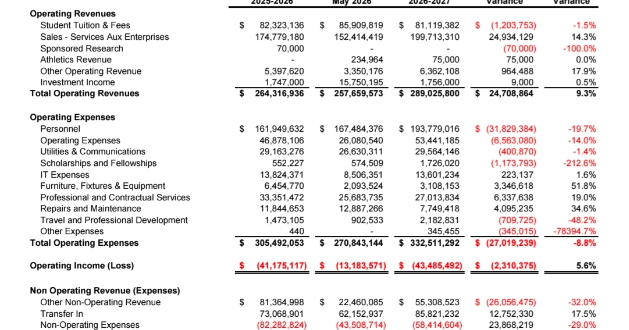
Breakdown of UCF’s BOT Auxiliary Funds Summary collected by incoming UCF junior plant biology major Marik Ahmed. Ahmed looked through the Board of Trustees funding plan released in June 2026 to collect the information.
Courtesy of UCF Board of Trustees Budget and Finance Committee
As of Oct. 2, the videos have been viewed over 22,600 times and shared over 200 times.
The social media posts are not the end of the students’ efforts to have their comments heard. The students plan on staying in communication through email with Kilbride to ensure their words are not only heard, but there is a paper trail to back them up, Chapiro said.
“The fact that it has got attention on social media will encourage more students to speak up and see that all these things we’re complaining about,” Tryphon Mazu, junior civil engineering major, said. “We all have these complaints and comments, so we should all be able to speak out and maybe more people can show up to the next meeting, and if that doesn’t work, we can find other ways to speak out.”
Mazu is involved in Student Tech Shares, a group of students hoping to act as a new LibTech resource, providing students the opportunity to rent technology. The group has not been registered as an official club with UCF but rather a collection of students looking to share resources with others. Mazu and Ahmed both planned to speak on the closure of LibTech during their speeches.
“The choice was made by a head of the library department, but coincidentally, almost everyone involved with the library department was excluded,” Ahmed shared in his speech, which he repeated to The Charge. “We are told the department needs these funds for other resources and aren’t told what those resources are. Yet somehow, we have enough in the general education budget for things like fraternities.”
Ahmed had prepared documents for the Board depicting the allocation of general student funding being funneled into three separate fraternities at UCF. Ahmed found funding allocations for the 2025-2026 year collected after the June 2026 Board of Trustees meeting. The document shows where funding was allocated and the difference in funding for different Education and General Funds from 2025-2026 to the 2026-2027 year.
The document highlights UCF’s current debt to Fifth Third Bank, which received the money from a second pool of funding provided to UCF. Ahmed highlighted a 2019 report by the Public Integrity and Ethics Committee of an investigation opened in 2018 against UCF for the unauthorized allocation and use of funds.
“The second pool of funding was put into a flow state to pay off debts to Fifth Third Bank. Meanwhile, parts of the general education funds, including technology, were gutted,” Ahmed said in his speech. “These meetings illustrated the sacrifices the board made on our behalf in order to meet capital expectations.”
Chapiro followed up Ahmed’s concerns about wealth distribution by breaking down agenda item GOVC-3, calling for amendments to the Union Faculty and UCF agreement.
“The amendment proposed for this year was that a 3% merit increase would be given to select employees who meet whatever merit qualifications they put up,” Chapiro said. “This is not enough; this is far below the bare minimum because UCF has been very stingy with giving their staff, who run this whole operation, the money that they deserve.”
He continued pulling information from the Union Faculty of Florida’s UCF Chapter, listing the increases and decreases in raises for UCF employees between 2022 and 2025.
“Basically, all the top of UCF administration has gotten a minimum of a 10% raise, some being 20%, 50% and Cartwright’s is notoriously 128%,” Chapiro said.
List of UCF Administrative employees depicting the percentage of raise each member received from 2012 to 2025, with data collected by the Union Faculty of Florida at UCF.
Courtesy of Union Faculty of Florida at UCF provided by UCF Young Democratic Socialists of America.
“This amendment proposes a 3% raise for a ‘merit raise,’ which is important to highlight because putting a benchmark on it excludes a large group of employees who deserve raises,” Chapiro said.
Mazu said these decisions don’t reflect what students want because of how difficult it is for them to have access to these resources.
“We’re not an organization. We’re just a bunch of organizers that kind of just became friends and really want to make a positive impact.” Ahmed said. “So influencing other people to do the same is how we are stronger.”
All three students plan on attending the next Board of Trustees meeting on Dec. 3.
“They’re supposed to allow us a platform. We should not have to build it ourselves,” Ahmed said.