
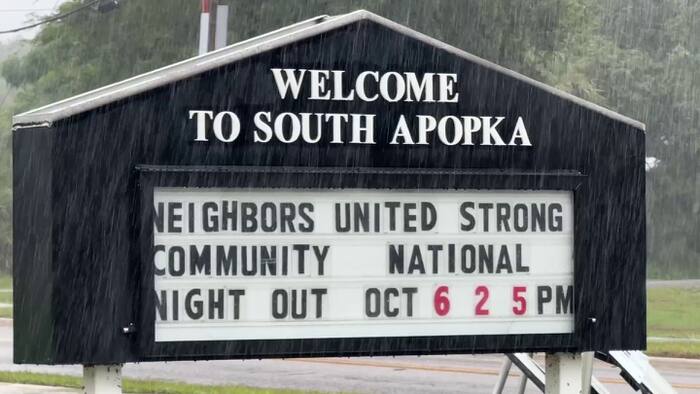
APOPKA, Fla. – A new city-commissioned study says South Apopka could legally and physically be brought into the City of Apopka — but doing so would come with significant costs, new staffing needs and potentially years of infrastructure work.
The 2026 South Apopka Annexation Feasibility Study estimates roughly 4,063 people across 2,450 parcels live within the proposed annexation area. If ultimately annexed, Apopka’s population would grow from an estimated 66,580 people to about 70,583 — an increase of roughly 6%.
Nothing in the study means South Apopka is being annexed immediately.
The report is one step in a longer process that would still require an annexation ordinance, public hearings and, ultimately, a referendum involving voters in the area proposed for annexation. Florida law also allows Apopka commissioners to choose whether to hold a separate vote among existing city voters.
The larger question now facing city leaders is whether the potential benefits of bringing South Apopka into the city outweigh the cost of providing city-level services to thousands of additional residents.
Where is the proposed annexation area?
South Apopka is currently part of unincorporated Orange County, rather than the City of Apopka.
The study area covers approximately 1,235.7 acres, or about 1.93 square miles. It is generally bounded by State Road 451/Alabama Avenue to the west and northwest, U.S. 441 to the northeast, Sheeler Avenue to the east, and Keene Road and State Road 414 to the south. Its northern boundary follows an irregular line near 10th Street.
The maps contained in the study show the proposed area sitting directly alongside — and in several places surrounded by — existing City of Apopka territory. The study concludes the area’s development pattern, land uses and zoning are generally compatible with the neighboring city
The consultants ultimately determined the proposed area meets the state criteria for being compact, contiguous and urbanized, making annexation legally and physically feasible.
But feasibility does not mean it would be inexpensive.
The biggest number: a preliminary $5.5 million annual gap
The study estimates South Apopka would generate about $1.31 million per year in new City of Apopka property-tax revenue.
At the same time, it estimates providing municipal services at the city’s current standards would cost approximately $6.87 million annually.
If those two numbers are compared by themselves, the result is a preliminary annual shortfall of roughly $5.5 million.
That figure needs an important qualification.
The study specifically says the $5.5 million figure is not a complete calculation of the overall financial impact of annexation. It does not include several other potential sources of city revenue, including utility fees, communications-services taxes, local-option gas-tax distributions, state revenue sharing, permit fees and development-related revenues.
The report also notes the city had about $6.46 million remaining in its General Fund after expenditures and before transfers in fiscal year 2025, and says General Fund money or other revenue sources could potentially be used to close some or all of the projected gap.
During Wednesday’s City Commission discussion, the consultant also stressed that the feasibility study is essentially a snapshot in time. Costs, development and other conditions could change before any annexation actually occurred. transcribe meeting
That makes the $5.5 million figure an estimate — not a guaranteed future deficit.
More police officers, firefighters and a new fire station
Public safety represents one of the biggest potential expenses.
South Apopka is currently policed by the Orange County Sheriff’s Office. If annexed, the Apopka Police Department would eventually assume that responsibility.
The study says the proposed annexation area generates an average of roughly 8,000 law-enforcement calls per year and estimates annexation would increase calls handled by Apopka police by about 10%.
To meet the city’s stated service standard, the study says Apopka would need at least 18 additional sworn police officers. It also says a new police substation may be needed.
The estimated nonannual police capital cost is approximately $18.7 million, including vehicles, equipment and a proposed $17 million police substation. The cost of land for that facility is listed as still to be determined.
Fire service would also change.
Orange County Fire Rescue currently provides primary fire and emergency-response coverage in South Apopka. According to the study, the proposed annexation area generates more than 1,800 fire-rescue calls per year, which it describes as a higher call volume than any of the five nearby fire stations.
The study says Apopka would need a new fire station and approximately 25 additional Fire Department employees, including firefighters, engineers, lieutenants and a fire inspector.
Fire capital expenses are estimated at roughly $9.3 million, including a $6 million fire station, a $1.5 million fire truck, a $400,000 ambulance and a $1.4 million tanker. Land costs are not included because a site has not been determined.
And that transition would not happen overnight.
The study estimates moving fully from Orange County Fire Rescue to the Apopka Fire Department could take 48 to 60 months or longer, depending on how quickly the city can obtain land, vehicles, equipment and employees.
What else would change for residents?
Some services would change providers. Others would not.
Police, fire and garbage collection would eventually shift from county-level service to the City of Apopka, although the study anticipates phased transitions for all three.
Roadway maintenance, building inspections, code enforcement and other municipal functions would also become city responsibilities. Orange County currently maintains about 21.9 centerline miles of roadway inside the proposed annexation area.
The city estimates it would need additional public-services employees, four new garbage trucks and other vehicles and equipment. The report puts Public Services capital needs at approximately $2.48 million.
Water and sewer are different because the City of Apopka already provides those utilities to much of the area. The study says there would be no change in utility provider simply because of annexation.
Street lights would also continue to be operated by Duke Energy.
Sewer could take years to fully expand
While Apopka already provides water and sewer service in South Apopka, not every property has access to the full centralized system.
The study says water lines already cover most developed areas, but sewer access is more limited — particularly in central and eastern South Apopka. Some properties still rely on septic systems.
Closing the identified infrastructure gaps could require approximately:
65,000 feet of gravity sewer, 8,500 feet of sewer force main and 6,100 feet of water main.
The study proposes breaking that work into 18 separate projects.
If those projects were built one at a time, consultants estimate completion could take roughly 29 to 44 years. If the city were able to advance three phases at the same time through a capital-improvement program, the timetable could shrink to roughly 10 to 15 years.
The report does not say every property owner would immediately be required to connect to a new line upon annexation. Properties already near an existing main could go through the city’s normal availability and approval process, while properties in identified infrastructure gaps would generally have to wait until a future extension reaches them. Cumulated_Final_Report_Apopka_0…
What could this mean financially for individual residents?
That remains one of the biggest unanswered practical questions.
The report calculates overall city property-tax revenue but does not provide one simple estimate showing exactly how much an individual South Apopka homeowner’s total tax bill would rise or fall after accounting for city taxes, county charges, assessments and services that may change.
The study estimates the annexation area’s median household income at $61,322, about 23% below the Orange County median cited in the report.
It also says roughly 25.9% of households earn less than $35,000 per year and specifically notes that some households could be particularly sensitive to increases in their effective tax burden or future utility-connection costs.
Under Florida annexation law, property brought into a municipality generally becomes subject to the municipality’s taxes and obligations once the annexation takes effect, subject to the timing provisions in state law.
That makes the eventual household-level financial impact an important issue still to be worked through before residents are asked to vote.
Parks are another existing challenge
The study also points to an issue that already exists before annexation: Apopka has less park acreage than its own adopted service standard calls for.
The city currently has about 480 acres of park space. Based on its standard of 10 acres for every 1,000 residents, the city would need approximately 665 acres for its current population.
Adding South Apopka would raise that requirement to roughly 669 acres.
The annexation area itself contains one park identified in the study — Wheatley Park, which covers approximately 5.8 acres.
The study estimates another three Parks and Recreation employees would be needed, along with additional operating and maintenance expenses for Wheatley Park and the John H. Bridges Community Center.
The history behind this discussion goes back decades
The current annexation debate also carries a significant historical backdrop.
According to the city’s feasibility study, South Apopka was excluded from Apopka’s corporate limits in a 1937 ordinance. The report says exclusion of majority-Black communities from municipal boundaries was a practice seen during the Jim Crow era and contributed to disparities in public services and investment.
The report also discusses the Dowdell v. City of Apopka litigation. It says a 1984 case found the city liable for intentional racial discrimination involving street paving, stormwater and water distribution and resulted in investment being directed toward South Apopka. A referendum connected to that earlier effort did not result in South Apopka being annexed.
The city examined annexation again in 2022, and the new feasibility study represents a broader attempt to evaluate the issue through infrastructure, land-use, service and financial data.
Commissioners questioned how the study was put together
Wednesday’s discussion also produced questions about public involvement.
One commissioner asked the consultants whether they held community meetings or spoke directly with people living inside the proposed annexation area while preparing the feasibility study. transcribe meeting
The response, as captured in a transcript of the meeting, emphasized that the feasibility work was primarily a factual analysis using sources such as Orange County Property Appraiser data and information about existing city staffing, pay and service levels. Because the transcript becomes unclear during that exchange, it does not establish clearly enough whether any resident outreach occurred as part of the study itself. transcribe meeting
Consultants did say they physically drove through the area, in addition to reviewing maps, to compare the neighborhood’s development and land-use patterns with the existing city. transcribe meeting
Mayor Nick Nesta also apologized during the meeting after realizing the presentation being shown to commissioners had not already been posted for the public, saying the city would make sure it was made available. transcribe meeting
So what happens next?
City staff brought the study to commissioners Wednesday as an action item and asked them to determine whether the city should continue the legal annexation process.
The staff recommendation says that, if the commission chooses to proceed, the next step would be to send the feasibility study to the Orange County Board of County Commissioners and direct city staff and the city attorney to prepare an annexation ordinance.
The recommended motion contemplated filing the study with Orange County on Oct. 8.
But even that would not annex South Apopka.
State law requires the ordinance to go through the formal annexation process, including at least two advertised public hearings before final adoption. After that, voters in the area proposed for annexation must approve the measure in a referendum. The City Commission may also choose to put the question before existing City of Apopka voters separately.
City documents had initially pointed toward a possible March 2027 election. During Wednesday’s meeting, however, the city attorney told commissioners they have discretion over election timing and could potentially align the issue with a later election, including 2028. The attorney cautioned that if too much time passes, underlying conditions could change enough that the feasibility study may need to be updated. transcribe meeting transcribe meeting.
For now, the new study answers one major question: South Apopka can be annexed.
What it does not settle is whether city leaders and residents ultimately believe it should be — or exactly how Apopka would pay for the transition if voters say yes.
Copyright 2026 by WKMG ClickOrlando – All rights reserved.