
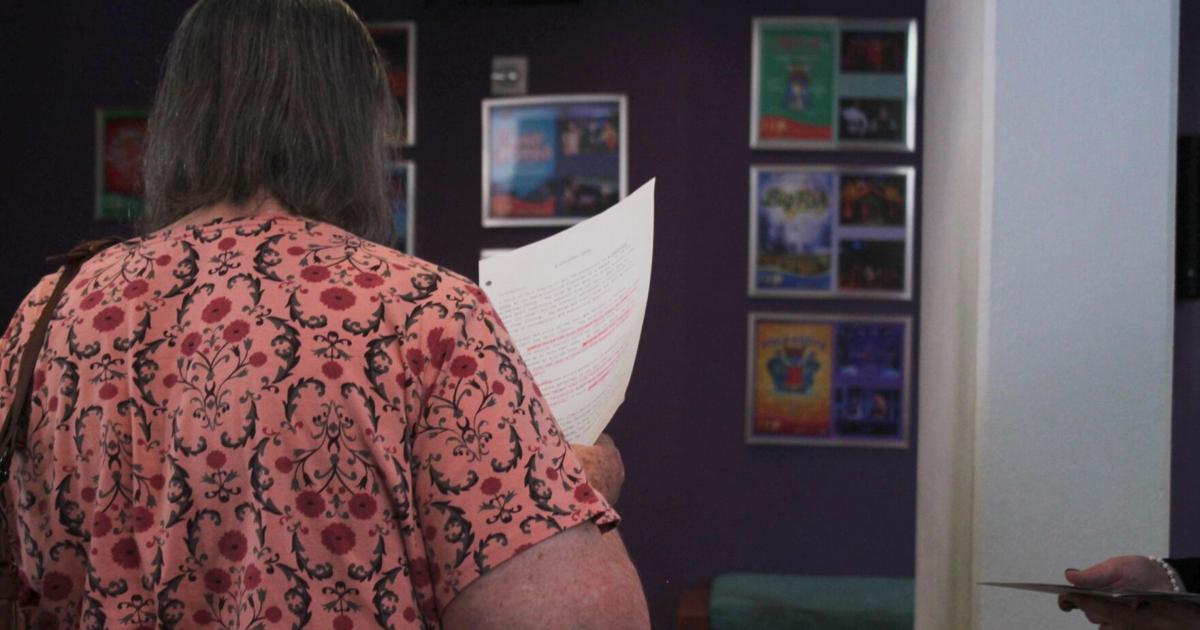

Teresa Dingman, former costume director at Orlando Family Stage (formerly Central Florida Civic Theatre), holds a stack of documents she brought to the theater on Sunday to be scanned into its digital archive. Dingman said that one of her favorite productions was Midsummer Night’s Dream.
Lola Fontanez
Orlando Family Stage alumni span decades, from performers who took the stage 40 years ago to students fresh from its most recent summer camp, gathered with the UCF history department for its latest History Harvest on Sept. 27 at the Orlando Family Stage theatre.
The History Harvest invited people to share stories, photographs, documents and other memories connected to the theatre. The materials will become part of UCF’s digital archive, the Regional Initiative for Collecting History, Experiences & Stories.
“RICHES’s collaboration with Orlando Family Stage is really about preserving as much of its 100-year history as we can and making that history accessible to the public,” Geoffrey Cravero, digital archivist for the project, said.
The History Harvest is part of an effort to document Central Florida’s history through the experiences of the people who have lived it. Rather than relying only on official records, the RICHES archive collects personal stories and materials that can help researchers and future generations understand the region’s past.
“I’ve been working with Madeline Lane to digitize materials from Orlando Family Stage’s own archives, and the History Harvest allows us to expand on that by bringing in materials that are still held by members of the community,” Cravero said.
The department also recently published an exhibit on voting rights and voter suppression, studying the Ocoee Massacre, and its next exhibit will focus on black entrepreneurship in Central Florida.
Cravero also conducted oral histories with multiple volunteers across generations, recording their stories with the theatre.
“Oral histories are another important part of the project because they allow us to preserve people’s memories and experiences in their own words,” Cravero said.
One of these volunteers was Teresa Dingman, a former costume designer for Orlando Family Stage in 1987, back when it was called the Central Florida Civic Theater.
“One of my favorite memories was Midsummer Night’s Dream– the fairies were staged on these turntable trees so you couldn’t see them at first, and then the tree turned, and they were exposed…and one of the little girls down in the audience audibly gasped and said, ‘she’s so beautiful,'” Dingman said.
Dingman was the costume designer for many shows during her time with the theater, including Robin Hood, The Snow Queen, and A Christmas Carol.
“She was so ethereal– her very pale skin, and then her costume was this opalescent, pearly color with just a slight tint of purple to it,” said Dingman.
For the Orlando Family Stage, the event also offered a chance to reflect on the theatre’s long history. The theatre is celebrating its centennial this year, marking 100 years of performances and connections with the Central Florida community.
UCF alumnus and Senior Director of Marketing, Zac Alfson, said that the work UCF is doing is vital to preserving the theatre’s extensive history.
“The UCF History Harvest is such an important part of our Centennial,” Alfson said. “As we continue the ongoing work of digitizing and preserving our archives, hearing directly from people who were part of this history gives those materials context and life.”
People who attended the history harvest could bring items and memories that helped tell the story of the theatre and its role in the community. These personal accounts provide a different perspective on the theatre’s history, shaped by the people who watched performances, worked there and made memories there.
Cravero said the memories collected during Sunday’s event will help ensure that the stories connected to the theatre remain part of Central Florida’s history for years to come.
“Together, the archival materials, community contributions, and oral histories help us document not only the institutional history of the theatre, but also the experiences of the performers, staff, audiences and families who have been part of it over the past century,” said Cravero.