
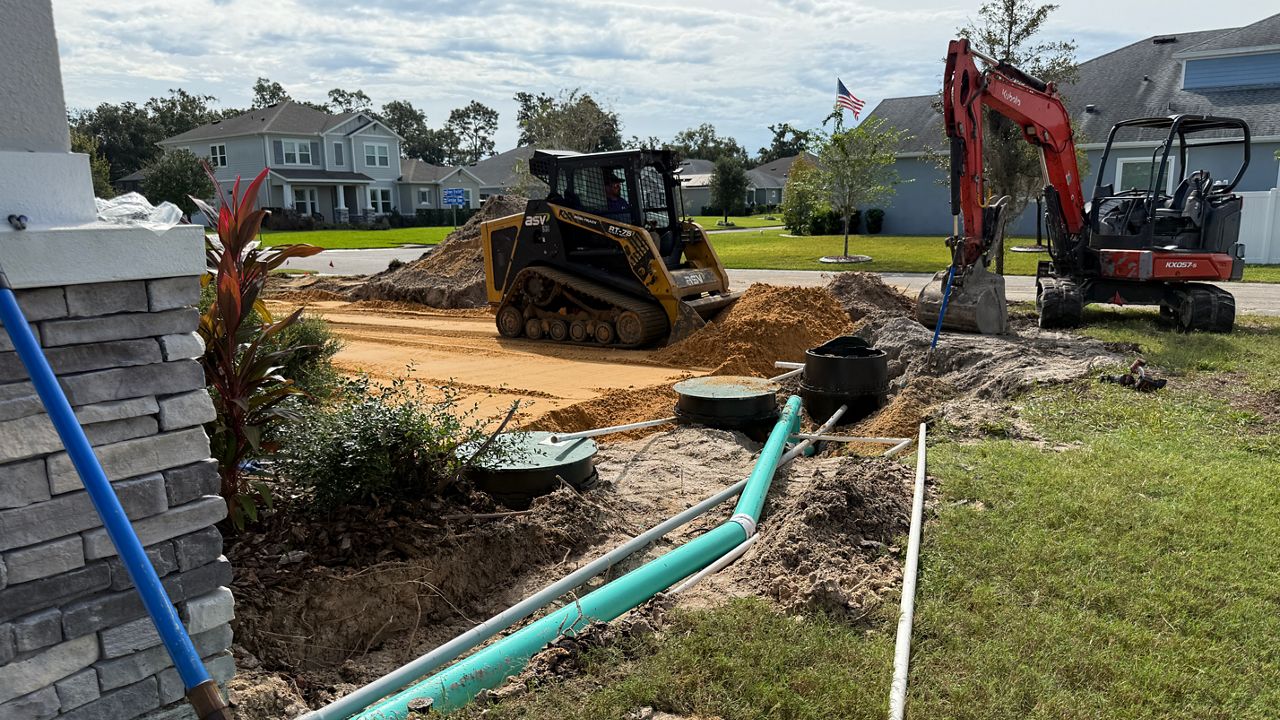
LAND O’ LAKES, Fla. — USF students are working with ACE Septic & Waste to test more affordable ways to remove pollutants from septic wastewater, a challenge experts say is important for protecting Florida’s springs and waterways.
Nearly 30% of Florida households rely on septic systems for wastewater disposal, amounting to about 2.6 million septic tanks across the state. Conventional septic systems do not remove most nitrogen from wastewater, allowing it to reach groundwater and contribute to pollution.
Greg Mayfield of ACE Septic & Waste said extending public sewer lines to older neighborhoods can be costly.
“You have subdivisions that were built out in the 50s, 60s and 70s. To run sewer to those locations is very, very expensive,” Mayfield said. “Sometimes $100,000 a lot. So we can do treatment on lot and on site for a quarter of that price.”
ACE Septic & Waste runs a clean water initiative and installs eco-friendly, state-approved nitrogen-reducing biofilters. The company is also helping USF researchers test systems in the field.
“We provide some technical background with them and actually some boots on the ground, so they can actually test some of their systems,” Mayfield said.
At USF, Dr. Sarina Ergas and her students are studying materials that could help wastewater treatment systems remove pollutants without making them too expensive for homeowners.
“The work we’re doing now, we’re using a natural zeolite mineral that’s mined in the southwest. We’re also using crushed oyster shells, which are a waste product, and we’re using biochar in that research,” Ergas said.
Ergas said crushed oyster shells and zeolite minerals are already showing results. Each has produced a 50% increase in nitrification, which researchers say indicates improvement in removal.
Student Andrew Easterling is working on a mathematical model to help guide future designs.
“My area is in developing a mathematical model for the system to try to help make decisions about how the system is designed and optimize treatment in the future,” Easterling said.
Kwabena Darko Okyere said the research builds on work done by previous students.
“We’ve learned a lot from our previous students, right? So the research we’ve done, you see what we’ve done and we’re trying to improve it,” Darko Okyere said.
Ergas said past students used scrap tire chips and elemental sulfur in one study that removed 80% of nitrogen.
USF Professor of Urban Hydrology Mahmood Nachabe said septic systems can create particular challenges in environmentally sensitive areas.
“The challenge is when you go to rural areas and when you put those septic systems in sensitive ecosystems, like spring sheds that feed our springs, you know, this is where it becomes very delicate,” Nachabe said.
Ergas said students continue to bring new ideas to the work.
“Some of my best research has come from my students. We work together,” Ergas said. “My students are coming with new, fresh ideas, and eventually I want my students to get to the point where they actually know more than me and they can start telling me when I’m wrong.”