
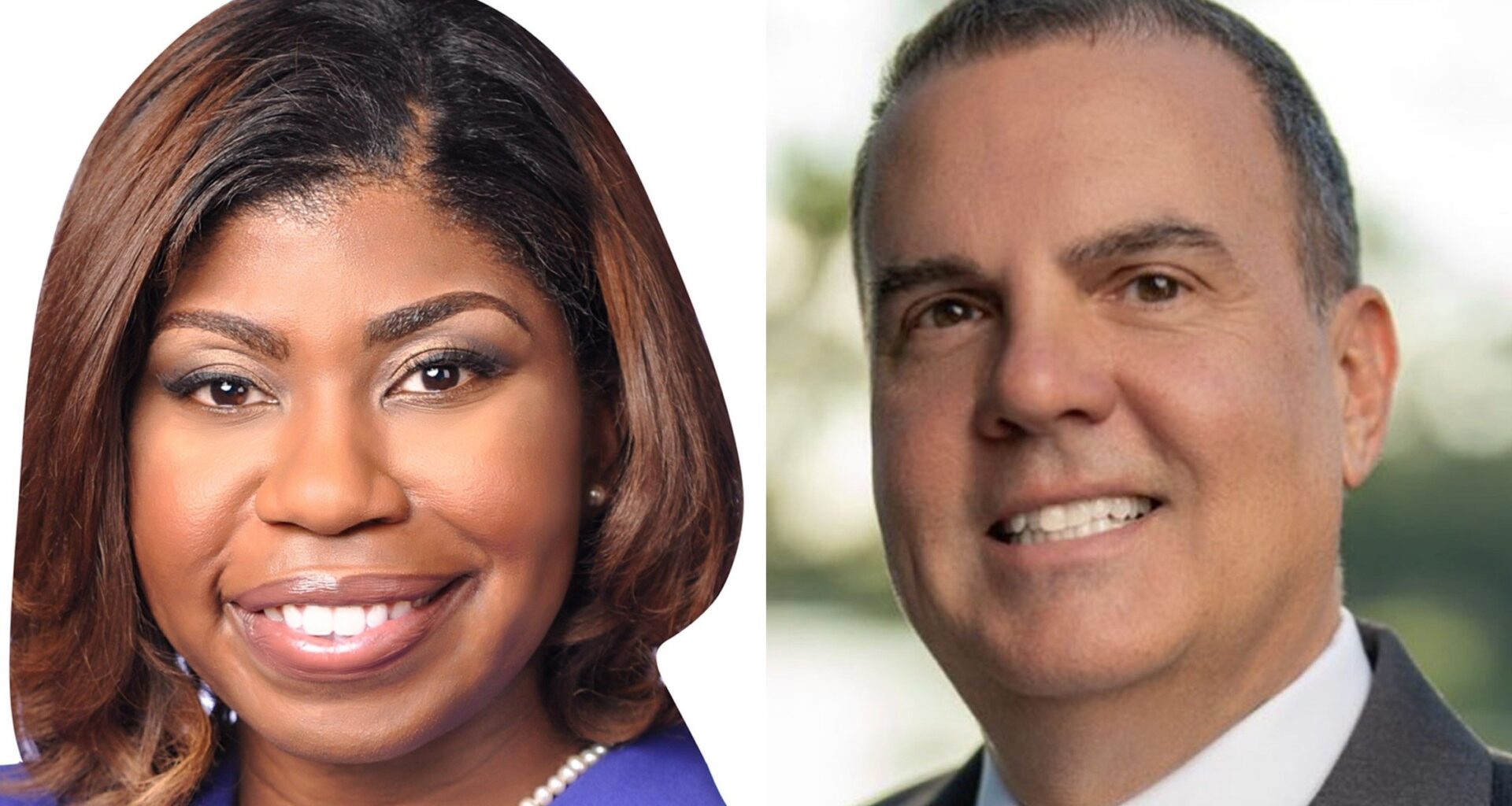
A former state legislator seeks to wrest the District 2 seat on the Orange County Board of Commissioners from the incumbent appointed just over two months ago by Gov. Ron DeSantis.
Former state Rep. Kamia Brown, a Democrat, will face Commissioner Mike Crabb, a Republican, in November to represent the northwest portion of the county. Commission seats are officially nonpartisan positions.
Crabb was tapped for the seat July 31 to fill a vacancy created three months earlier when two-term Commissioner Christine Moore resigned to run for mayor of Apopka, a contest she lost in an April runoff.
In the Aug. 18 primary, Brown won about 32% of ballots cast and Crabb got 25.6%, propelling them into the November runoff. Wes Hodge, a former Orange County Democrats, finished third with 19.5%; former Ocoee city commissioner George Oliver III took 15%; and family law attorney Marsha Summersill got 7.6%.
The district includes the communities of Apopka, Clarcona, Lockhart, Ocoee, Paradise Heights, Tangerine and Zellwood. Commissioners serve four-year terms and collect an annual salary of $135,000.
Brown was a legislative assistant before her election to the House in 2016 representing District 45, which covered most of northwest Orange. She served until 2022 when she lost a bid for state Senate in the primary.
In the House she was the ranking Democrat on the Workforce Development & Tourism Subcommittee and a member of the Health & Human Services Committee, Health Quality Subcommittee and Government Operations & Technology Appropriations Subcommittee.
Since leaving office, she continued work in health care advocacy and community development, first with Sunshine Health (a top Florida Medicaid provider), and now with the Foundation for Sickle Cell Disease Research.
Brown said she’d serve District 2 residents well, since she already represented much of the same area in the House.
“When you’re talking about constituent services and helping folks cut through the red tape, I’ve done that for a number of years,” she said. “I’ve always worked in a bipartisan manner there within the Legislature and was able to bring money home to the various cities.”
Crabb, who retired as a lieutenant after 30 years with the Orange County Sheriff’s Office and owns The Shirt Shop USA in Ocoee, said 20 years of owning a small business and decades in law enforcement are what set him apart.
“(The commission) needs some calm, common sense leadership with experience — especially from the business side,” he said.
One of the issues looming over the Nov. 3 election is Amendment 3, the statewide ballot measure that would raise the homestead exemption for those who’ve owned homes in Florida for at least five years.
The exemption would increase to $150,000 in 2027 and to $250,000 in 2028, with annual inflation adjustments ever after. It also halves assessment increases on non-homesteaded property to 5% a year, and calls on the Legislature to establish a way for local governments to repeal homestead taxes entirely if they choose.
Orange County expects to lose about $165 million in tax revenue in 2027 if it passes.
Brown said she opposes Amendment 3 because it’s a tax shift, not tax relief, and local governments will have to find ways to replace lost tax revenue — or cut services — if it passes.
Counties, cities and towns could be forced to consider options such as raising tax rates, imposing and increasing local fees or shifting a larger share of the tax and fee burden to renters, she said.
“If you’re wanting relief, if you’re listening to constituents who want relief, I think we have to do it in a way that is economically sound for all,” Brown said.
Crabb said he’s leaning toward voting for it, but his main concern is how it would impact spending on public safety — his top priority.
Fire Rescue gets about 86% of its funding from a dedicated fire-specific property tax, he said. It’s levied on residents living within unincorporated areas and municipalities that rely on the county for fire protection. The Sheriff’s Office gets about half of its funding from a similar tax levy.
Crabb said the county can offset decreased tax revenue for the Sheriff’s Office using the general fund, but that’s not an option with Fire Rescue because of the charter. He said he’s working with staff to find options.
“Something’s going to have to get cut, but I promise you it’s not going to be public safety,” he said. “My passion for not cutting public safety could overrule my passion for trying to get constituents tax savings.”
Among his other priorities are infrastructure, specifically roads, as well as protecting the rural boundaries and the impact of data centers.
“The county’s done a pretty good job of public safety, but they’ve done a pretty horrible job with infrastructure,” he said.
Crabb said the county is years behind on its road-paving program, with seriously dangerous intersections that haven’t been properly funded, adding that even some work in the planning stages is still five to eight years away.
Brown said her other priorities also include improvements to infrastructure and transportation, as well as affordable workforce housing and streamlining the county’s permitting process.
“It’s taking a little too long, and as we know, today’s price is not tomorrow’s price,” she said.
As of Friday morning, campaign finance information from the county supervisor of elections’ website shows Brown has raised $87,176.85 (with $920.72 from loans) and spent $65,004.18 while Crabb has raised $48,707.33 (no loans listed) and spent $33,691.43.
The election is Nov. 3. Early voting in Orange County begins Oct. 19.