
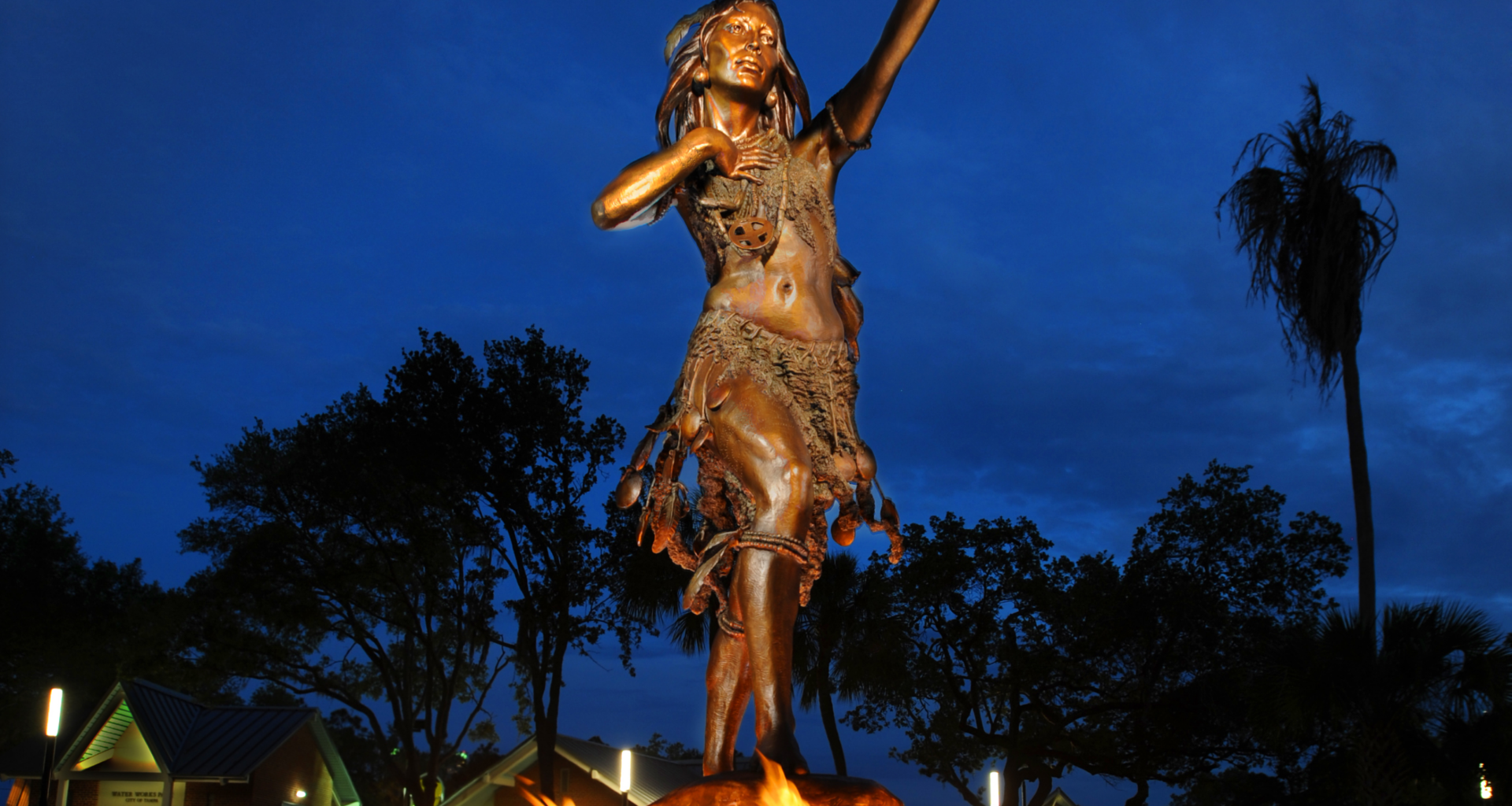
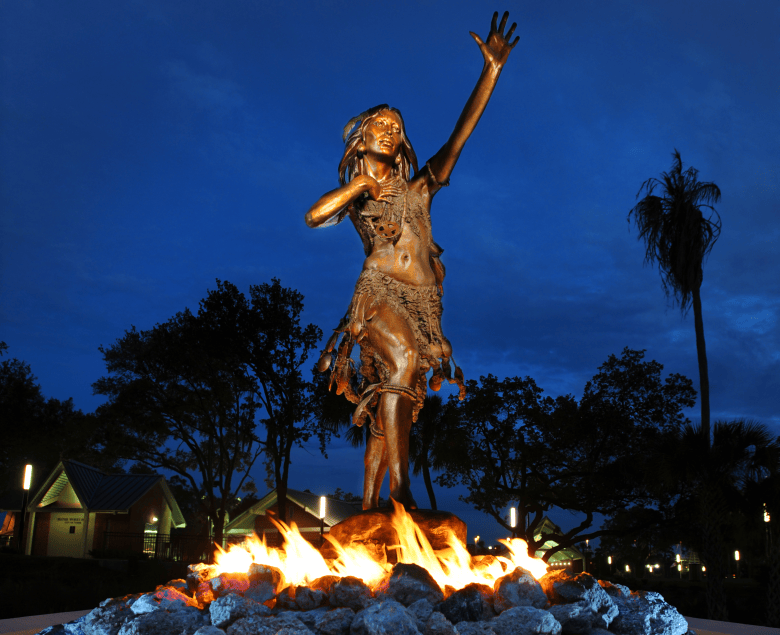
 ‘Princess Ulele’ by Vala Ola at Ulele in Tampa, Florida. Credit: c/o Ulele
Although “Princess Ulele” probably inspired the more famous tale of Pocahontas, she may have never actually existed, probably wasn’t a princess, and certainly did not go by the name “Ulele.” This month, as we reflect on Columbus and the Indigenous peoples of the Americas, it’s worth reflecting on what we get right and wrong—and what we can never know for certain—about Tampa Bay’s most famous Indigenous woman.
Historical evidence for Princess Ulele’s existence is ambiguous.
The woman we know as “Ulele” is mentioned in only two of the five firsthand (or partially so) accounts of the expedition of Hernando de Soto, which landed in Tampa Bay in 1539. One of these was written anonymously by the “Gentleman of Elvas” (a survivor of the failed expedition) and the other by Garcilaso de la Vega (who interviewed other survivors). Both described finding Spaniard Juan Ortiz, a member of an earlier Spanish expedition who had been captured by a chief known as “Ucita” (Vega, who is considered less reliable, recorded the chief’s name as “Hirrihigua”—probably in confusion with another chief). Both also describe how the chief had ordered Ortiz to be burned alive, and how the chief’s daughter intervened to spare Ortiz’s life. However, a few historians have speculated that Elvas (or his publisher) may have invented the girl’s rescue of Ortiz for dramatic effect; tales of corsairs imprisoned by Moors—sometimes Moorish women—in North Africa were beginning to appear in Europe around this same time. Still, most historians consider Elvas a reliable source, given that many of the details he provided are consistent with other sources.
Princess Ulele has been called ‘The Pocahontas of Florida‘ but the reverse is probably more accurate.
Several historians have pointed to evidence that Jamestown leader John Smith plagiarized the story of Juan Ortiz’s rescue by a Native woman of Tampa Bay to create the tale of his own salvation at the hands of Pocahontas. First, the story of Smith’s near-execution appears only in the last of his four accounts of Jamestown, published in 1624—a few years after Richard Hakluyt printed the first English translation of Elvas. Smith is known to have been an admirer of Hakluyt, so he likely read the Ortiz story. Finally, Smith told the tale of his rescue only after the deaths of Pocahontas and other potential witnesses to the scene.
The modern popularity of Princess Ulele’s story began with a romanticized re-telling by Theodore Irving in 1835.
Theodore was the nephew of Washington Irving, famous for his short stories “Rip Van Winkle” and “The Legend of Sleepy Hollow”—classics of American Romanticism. But Washington Irving is also famous for his 1828 biography of Christopher Columbus—a work scholars today generally regard as deeply flawed. A number of historians have cited romantic portrayal of Columbus as providing justification for Indian Removal. Theodore, following his uncle’s approach, romanticized de Soto at a time when the US government was engaged in a costly and unpopular war with the Seminole and Miccosukee peoples for control of the Florida territory (one scholar has noted that he used the word “savage” 139 times in his descriptions of Indigenous peoples). Newspapers of the day often reprinted excerpts from Irving’s de Soto biography with the drop heading “Some Spaniards taken prisoners were condemned to die by the Indians”—ignoring or minimizing Spanish mistreatment of Native peoples.
The name ‘Ulele‘ was a late addition to her story, invented for a 1858 biography of de Soto by little-known writer Lambert Wilmer—probably as a tribute to his friend and fellow satirist Edgar Allan Poe.
Wilmer and Poe were personally and professionally entangled; among other bonds, they shared a distaste for the jingoism of many of their contemporary writers and politicians. Poe satirized not only Andrew Jackson and the war against the Indians of Florida, but also the romanticism of Washington Irving and other nationalist writers of the day. Lambert seems to have followed Poe’s example; in the preface to his de Soto biography, he criticized Theodore Irving and other romantic historians for their sloppiness with the facts. However, his subsequent embellishments of the story are so exaggerated that, with the benefit of hindsight, they plainly read as a satire in the style of Poe. Lambert’s coining of the name “Ulele” probably draws not only from Poe’s general tendency toward alliteration, but specifically from two of Poe’s love poems: “Eulalie—A Song” and “Ulalume—A Ballad.”
Ulele may or may not have been the chief’s daughter, let alone a ‘princess.‘
Wilmer, in his satirical version of the story, was the first to refer to the girl as an “Indian Princess”—Elvas described her only as the chief’s daughter. But in any case, it’s important to bear in mind that Europeans had a poor understanding of Indigenous kin relations. Some of the Native peoples of Florida, such as the Timucua, appear to have traced descent matrilineally; in these kin systems men are usually considered more closely related to their sister’s children than their own offspring. Other Native societies, such as the Calusa, may have reckoned kinship through the male line. The Spanish probably simply assumed that Ucita and his people, like themselves, were patrilineal. Thus, we can’t be sure if the girl was Ucita’s daughter or niece, let alone if the chief and others of the tribe considered her as his potential successor.
The fate of the people of Ucita is unknown—the name does not appear in any subsequent historical records—but this does mean they ‘disappeared.‘
De Soto and his men killed or enslaved hundreds of Native peoples in their few short months in Tampa Bay. However, the Spanish also became frustrated that Ucita and other Indigenous groups in the region were so adept at resisting capture. In the wake of de Soto, Ucita and his people may have retreated to areas of the Florida peninsula well removed from Spanish colonizers. Alternatively, they may have been absorbed or adopted by other Native groups in Tampa Bay, such as the Tocobaga.
In the past, many anthropologists and historians have been skeptical of connections between Ucita, Tocobaga, and other 16th-century groups and the Native American tribes of modern Florida—but this has changed dramatically in recent years.
Today, many scholars recognize that the Seminole and Miccosukee formed through the coalescence of migrant Creek Indians with Indigenous groups who had resided on the Florida peninsula for many years—consistent with the contention of the modern tribes that their ancestors had lived here for millennia. Modern tellings of the story of Ortiz and “Ulele,” by ignoring these historical connections, perpetuate the notion that groups like the Ucita “disappeared.”
Richard Gonzmart and his namesake restaurant Ulele are arguably an exception. By consulting with members of the Seminole Tribe of Florida in the naming of the establishment and the erection of statues in the girl’s honor, Gonzmart tacitly acknowledges connections to modern descendant communities. Others who invoke the name and story of “Ulele” should consider doing the same.
Tom Pluckhahn is a Professor of Anthropology at the University of South Florida. His article “Larger Than Life: The Legend of ‘Princess Ulele,’ the ‘Pocahontas of Florida’” appears in the forthcoming issue of the journal ‘Ethnohistory.’
This article appears in Oct. 08 – 14, 2026.
Related