
Some Broward legislators say they may not be able to repeal a controversial law that allows charter schools to co-locate on existing school campuses, but they do think they can blunt the impact to school districts.
The new law allows special charter schools known as “Schools of Hope” to occupy space rent-free at traditional schools. It was a major area of discussion during a joint meeting on Monday between the Broward School Board and Broward legislators. Most Broward legislators are Democrats and opposed the law, which was championed by Republicans in the supermajority.
School districts are expected to get numerous applications this week from charter school providers who want to operate schools of hope. The program created major concern and confusion from school leaders in Broward and throughout the state.
One provider, Mater Academy of Miami, has already made numerous requests, although most school district officials say the application window doesn’t open up until this week. In Broward, the requests include A-rated campuses that are nowhere near a low-performing school as well as on campuses of special needs and vocational schools where district officials say there is no room.
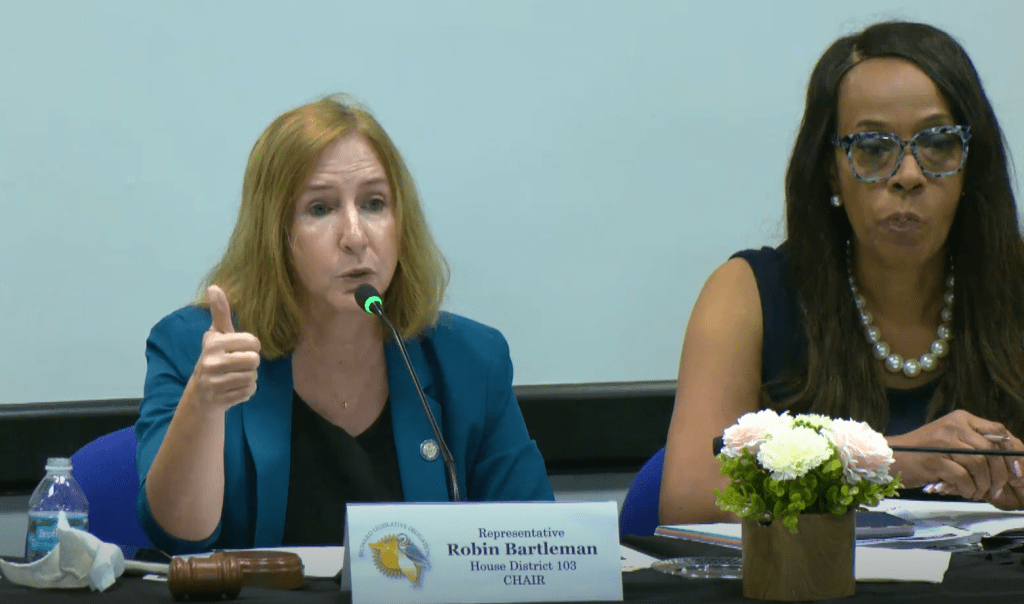
State Rep. Robin Bartleman, D-Weston, said she’s been talking to school boards throughout the state, including ones controlled by Republicans, and most agree that the law is unmanageable as it’s currently written. She said she thinks Republicans in the Legislature will be willing to make changes.
“Everyone knows guardrails have to be put in place,” Bartleman said. “I don’t think there’s going to be a repeal. That’s just my opinion, but I think they’re going to find a way to make it work.”
The program started in 2017 for high-performing charter schools to serve students in failing schools, but the criteria has been expanded so dramatically that critics say schools of hope can operate just about anywhere a school is listed on a state report as having extra seats.
One legislator, Sen. Daryl Rouson, D-St. Petersburg, has filed a bill trying to get the most controversial part of the bill, co-location, repealed.
“Constituents and stakeholders from across the state have reached out to my office with concerns about the overly broad Schools of Hope program,” Rouson said in a release from the group Florida Coalition for Thriving Public Schools. “By eliminating language requiring co-location in public schools, we are ensuring schools do not face the unintentional consequence of an unfunded mandate, and that students can continue thriving in their schools without losing access to spaces they need for academic success.”
State Sen. Rosalind Osgood, D-Fort Lauderdale, said she is co-sponsoring the legislation. She said the schools of hope program has raised a lot of concerns, including security and liability. Like Bartleman, Osgood is a former Broward school board member.
“If something happens on the campus with a student that’s attending the schools of hope program, who’s going to get sued?” she asked. “We know the district gets sued for everything. I think that there are a lot of things from an implementation perspective that we don’t oftentimes think about in Tallahassee.”
Bartleman said there are many other concerns. In addition to requiring the schools of hope to locate rent-free, school districts are also required to provide custodial, maintenance and cafeteria service without charge.
She asked Broward school officials to provide legislators with a list of likely expenses, including I.D. badges, additional janitorial staff and extra security. Schools Superintendent Howard Hepburn said he would provide that.
Bartleman said charter high schools operating as schools of hope are allowed to locate on elementary campuses. The schools can operate year-round, even if the main school operates during a traditional calendar, she said. Charter schools can operate on campuses such as special-needs schools where a state list says there is room but are actually full due to the way they use the space, she said.
She said the law doesn’t address what to do if charter schools request space that the district already has plans for, such as leasing it to a nonprofit or using it for office space.
Bartleman referred to an unusual request in Hillsborough County. A state report for Kenneth E. Adum Pre-K Magnet School in Hillsborough stated all 1,671 seats were empty, so Mater requested them all. But the school just opened in 2024, and the calculations were taken before it had any students. The school actually has about 1,000 students.
Broward School Board member Rebecca Thompson, who represents the southwest part of the county, said many parents and administrators in her area are confused about how schools of hope will work. She said it’s been a major topic during recent meetings she’s had about possibly closing or repurposing schools.
“The community doesn’t know and doesn’t understand, so any advice you guys could give us on how to mobilize and how to explain it in a way that they understand would be appreciated,” she said.
Bartleman said there are already charter schools co-locating on district campuses outside the schools of hope program, and school districts are allowed to charge them for expenses.
“That’s why schools of hope came out of left field, because (co-locating) is not something new,” she said. “What’s special about the schools of hope is they’re getting everything scot-free.”
Adam Cervera, the only Republican on the Broward School Board, told legislators he agrees the law probably needs some changes, but he thinks the concept can still work.
“I have all the confidence in the world that you guys, in conjunction with local school board members and other elected officials, will get this right,” Cervera said. “I think what’s important right now on this matter and all matters is this district will follow the law whatever that may be, until it is changed.”