

Principal Darlene Lebo’s phone rang nonstop Monday, and her email inbox filled up, all with people wanting to know one thing.
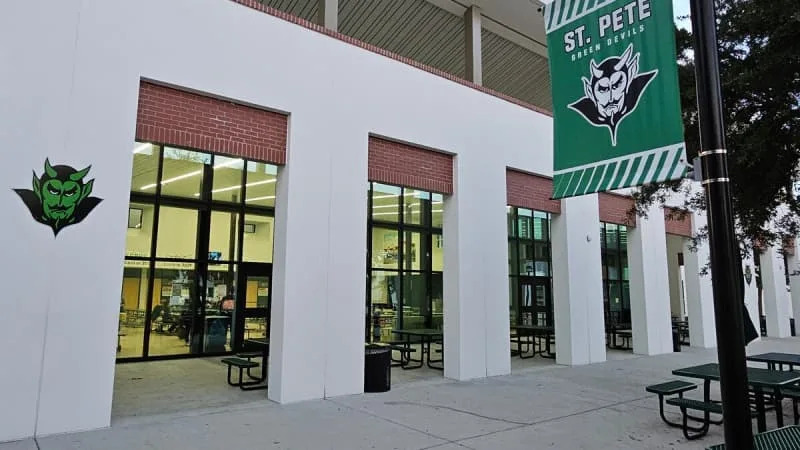
Was there really a proposal to dump the Green Devil, a symbol of St. Pete High School since the 1920s, in favor of a Pelican?
“She said it was true,” said Lisa Day Walker, Class of 1984, who made one of those calls.
Walker put a post on Facebook urging alumni to attend the school’s 6 p.m. advisory committee meeting, where the idea would be discussed. She wasn’t alone, as several school-related organizations took to social media asking Green Devils to unite in support of their shared history.
“St. Pete people love their Green Devils,” Lebo said.
More than 200 current and former students showed up, many decked out in green and white, for what Lebo said was the school’s best-attended advisory committee meeting that she could recall.
They didn’t face much of a fight.
Parent R.J. Garbowicz, who asked about replacing the Green Devil with a “less divisive” mascot, didn’t come to make his case. Each speaker who addressed the committee rejected the idea that the Green Devil carried some sacrilegious connotation.
“Our devil doesn’t represent the actual devil,” senior Daniela Julian said. “It represents spirit.”
Rui Frias, a former teacher and soccer coach, said he and his staff at the St. Petersburg Museum of History researched the origin of the mascot and found it had “nothing to do with religion or Satan.”
Rather, he said, the story was that an underclassman on the football team returned a kickoff for a touchdown, prompting the announcer to shout, “Look at that little green devil run.”
The St. Petersburg Times first referred to the team as the Green Devils in late 1920, he said, and the community has done so ever since.
Over time, senior Rafael Faraci said, the mascot has come to represent unrelenting dedication to service, and a strong school community.
“The impact of our mascot cannot be understated,” he said.
He and other speakers mentioned “Mr. Green Devil” Bob Pfeiffer, an ardent school booster who regularly dressed the part until his death, as the epitome of what’s good about the mascot. Pfeiffer’s grandson Nick Hansen, Class of 2000, said his grandfather — who led fundraisers for the school and helped preserve its history — wouldn’t have wanted the discussion to be about him, but rather about the school, community, students and staff.
“It’s a great stress test to see everyone come together to rally behind a symbol that is more than a cartoon character,” he said.
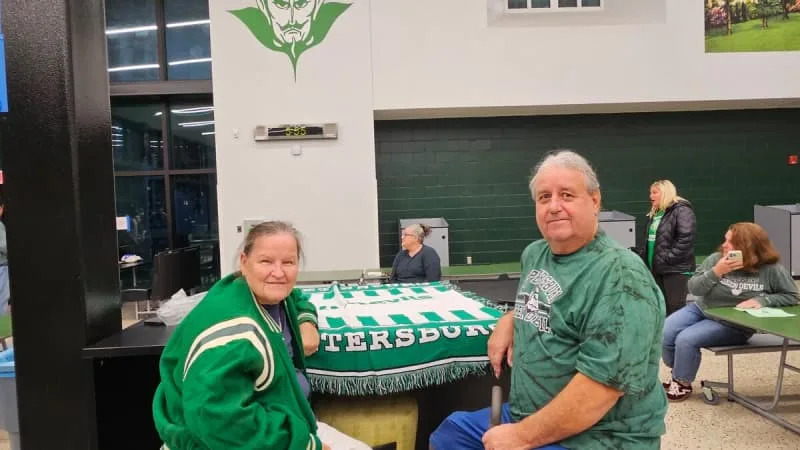
Barbara Melander Keller, Class of 1974, was the last speaker before the committee. She led the crowd in singing the alma mater.
After the applause subsided, Lebo took the microphone.
“It is my opinion we do not need to move forward any further,” she said to more cheers.
Junior Kelly Fuss, a committee member, said she was thrilled, but not surprised, with the outcome.
The meeting had the potential to become dramatic and messy, Fuss said. Instead, it showed the school’s unity.
“I think this is symbolic of how much this school means to everyone,”she said.
Jeffrey S. Solochek is a reporter covering education as a member of the Tampa Bay Times Education Hub. You can contribute to the hub through our journalism fund by clicking here.