
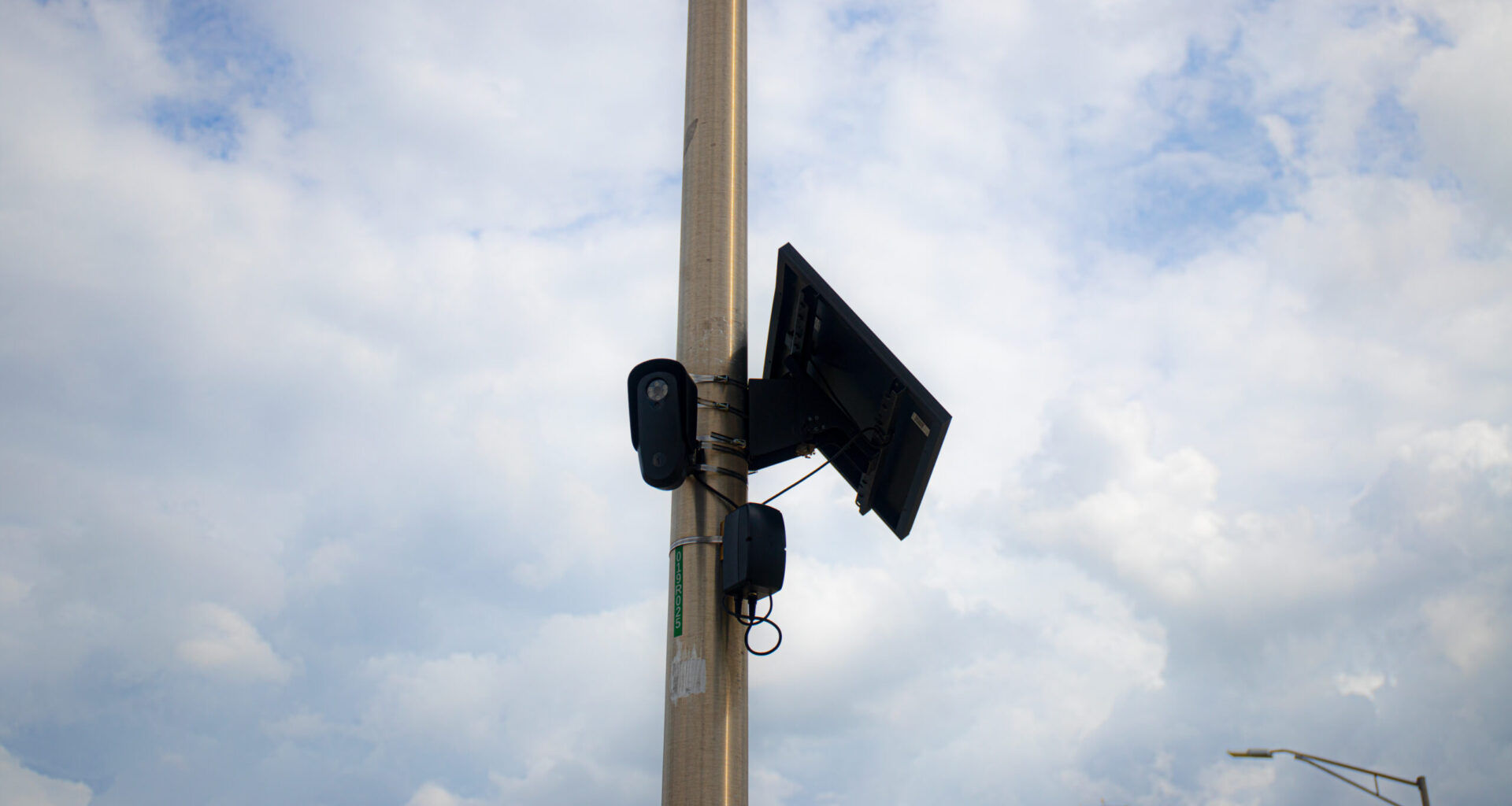
 USF is following the herd by keeping Flock and other automatic license plate reader cameras on campus, but this surveillance could bring more harm than good. ORACLE PHOTO / THOMAS MARRS
Last month, a Florida woman was jailed for 13 days after a Flock Safety automatic license plate reader (ALPR) incorrectly matched her license plate to a car responsible for a hit-and-run in 2025, according to Fox 13 News.
The same technology involved in this incident is now also installed across USF’s campus.
These systems use cameras to continuously capture vehicle license plate information and create records of vehicle activity, according to the Department of Homeland Security.
Like many other law enforcement agencies, USF uses Flock and other cameras to locate stolen vehicles, assist with missing persons cases and generate investigative leads, according to USFPD’s Public Information Officer Larry McKinnon.
“Access to this technology is limited to trained law enforcement personnel, and its use is governed by internal policy,” said McKinnon. “The privacy of our community is something we take seriously.”
While this has potential to increase security on campus, this technology also infringes on student privacy by expanding surveillance that can track their whereabouts across locations.
However, these privacy concerns don’t just surround USF’s use of this technology, but the companies behind it.
ALPR cameras, often referred to as “Flock cameras” after leading company Flock Safety, have become the subject of ongoing debate about privacy, surveillance and law enforcement practices.
RELATED: USF police confirm license plate cameras on campus, students raise privacy concerns
Despite existing for over two decades, usage of this technology has increased as it continues to become more accessible and advanced.
Recent innovations in artificial intelligence (AI) technology also allow these cameras to detect more information like specialty tags, bumper stickers or even dents on a vehicle, according to the Department of Homeland Security.
A 2024 Congress report found that nearly 90% of sheriffs’ offices with 500 or more sworn deputies reported using ALPR technology.
Congress also states in a 2025 report that a warrant is not required to access information from this technology.
When asked, McKinnon said that the official number of cameras on campus is confidential under Florida law.
Crowdsourced maps like DeFlock report over 20 potential cameras surrounding USF’s Tampa campus.
This could mean over a dozen cameras with information that could be accessed by law enforcement without a warrant.
Multiple cases this year demonstrate the risks that arise when this technology falls into the wrong hands.
On Aug. 26, a police officer in Kentucky was arrested for allegedly using Flock cameras to track his ex-girlfriend’s license plate over 2,000 times, according to CNN.
Two weeks later, a similar incident was reported by ABC News when an investigator in New York allegedly used Flock cameras to track four acquaintances and an ex-girlfriend.
These cases expose a weakness that cannot be solved by simply trusting law enforcement to use the technology responsibly.
Although USFPD’s intentions may be to create a safer environment on campus, this doesn’t mean ALPR systems like Flock are the right tool to reach that goal.
If USF cannot demonstrate that this level of surveillance meaningfully improves campus safety, students should have the right to question if it is necessary.
RELATED: Waymo launches driverless rides in Tampa, USF students share concerns
This issue extends far beyond just Tampa. In 2025, Wired reported an incident of footage from Flock cameras being sent overseas to workers in the Philippines to improve upon the technology’s AI capabilities.
This footage not only contained license plate and vehicle information, but also detected people and specific details like what they were wearing.
This article also reports that some Flock patents even mention the ability to detect gender and race.
Surveillance on campus doesn’t guarantee safety. And these cases go to show that it definitely doesn’t guarantee privacy, either.
Still, Flock doesn’t have to be our future. Changes are already being made as backlash continues to grow.
On Aug. 31, the Florida Department of Transportation (FDOT) issued a memorandum revoking permits for all existing ALPR systems installed on highway rights-of-way.
This is just one step in the right direction.
The FDOT’s decision shows that the expansion of automated surveillance does not have to be treated as inevitable. But it doesn’t resolve concerns surrounding the systems that remain in use, including those on college campuses.
USF should take this opportunity to review its own use of the technology instead of waiting for lawmakers or a privacy violation to initiate the conversation.
Flock’s polished website markets these cameras as a product to create “safer communities” for the public.
Yet when citizens in Florida are wrongfully accused of a crime due to a misread license plate, this definition of “safety” becomes uncertain.
Students might not be able to opt out, but we can speak up. It is more crucial than ever to urge the USF administration to be publicly transparent about what data is being collected and how it is being used.
Creating a safer campus is an important goal, but it should not come at the cost of making third-party surveillance tools part of everyday life for students.