
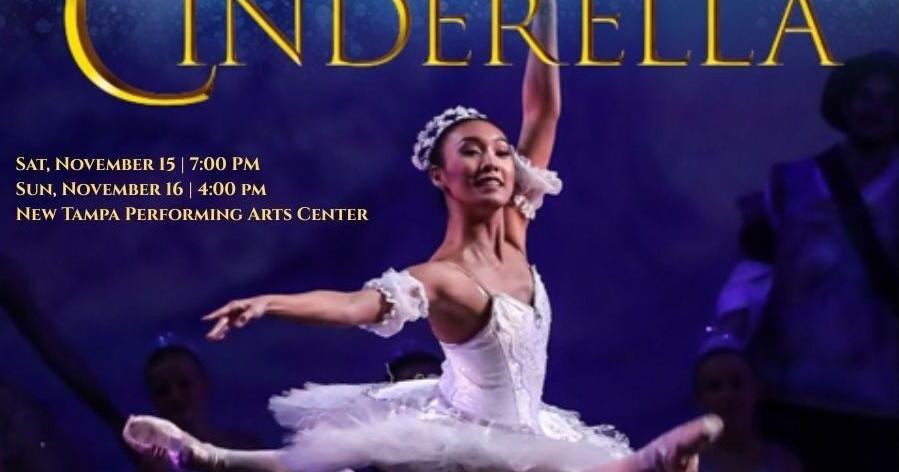
The upcoming season of Tampa City Ballet will present “Cinderella” on Saturday-Sunday, Nov. 15-16, at the New Tampa Performing Arts Center. The production, directed by Venezuelan choreographer Paula Núñez and featuring Cuban dancer Marta Ortega as the stepmother, offers a contemporary interpretation of a classic that transcends the stage and connects with the daily lives of the Hispanic community.
Núñez explained that this story, adapted for today’s audience, preserves the essence of ballet while keeping spectators engaged through a modern and visually dynamic performance. “Cinderella is a beautiful story for the whole family. At Tampa City Ballet, we have two programs dedicated to children and families. This time, we wanted to bring a shorter version adapted to the 21st century,” said the Venezuelan director.
Ortega, who trained as a dancer in Cuba, said her role represents a different kind of challenge.
“I had never had the chance to play the stepmother. It’s a character that allows you to improvise within the boundaries of ballet and create your own version. For me, it has been a tribute to my Cuban grandmothers — their strong character and the way they corrected us,” she said. The artist added that her experience as an interpreter has allowed her to play with improvisation and enjoy the spontaneity of the role.
A universal language
This production includes no spoken dialogue; everything is conveyed through movement and expression. Núñez emphasized that dance remains a universal language.
“It’s the most wonderful thing because it unites us. Nowadays we need to communicate beyond words,” she said.
Ortega agreed that body art breaks down barriers. “Dance comes from primitive times, when people could communicate without words. It doesn’t matter if you speak Spanish, Japanese, or English, you can still understand and enjoy it.”
That diversity also emerges during rehearsals. “Sometimes ideas come quickly, and we end up speaking in Spanish. The American dancers already understand what we’re saying. It’s become part of the creative process,” Ortega explained.
The cast of this version includes artists from various countries including Cuba, Venezuela, the United States, Russia, and the Netherlands. Núñez believes that mix gives the company its identity. “It enriches us. Everyone brings a different story, and that blend of styles defines the character of Tampa City Ballet,” she said. For Ortega, this diversity is a constant learning process. “The company aims to make every show an experience. Today’s audiences want to feel something beyond just watching a performance. That’s why we integrate digital elements, mapping, and new visual forms.”
A modern Cinderella
The stage design features digital scenery created by Colombian professor Santiago Echeverry from the University of Tampa, who collaborates with Núñez on animated backgrounds and visual effects.
“We want the audience to enter a different dimension. The seasons change color, and each one brings Cinderella a gift. It’s both a visual and emotional journey,” Núñez explained. Ortega added that the costumes and music were designed to engage modern audiences. “The company strives to make every piece a sensory experience. Life moves faster now, and children have shorter attention spans. So we reinterpret the classics without breaking their essence, allowing both kids and adults to enjoy them.”
Núñez said this will be the third time Tampa City Ballet performs Cinderella. The first was in 2017 and the second during the pandemic, when the company offered parking lot performances as a way to reconnect and lift spirits. This new edition stars Nicole Azat as Cinderella and Cuban dancer Brian González, Ortega’s husband, as the prince. “We want this production to become a tradition in Tampa, where families begin the holiday season by attending a ballet that everyone can enjoy together,” the director said.
Beyond the stage
For Núñez and Ortega, the story of Cinderella serves as a metaphor for the immigrant experience. “Hispanics are resilient Cinderellas. We come to this country to work, to move forward, and to show what we can achieve through effort,” Ortega said. The dancer recalled that many artists migrate after building successful careers in their home countries. “In Venezuela and Cuba, there are professional ballet companies in every city. In Tampa, we still don’t have that structure. It’s difficult to build from scratch, but we keep working toward establishing a stable professional company.”
Núñez added that Tampa City Ballet is pursuing that goal through initiatives such as the Friends of TCB program, which will launch in the coming days. “If we can gather 100 sponsors in 100 days, we’ll be able to maintain four full-time dancers. We need that support to solidify an artistic foundation in the city.”
Both artists agree that dance can drive cultural growth. “Art transforms. In Cuba, ballet reached even the most remote towns and inspired generations. Here in Tampa, it can do the same if given the right support,” said Ortega. Núñez highlighted ongoing collaborations with local institutions such as the New Tampa Performing Arts Center and the Tampa Museum of Art, where they’ll present a new project in December alongside Japanese American artist Jun Kaneko.
Reflecting the community
The parallel between Cinderella and the Hispanic immigrant experience is evident in every movement. “Cinderella works, cleans, starts over. That’s who we are in the Hispanic community. Sometimes we feel like we don’t fit in, but we keep trying until the shoe finally fits,” Núñez said. Ortega added that many face similar challenges. “We’ve all had stepmothers, symbolically speaking, who don’t let us shine. But when we hold on to discipline and kindness, good always prevails.”
The director said the play’s main message is hope. “No matter how hard life gets, there’s always a door that opens. The shoe will always find its rightful owner. You can’t lose faith or stop dreaming. That’s what Cinderella teaches: to believe with kindness and integrity and to keep working until your dreams come true.”
For Ortega, the key for immigrants who succeed lies in perseverance and authenticity. “You have to put on your shoes, shine, persevere, and keep dancing,” said the Cuban performer. Meanwhile, Núñez emphasized her invitation to Tampa Bay families to come and enjoy the performance. She believes that with the support they’re seeking, the company can continue improving its cultural offerings and ensure the continuity of projects that bring the community together. “The arts can save people from loneliness and anxiety. They can offer hope. Anyone who can’t attend for financial reasons can contact us. We want the arts to be accessible to everyone.”
In the end, the story of Cinderella reminds the Hispanic community that dreams never fade; they simply wait for the right moment to put on the shoe and move forward. Every effort, every overtime shift, and every obstacle overcome form part of the ongoing reinvention that turns the pumpkin into a carriage. Perseverance, empathy, and faith remain the true magic wand of a united community that, in most cases, arrives in this country performing modest jobs and, through resilience, moves beyond them — studying, progressing, and building their own businesses. Because just like in the fairy tale, there will always be a kingdom to build when people work with purpose and pursue the shared dream of the common good.