
If you were to randomly choose a person living in Central Florida in 1876, they might have been a farmer putting his hopes on the fledgling citrus industry, a rugged cattleman roaming the ranges, or a townswoman walking the dirt streets of the tiny Orange County settlement of Orlando.
They also lived amid a fast-growing population. Orange County, which included much of what would later become Osceola, Lake and Seminole, was on track to reach 6,618 people recorded by 1880, triple its headcount a decade earlier.
While demographic breakdowns were not nearly as specific then, most residents were white with only about 15% — or 1,023 people — listed as being “colored.”
If those 1870s residents could see how Central Florida has changed in the past 150 years, it would be unrecognizable.
Newcomers from all corners of the world have set down roots, driven by a mix of politics, a search for refuge and economic necessity. Population booms turned the region into a multicultural hub, with Latinos — most prominently, Puerto Ricans — making up the largest share of new Central Floridians.
But over the decades, the promise of opportunity and dreams of a new life came amid periods of terror and discrimination for many, particularly Black people and immigrants. This was often downplayed and tolerated, if not supported, by area institutions and businesses, including the Orlando Sentinel and its predecessors.
Between clashes with Jim Crow and the Ku Klux Klan from yesteryear to modern uprisings against social injustice, the area’s transformation is not linear but veers toward progress.
This is not an exhaustive history of the many people and cultures who have made Central Florida home, but a series of snapshots showcasing struggle and excellence, hate as well as hope.
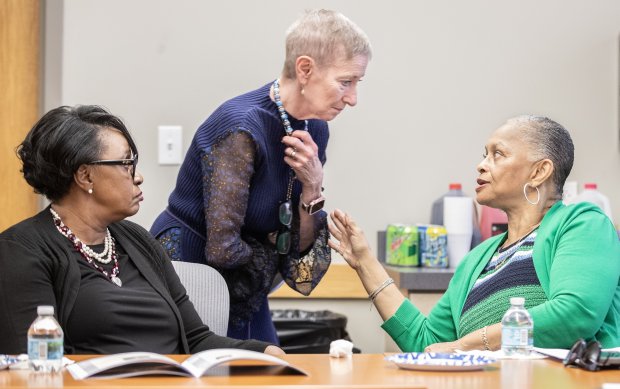 At a 2023 workshop on the making of the “Oscar Mack vs. The Ku Klux Klan,” Mack’s great granddaughter, Vanessa Bonner, left, listens as Renee Bronson, middle, the great granddaughter of KKK member Stewart Ivey, speaks with Juanita Lesesne, right, a descendant of one of Osceola County’s most prominent families. (Orlando Sentinel file)
Trailblazers and difference-makers
Juanita Lesesne’s family history sits at the nexus of two of Osceola County’s legendary Black pioneers.
She is the granddaughter of Scipio Lesesne, a Barbados-born son of slaves whose knack for learning languages — he spoke at least five — made him indispensable as the foreman of a sugar plantation located in what is now St. Cloud in the 1880s. The following decade, he moved his family to Kissimmee and began farming 100 acres on what would someday become the Kissimmee Gateway Airport.
She is also the great-niece of Lawrence Silas, whose father, Tom, started a ranch near what is today Kenansville in the years after the Civil War. A legend in his own right, Lawrence went on to own 3,000 acres along the St. Johns River, solidifying his father’s legacy while paving a way of his own.
Beyond being agricultural giants, they were considered de facto liaisons between Osceola’s Black and white communities at a time when Jim Crow reigned.
The two families joined with the marriage of Malinda Silas and William Harleston Lesesne, better known as “Buster.” It’s a heritage their daughter, Juanita, has spent decades preserving with a collection of records and family stories.
“Before my dad came of age, they were probably the two most respected men in the community, and maybe even the county,” Lesesne said.
Elsewhere in Central Florida, Jonestown, a community of freed slaves, became Orlando’s first Black neighborhood in 1880, with Hannibal Square in Winter Park following suit in 1881.
Meanwhile, Eatonville, founded in 1887, was in its early years as the first all-Black incorporated municipality in the U.S., while Goldsboro was established just four years later by the Freedmen’s Bureau.
For many decades, Black Floridians were segregated but still flexed their political muscle. Scipio Lesesne was Osceola County’s first Black voter, and his son Buster was a political insider, working on the campaigns of three Democratic governors and an invitee to Gov. Bob Graham’s second inauguration in 1983.
By then, Central Florida had seen many political firsts. Arthur “Pappy” Kennedy became the first Black man on the Orlando City Council in 1973, while Alzo Reddick of Orlando was the first elected to the Florida Legislature post-Reconstruction in 1982. Two years later, Mable Butler became the first Black woman on the Orlando City Council, later becoming Orange County’s first Black commissioner in 1990.
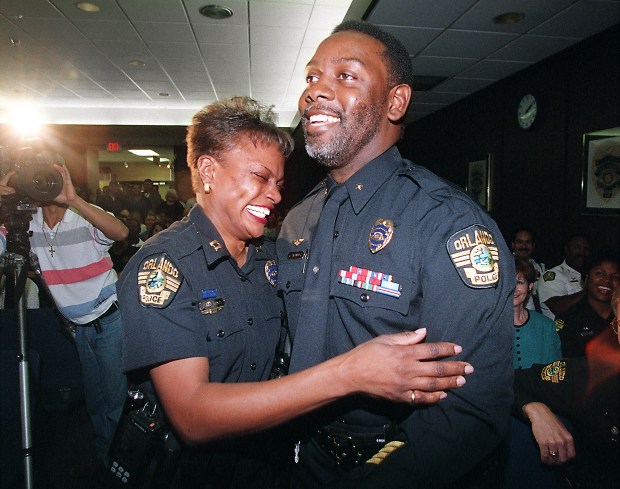 Jerry Demings gets a hug from his wife, Capt. Val Demings, after being named Orlando’s first Black police chief in 1998. Val Demings would later become the department’s first woman chief. (Orlando Sentinel file)
More recently, Jerry Demings, Orlando’s first Black police chief and Orange County sheriff, was elected the county’s first Black mayor in 2018.
George Oliver III also became Ocoee’s first Black commissioner that year — decades after the city, which expelled its Black residents a century earlier, ceased being a “sundown town.”
Author James Loewen wrote that many whites-only towns got the name from the unspoken — or sometimes, overt — warnings that Black people shouldn’t let the sun set on them within city limits.
In 2024, Jennifer Paul, a fourth-generation Osceola County resident, became the first Black member of St. Cloud’s city council. One of her first acts was to issue a proclamation acknowledging St. Cloud’s own dark history as a sundown town.
“We’re a diverse community, and no one should be be afraid to come to St. Cloud,” Paul said.
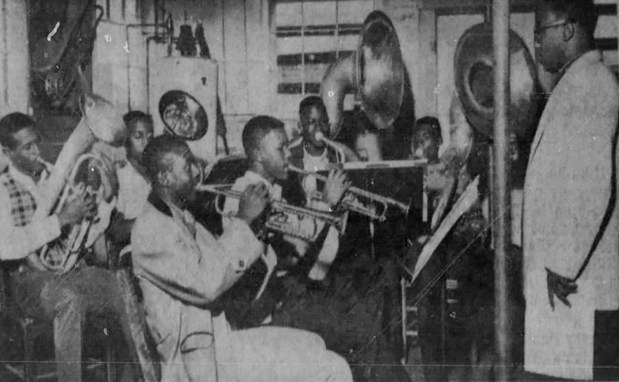 A 1965 photo of the band at the segregated Kissimmee High School in Osceola County. (Orlando Sentinel file)
Desegregation, terror and attempts at reconciliation
As a girl, Juanita Lesesne grew up around Black royalty inside her family’s Brack Street home. It was not uncommon for figures like Zora Neale Hurston and Hank Aaron to swing by, just two of the high-profile connections her father made over the years.
Lesesne attended the all-Black Kissimmee High School until 1965, when she transferred to Osceola Junior High School as part of a “voluntary integration” effort. Kissimmee High School closed in 1967, and Central Avenue Elementary School sits on the property where it once stood.
While she did feel the racism from the white students and adults at her new school, they knew who her father was.
“They didn’t treat me as an equal, but they treated me better than they did most of the kids,” Lesesne said.
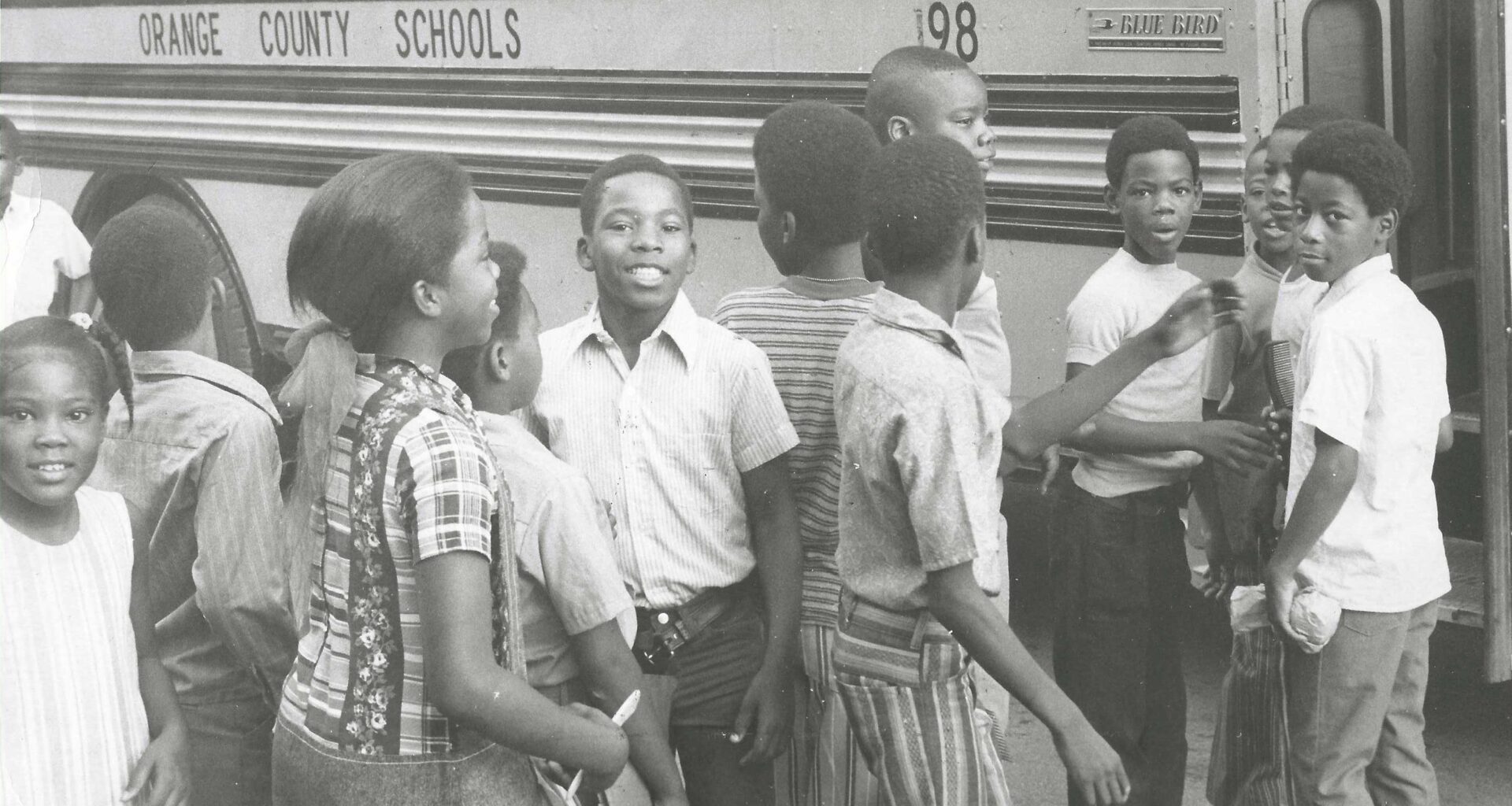
Though the 1954 Supreme Court decision in Brown v. Board of Education mandated school desegregation, many Central Florida counties struggled to comply. In Orange County, that led to a 1962 lawsuit that placed it under federal oversight until 2010, when a judge ruled the school district phased out any remnants of segregation.
Similarly, Seminole County was sued in 1970 after it failed to integrate. It wasn’t until 36 years later, after following a plan to renovate Seminole’s mostly-Black schools, that federal oversight ended.
In contrast, Lake County schools integrated by the 1970-1971 school year, but not without immense pressure by federal regulators to either desegregate or face massive funding cuts. Osceola County schools, meanwhile, were considered desegregated by 1966.
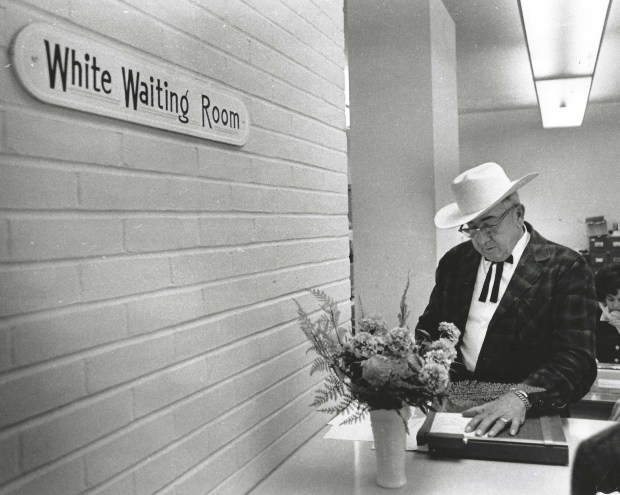 In this 1971 photo, notorious Lake County Sheriff Willis McCall stands next to a formerly segregated waiting room. (Orlando Sentinel file)
Outside the schoolhouse, the Civil Rights Movement reached a fever pitch in the 1950s and ’60s. Goff’s frozen custard stand on Orange Blossom Trail was bombed by white criminals offended that it served Black and white customers at the same counter.
In 1960, sit-ins led by Jones High School students disrupted segregated businesses and lunch counters. The following year, Black people attempting to use the beach at Orlando’s Lorna Doone Park prompted city officials to respond by closing it down.
While it flew under the radar nationally, the actions in Orlando and elsewhere made waves in Tallahassee. In March 1960, Gov. LeRoy Collins shocked the public when, in a televised speech, he called on businesses to voluntarily desegregate.
Meanwhile, in 1963, Orlando Mayor Bob Carr appointed an interracial committee to discuss desegregation. While it stopped short of that effort when it decided to desegregate most city-owned facilities but not its parks and lakes, the committee is credited with beginning the peaceful end of segregation in Orlando.
However, with a helping hand from public officials and newspapers like the Sentinel, the region’s pivotal episodes of explosive violence and terrorism, often masterminded by the Klan, were for years either poorly told or otherwise obfuscated.
The 1920 Ocoee massacre, for instance, was downplayed as merely a “race riot” brought on by the city’s Black community, turning Ocoee into a sundown town. By 1940 and until the 1970s, no Black people were recorded living in the city.
A year later, World War I veteran Oscar Mack fled Kissimmee and was presumed killed by a lynch mob after fatally shooting two Klansmen in self-defense. Other than a series of exposés by a Tampa newspaper of long-denied Klan activity in Osceola County — a story the Sentinel did not touch — Mack’s name and story went forgotten until many decades later.
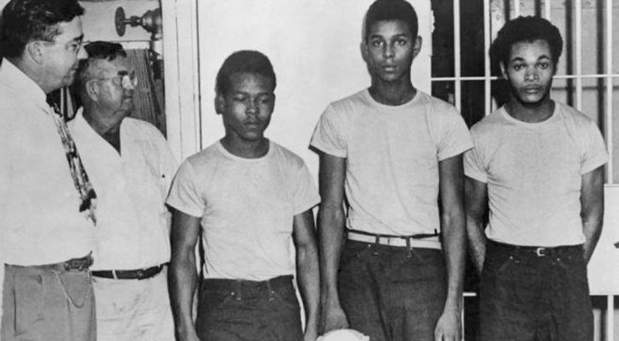 Lake County Sheriff Willis McCall, far left, and an unidentified man stand next to Walter Irvin, Samuel Shepherd and Charles Greenlee, from left, in Florida. The three men along with a fourth were charged with rape in 1949. Florida Gov. Ron DeSantis and a Cabinet granted posthumous pardons in 2019. (State Library and Archives of Florida)
In 1949, the Groveland Four, a group of Black men falsely accused of raping a white woman, were assumed guilty even before their trial. That year, a cartoon on the Sentinel’s front page featured four electric chairs with the words “No Compromise!” over the top.
Few, if any, of the victims of those tragedies lived to see the record set straight, and their descendants would wait decades before any wrongdoing was acknowledged, let alone rectified.
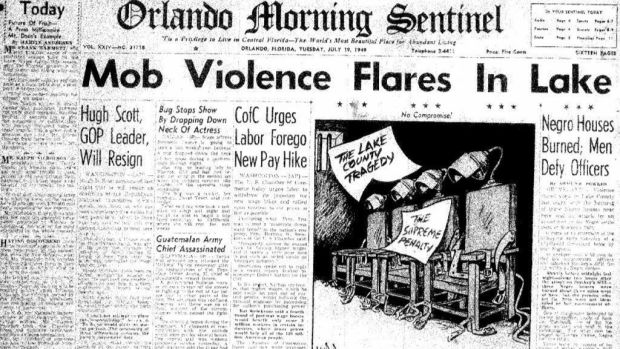
Orlando Sentinel
The guilty verdicts for the Groveland Four were overturned by the state Supreme Court, which specifically criticized a front-page cartoon in The Orlando Sentinel labeled, “The Lake County Tragedy”. The cartoon of four electric chairs, which the justices called “highly prejudicial,” had appeared before a grand jury indicted the men. (Orlando Sentinel file)
Today, the Ocoee massacre is required learning in Florida classrooms, while the Groveland Four, the subject of a Pulitzer Prize-winning book, were officially exonerated in 2021.
This year, the Florida Legislature approved a $4 million compensation fund as reparations to their surviving families.
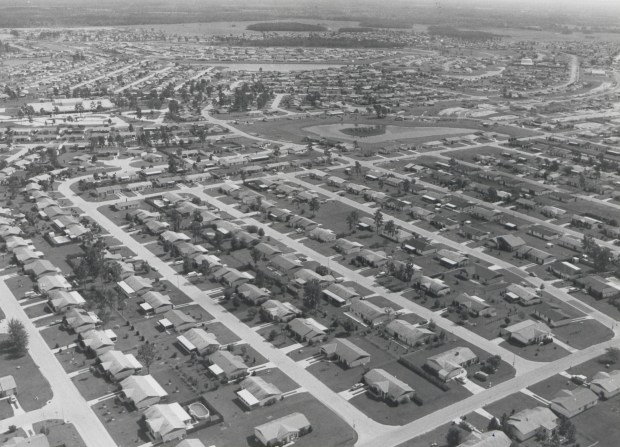 A large section of Buenaventura Estate, shown in 1987, shows the size of this Osceola County community that reaches up into Orange County. (Orlando Sentinel file)
Latino migration
Hispanics have long lived in Central Florida, but it wasn’t until the late 1980s that their numbers exploded.
Puerto Ricans made up the largest influx of Hispanics to the region, thanks in large part to Miami-based developer Landstar Homes.
Setting up offices in Puerto Rico, New York and Chicago, the company bet that Florida, specifically a new subdivision called Buenaventura Lakes, or BVL, would be the next hub for the Puerto Rican diaspora.
“They were offering folks a free hotel stay, and if you come down you’d get Disney tickets and you’d get to see the new development,” said Simone Delerme, a University of Mississippi professor and author of the 2023 book, “Latino Orlando: Suburban Transformation and Racial Conflict.” “That really appealed to folks.”
And it worked. Landstar’s aggressive ad campaign prompted an exodus of Puerto Ricans from the island and the northeast to Florida as they sought cheaper, safer housing with less congestion, lower crime and weather that reminded them of home.
“The only thing missing is the mountains,” said a new resident, who bought a home on a whim while vacationing at Walt Disney World, to the Sentinel in 1991.
Their families soon followed. By 1990, Osceola County’s Hispanic population grew an eye-popping 1,100%, the largest in the U.S. at the time — and likely an undercount, the Sentinel reported. Meanwhile, BVL went from a large pasture 15 years earlier into a community with a larger population than St. Cloud, housing about a third of all Hispanics living in the county.
With the newcomers came new businesses catering to Spanish-speaking customers. Some Puerto Rico-based corporations, like Banco Popular, opened branches in Central Florida while grocery stores began selling Puerto Rican products.
Latinos continued moving to Central Florida from other parts of the country, while others migrated from countries like Cuba and Mexico and later Brazil, Venezuela and elsewhere. In a relatively short period, it became a well-known destination for Latinos, a reputation once more closely linked to South Florida.
As the region’s people changed, so did the faces of its leaders. Osceola County elected its first Hispanic commissioner, Robert Guevara, in 1996. Viviana Janer was elected the first Hispanic woman commissioner 18 years later.
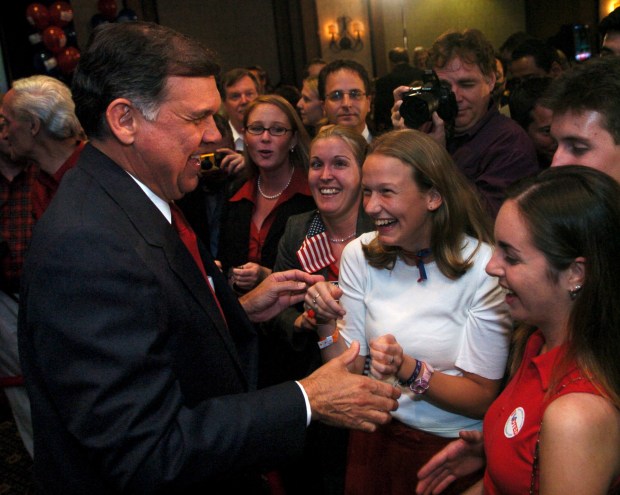 Candidate Mel Martinez is congratulated at a victory party in Orlando following his victory in the 2004 U.S. Senate race. Martinez, already the first Hispanic Orange County mayor, became the first Cuban American to serve in the Senate. (Joe Burbank/Orlando Sentinel file)
Mel Martinez, Orange County’s first Hispanic mayor, became the first Cuban-American in the U.S. Senate in 2005, and in 2016, U.S. Rep. Darren Soto became the first congressman of Puerto Rican descent to represent Florida.
By 2024, Hispanics made up nearly a third of the population in Orange, Osceola, Lake and Seminole counties at well over a million residents, with Puerto Ricans making up the largest share with nearly 400,000, according to the latest U.S. Census data.
Osceola County has by far the largest regional concentration of Hispanics, who make up 57% of its population.
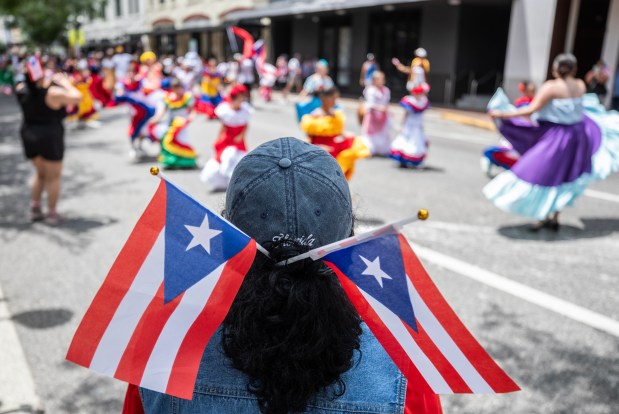 Attendees at the Florida Puerto Rican Parade and Festival celebrated the island in Orlando in April 2025. Central Florida became the center of Puerto Rican culture in the mainland U.S. beginning in the 1980s. (Orlando Sentinel file)
News for a new audience
Spanish quickly became a ubiquitous language in the region by the mid-1990s, and that came with news organizations rushing to fill a need for Spanish-language news.
Before 1990, Central Florida Hispanics already had a weekly newspaper, La Prensa. Founded on a whim in 1981 by Manuel and Dora Toro after spending their savings on a typesetter, it continues today as the oldest Spanish-language paper in the region.
El Osceola Star followed in 1990 as the region’s first bilingual newspaper focusing on Osceola County.
But the growing attention to the new demographic came expanded — and often low-hanging —crime stories that too often were seen as painting Hispanics in a negative light. Then, amid renewed concerns about drugs flooding American cities, came the 1996 March for Dignity.
Described by then-Orange County Sheriff Kevin Beary as the “largest anti-drug march in Orlando history” at the time, the rally saw thousands of Hispanics, including the late legendary salsa singer Willie Colón, marching through downtown in a bid to tear down harmful media stereotypes.
“We are part of the community. We are not part of the problem,” Orlando-based attorney Anthony Suarez said in a story about the rally. “We’ve been painted with a broad, negative brush.”
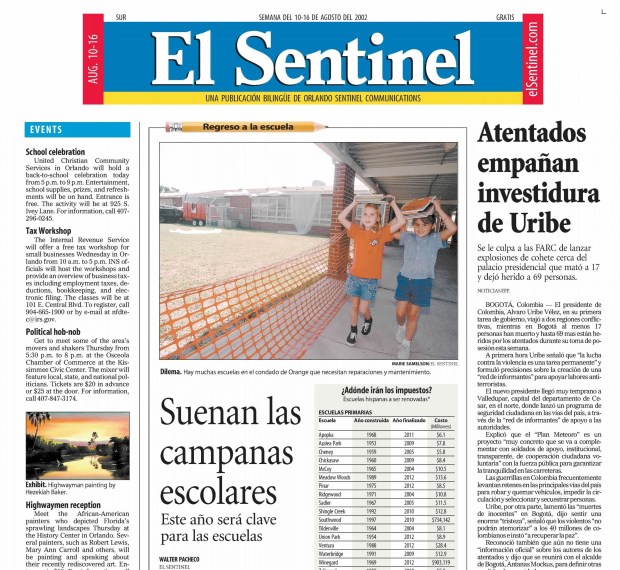 In 2001, the Orlando Sentinel launch El Sentinel — a free, bilingual weekly with English and Spanish presented side-by-side. (Orlando Sentinel file)
In 1997, partly in response to discontent by Hispanic readers, the Sentinel hired Puerto Rican reporter Maria Padilla, tasking her with covering the region’s changing racial landscape. Two years later, the paper opened a bureau in Puerto Rico.
The Sentinel’s efforts to more competently cover the growing community culminated in the 2001 launch of El Sentinel, a free, bilingual weekly with Padilla as its founding editor.
Its first issue, published Aug. 11, 2001, came out with English and Spanish presented side-by-side — a format soon dropped after confusing readers. The front page focused on helping Spanish-speaking parents navigate the public school system amid “unequaled growth in the population.”
“I had never really done anything that just catered to the Latino community until this, and to me, we had to tell people real stories,” Padilla said. “It was a big thing for me that we not write about things that would appear in the English paper.”
Padilla left El Sentinel in 2004, but her passion for journalism never faded. She co-authored a book memorializing the testimonies of Puerto Ricans who fled to Central Florida after Hurricane Maria in 2017.
But over time, El Sentinel saw severe cuts to its staff, ultimately publishing its final issues in 2022 due to dwindling readership and financial woes amid the COVID-19 pandemic.
“It was a very special time — it was rough, it was hard and it was fun, and we knew we were breaking ground,” Padilla said. “I’m glad we did it. It didn’t end up the way we wanted it in the end.”
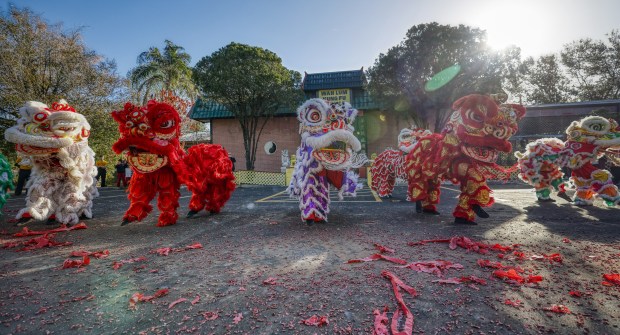 Lions dance during the celebration of the Lunar New Year of the Fire Horse at the Wah Lum Kung Fu Temple in Orlando in February. The temple has been a staple of the Chinese community in Central Florida for nearly 50 years. (Orlando Sentinel file)
Tradition meets a modern age
On 851 N. Goldenrod Road in Orlando, tucked between gas stations, auto repair shops and a school, sits a unique building: the Wah Lum Temple.
Opened in 1980 by Grandmaster Pui Chan, it was the first of its kind in the U.S., designed with traditional architecture and decorated with artifacts within its vast training spaces.
Chan’s aesthetic vision and his use of techniques and customs tweaked and passed down over hundreds of years is a love letter to his native China. It’s now under the care of his eldest daughter, Mimi Chan.
“We have people from all over the world … come here and say, ‘Hey, my family’s at Disney, but I needed to come to the Wah Lum Temple,’” said Mimi Chan, who told her father’s story in the award-winning 2011 documentary, “Pui Chan: Kung Fu Pioneer.” “It’s become a destination for people who love traditional Chinese culture. But in 1980, people had no idea what it was.”
Pui Chan came to the U.S. in 1968, carrying with him his master’s teachings, $24 and a dream. When Chan and his wife, Suzy, decided to leave Boston for a warmer Orlando with their daughters Mimi and Tina, they had a choice: open a Chinese restaurant or take an even bigger risk by opening a kung fu temple.
Mimi Chan, who was raised in the temple and began her training as a 3-year-old, said life in Orlando at that time was very different than today. There were few Asian families at the time, and the temple itself was built when much of the area was woods.
With no Chinatown and a small Chinese population, Chan quickly put on some of the first annual Chinese New Year celebrations in the region, complete with fantastical kung fu demonstrations and mesmerizing lion dances.
Two years after the temple opened, Chan’s Lion Dance Team performed at the opening of the China Pavilion at Epcot, where they continued performing for years.
The temple’s ties to Disney further deepened in the 1990s when Mimi Chan was invited to choreograph the fight scenes for the 1998 classic, “Mulan,” animated at Disney-MGM Studios. At the time, its lead animator, Mark Henn, said meeting her was “like Mulan walked in the room.”
“Even today … to see every generation be so connected and tell me how how impactful ‘Mulan’ was to them, to see this Chinese woman on screen doing the things she was doing,” Mimi Chan said, “it’s absolutely wonderful and such an honor to be part of such an inspiring film.”
In July, in a ritual passed down for generations, she was anointed grandmaster by the man who trained her all her life: her father.
“I am dedicating my life to preserving the Wah Lum culture and the history and the style and what that means for future generations,” she said. “The work I’m doing now is essential to ensure that this goes on in perpetuity, and it is a very heavy weight.”
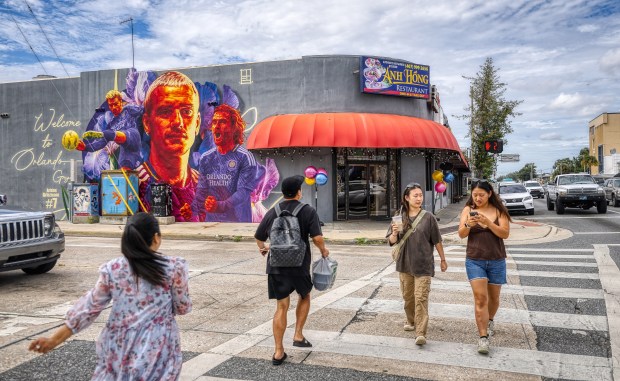 Pedestrians cross in front of the Anh Hong Vietnamese Restaurant on East Colonial Drive and North Mills Avenue, on Monday, October 5, 2026. The Mills50 neighborhood has become known as “Little Saigon” due to its many Vietnamese businesses. (Ricardo Ramirez Buxeda/ Orlando Sentinel)
Building home away from home
Today, Central Florida makes up about a fifth of the state’s Asian population with nearly 180,000 residents, mainly concentrated in Orange County.
While Orange’s Indian, Chinese and Filipino enclaves are the largest among local Asians, its Vietnamese population, centered in Orlando, made a habit of punching well above its weight.
Waves of Vietnamese refugees came to the U.S. after the 1975 fall of Saigon. Florida was one of four states with camps welcoming them. Driven by the warmer climate, many decided to stay.
By the 1990s, despite a significant language barrier, the relatively small but tight-knit community began opening new businesses in what’s now the Mills50 District.
What was then a run-down stretch of land was later put on the map as “Little Saigon,” as families raised their kids in their newly adopted country while clutching to their heritage and sharing it with the broader community.
Today, the mark left by Vietnamese immigrants continues to shape the cultural and political scene. The community was propelled into the political spotlight in 2016 with the election of Stephanie Murphy, the first Vietnamese-American to represent Florida in Congress.
“I was a beneficiary of an America that provided opportunities for people who were willing to work hard to make the most out of them,” Murphy, a refugee whose family fled Vietnam when she was an infant, told the Sentinel after her win.
The Asian community’s political influence continues to be felt. In 2023, the Florida chapter of Make Us Visible, led by Mimi Chan, successfully pushed legislation requiring Asian American and Pacific Islander history be taught as part of Florida’s curriculum.
“I grew up here in Florida and was educated in Florida; I learned nothing about the contributions of Asian-Americans,” Chan said. “Had I seen myself reflected, I would have had a different childhood. Had others learned about it, they would see us as American.”
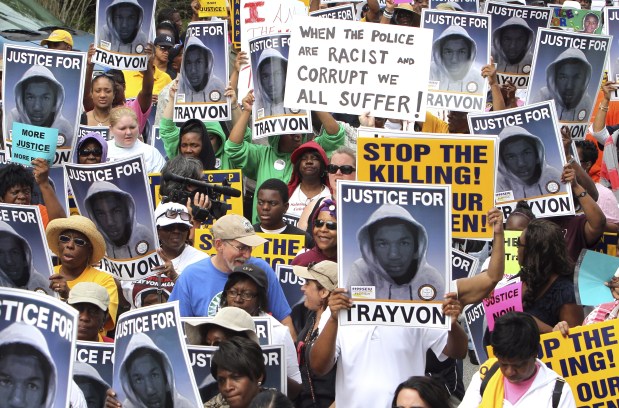 Thousands of marchers rally in the streets of Sanford on March 31, 2012, demanding the arrest of George Zimmerman for the killing of Trayvon Martin. (Orlando Sentinel file)
Central Florida’s future
Today, the region is a gorgeous mosaic, a patchwork of neighborhoods and communities reflecting the people whose roots blossomed and continue to thrive.
Central Florida’s legacy, like other communities, was built through hardship. But now it’s in the hands of a generation eager for a reckoning.
Sanford, for instance, was the birthplace of the Black Lives Matter movement, spawned in the aftermath of the 2012 killing of Trayvon Martin. That legacy extended into future social justice movements, like the tens of thousands of people nationwide who protested police brutality following the 2020 murder of George Floyd.
Meanwhile, the Sentinel continues its modern attempts at reconciling its shameful contributions to the region’s bleakest historical episodes. In 2020, the paper reckoned with its coverage of the Ocoee massacre, a year after issuing an apology for its coverage of the Groveland Four.
“We’re sorry that the newspaper at the time did between little and nothing to seek the truth,” its Editorial Board wrote in a front page column. “We’re sorry that our coverage of the event and its aftermath lent credibility to the cover-up and the official, racist narrative. We’re sorry that reporters and editors failed in our duty to readers, to the community and to the Groveland Four and their families.”
Challenges remain, however, as changing national political tides renewed efforts by state and federal authorities to reshape the social landscape back into its own image.
Restrictions against “Diversity, Equity and Inclusion,” or DEI, and the teaching of history deemed to cause “discomfort, guilt or anguish” aim to downplay or expunge the legacy of many of the people you’ve just read about.
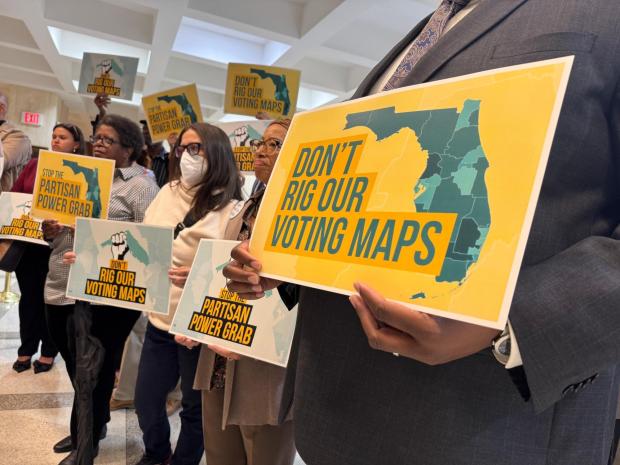 Opponents of mid-decade efforts to redraw congressional voting districts, undoing many majority-minority seats, gather to protest in the Florida Capitol in Tallahassee in 2025. (Kate Payne/AP file)
This year, the redrawing of minority-majority voting districts — or racial gerrymandering, depending on who you ask — following the gutting of the Voting Rights Act threatens to dull the political power of Florida’s minorities.
Meanwhile, the state’s sweeping approach to immigration enforcement has left many among its targeted migrant communities uneasy, regardless of legal status or political ties.
But come what may, its people persist.
“We have to be able to acknowledge the history of things that have happened here,” Paul, the St. Cloud commissioner, said. “I’m not afraid to talk about the history to my children. And I hope they’d be able to do the same thing when they have children in the future.”