
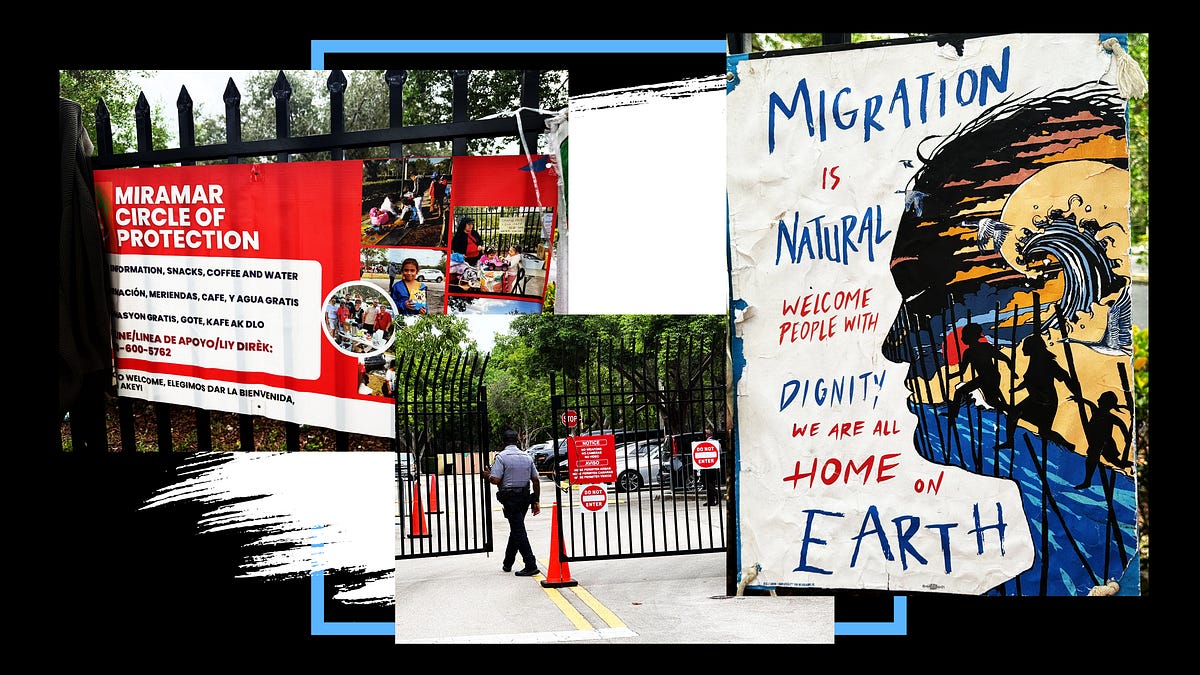
 (Photo illustration by Bill Kuchman/The Bulwark | Photos: Adrian Carrasquillo, Shutterstock)
Miramar, Florida
JUST AROUND THE CORNER FROM A PUBLIX and La Carreta Cuban Restaurant in Miramar, Florida is a nondescript road flanked by trees on each side. It takes you to a tall, black wrought-iron fence. The palm trees and perfectly trimmed hedges out front might lead you to believe you’ve arrived at the headquarters of a tony but security-forward corporation—until you see the agents.
This is the Miramar Sub Office of ICE Enforcement and Removal Operations. Miramar is not a detention center. It’s meant for check-ins, interviews, application submissions, and appointments. But under the Trump 2.0 deportation regime, many visitors—after waiting, sometimes for hours, outside in the punishing 100-degree Miami heat—find themselves detained by ICE. Not for the twelve-hour maximum that these offices are allowed to hold people, but for extended stints of twelve days.
The squalid conditions at Miramar, which immigrant-rights advocates have complained about for months, came to wider public attention recently when Democrats on the House Committee on Oversight and Government Reform published findings from a whistleblower report. The report revealed that the building, with its maximum capacity of 50 people, at one point held 342 people, including the elderly and unwell, with detainees shackled for long stretches without (or with limited access to) basic amenities like soap, toothbrushes and toothpaste, and menstrual products. The report alleges detainees are held under constant bright artificial light and have no access to changes of clothes.
The makeshift detention center is reportedly severely understaffed, lacks any ability to deal with medical emergencies (a Miami Herald investigation found that 911 emergency medical calls from the Miramar Sub Office “had risen sharply between July 2025 and July 2026”), and the staff who do work there refused to service the toilets. While leadership has allegedly threatened officers with retaliation, whistleblower photos reveal the grotesque conditions.
When I visited Miramar, I was struck by
It’s easy to become numb.
Another detention. Another family. Another video. Another headline.
Good journalism fights that numbness. It slows down. It looks closely. It reminds us that every story happened to somebody—and that what we permit government to do to others says something about us, too.
Stay curious. Stay human. Stay with us.