
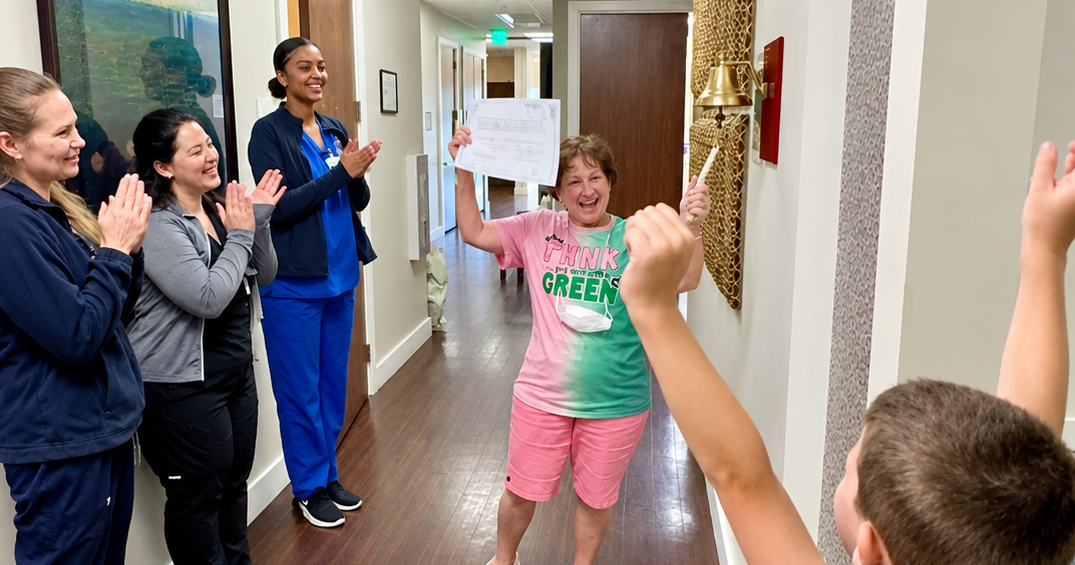
The first call can be one of the hardest.
A woman has found a lump, been told she needs more testing or learned that a mammogram revealed something suspicious. She fears what doctors may find, but without health insurance, she also fears what finding out may cost.
When that call reaches Partners for Breast Cancer Care (PFBCC), Janet Darnell, executive director, understands firsthand. She underwent several biopsies, a lumpectomy and radiation.
“I understand when somebody calls and asks for help. That was me. I know how they feel,” Darnell said.
PFBCC helps fund services ranging from mammograms to chemotherapy for qualifying uninsured, low-income residents of Charlotte, Lee, Collier, Hendry and Glades counties.

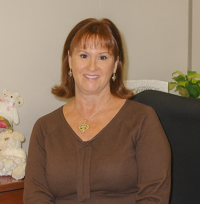
Janet Darnell, executive director of Partners for Breast Cancer Care. -COURTESY PHOTO
“When they find us and find out that we’re going to cover the cost for everything, that fear goes away because they don’t have to worry about the medical costs,” Darnell said. “So, we do a lot of crying here.”
Since 1990, the organization has helped more than 20,000 women and men and funded more than 29,000 breast care procedures.
Susan Condenzio, a former Fort Myers resident, knows both the organization’s impact and what it means when breast cancer returns.
“She has put me on the positive path,” Condenzio said of Darnell.
Condenzio’s journey began in 2005, shortly after her husband died, when she found a lump on New Year’s Eve. By June 2006, she underwent a modified radical mastectomy and learned reconstruction was not an option.
“Finding out after my surgery that I was not a candidate for reconstruction surgery was quite devastating,” Condenzio said.
One daughter was pregnant, and Condenzio wondered whether she would live long enough to meet the baby. Twenty years later, she has eight grandchildren.
When breast cancer returns
In 2014, after a car accident triggered lymphedema, Condenzio found another lump while undergoing therapy. The cancer was determined to be a recurrence of her original breast cancer.
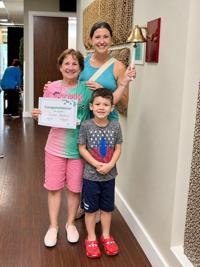
Susan poses with her daughter Stephanie and her 7-year-old grandson during a ringing the bell celebration in June 2026. -COURTESY PHOTO
Her surgery fell on her wedding anniversary, a date already carrying the memory of her late husband.
“The distressing part of that is, five days later, I got a phone call right before Christmas that they did not get clear margins,” Condenzio said.
She underwent another surgery the following January.
According to Dr. Debra Brandt, director of medical oncology at the Anderson Family Cancer Institute at Jupiter Medical Center, a recurrence can occur months, years or even decades after an earlier breast cancer.
“A recurrence of breast cancer is when you’ve had an early breast cancer, early-stage breast cancer, months or years or even decades before the cancer shows up in a different part of your body, and that’s different than developing a second breast cancer, a second primary breast cancer in the same breast or in the opposite breast,” Brandt said. “Breast cancer is not one disease. It’s many different types of diseases.”
Dr. Christopher Lobo of Florida Cancer Specialists & Research Institute (FCS) in Port Charlotte said some breast cancers carry a greater risk of returning within several years, while others can return decades later.
“The risk of recurrence decreases over time. The biggest difference is the triple-negative breast cancers. Usually, after five years, they do not recur as much,” Lobo said. “Contrast that with estrogen-positive breast cancers, and they do recur within five years and 10 years, but they can even recur up to 25 years later.”
Condenzio’s daughter, Stephanie Robinson, remembers her mother being there for her children.
“She would drive herself to her treatment for 30 treatments and then get home to us,” Robinson said. “Radiation was tough, and it was every single day.”
For Condenzio, faith became a source of strength through treatment.
“I think this strength came from God,” Condenzio said. “I always have this big poster at work: ‘Keep looking up, or you miss the rainbows.’ I love that because it’s so hard some days to just get up and say, ‘All right, I’m going to do it all over again today.’”
Robinson sees the familiar metaphor of a light at the end of a tunnel differently.
“Everybody always says, like the light at the end of the tunnel, like the end, the end. But cancer is not really like that,” Robinson said. “It’s literally like you’re going through the tunnel, and there’s just a little light to pop up every now and then.”
Finding the right support
For a time, it seemed the worst might be behind her. In 2016, during a visit to Moffitt Cancer Center in Tampa on Red Nose Day, doctors told her she was cancer-free.
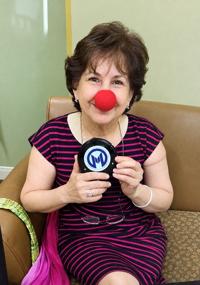
Susan Celebrates Red Nose Day after being declared “cancer free” in 2016 at Moffitt Center. -COURTESY PHOTO
That same year, she moved to Royal Palm Beach to be closer to her daughter, son-in-law and a brand-new grandson. There, she spent several years under the care of a physician she described as knowledgeable but lacking the bedside manner she needed. After one appointment, she sat in her car and cried.
“The way she felt just having to get in the car to go see him — nobody should have to feel that way, especially somebody in a cancer situation,” Robinson said.
For patients with a history of breast cancer, having a physician they feel comfortable talking to can become particularly important when something changes.
“I think good communication is important. For example, if you are losing weight and don’t know why, it is good to ask. If you have worsening bone pain, shortness of breath, nausea, or headaches that are persistent, (you) should ask,” Lobo said.
Eventually, Condenzio decided it was time to change physicians. She found Dr. Kelly Foster with Tampa General Hospital Cancer Center of South Florida in Palm Beach Gardens.
Condenzio said Foster took the time to review her medical history and understand what she had already been through.
For years, Condenzio said her previous physician examined her mastectomy scar and told her everything “looked good.” However, at Foster’s recommendation, she later saw a dermatologist who found and removed multiple small skin cancers along the scar line, which Condenzio said she learned could be a late effect of radiation treatment.
In 2025, Foster identified another concerning area and recommended further evaluation. A skin biopsy showed metastatic breast cancer.
A lesion in the T4-T6 area of Condenzio’s spine was also biopsied and treated with radiation.
“So luckily, that has dissipated, but you know, it is stage four, so I know it’s up somewhere else,” Condenzio said.
How long someone can live with metastatic breast cancer varies, but advances in treatment have changed what living with the disease can look like.
“Some women and men with breast cancer can live very long periods of time — very long periods of time — with metastatic breast cancer, but not everybody,” Brandt said.
“We’re getting closer to making breast cancer, even when it’s spread, a more chronic disease that people are living with for longer periods of time and living better when they’re on treatment than they ever used to be.”
Twenty years after finding that first lump, cancer has interrupted Condenzio’s holidays and anniversaries, changed her body, tested her faith and forced her family to adjust to uncertainty.
Yet, she refuses to give it ownership.
“It’s not a bed of roses, it’s not 100% cured, but there is always hope,” Condenzio said. “But you can’t rely on a cure. You have to rely on yourself, not owning it. You have to say, you know, ‘God, give me the strength for another day.’
“I can’t go backward. I have to keep moving forward, and today’s a new day. Let’s see what it brings.”