
Many Broward teachers spent hundreds of dollars out of pocket to buy school supplies, expecting to get reimbursed — only to be told later they wouldn’t be paid back.
These teachers flooded the Broward School Board with complaints, and on Tuesday, the School Board may take steps to fix what some described as disrespectful treatment of teachers.
The issue relates to a state-funded program called the Florida Teachers Classroom Supply Assistance Program, which for years has allowed teachers to be reimbursed up to $300 each for supplies they buy for their students.
District administrators say a change in state law restricted eligibility to classroom teachers only. About 1,623 teachers who don’t stay in a single classroom no longer qualify, district officials say. This includes reading coaches, speech-language pathologists and social workers.
Although the law changed in 2023, the non-classroom teachers were able to get reimbursed by submitting receipts to a website called ClassWallet as late as last school year.
This year, affected teachers say they got no advance notice they’d be excluded, only receiving an email about eligibility changes on Sept. 17, five weeks after the school year had started and after many had already bought supplies.
“Considering we work directly with students on a daily basis, I am thinking there must be an error in the notice,” Adira Bagoon, a speech language pathologist at Eagle Ridge Elementary in Coral Springs, wrote to School Board members on Sept. 18. “Please confirm that my assumption is correct. It would be a shame for me to run out of Velcro, laminating pouches, reinforcers, batteries for communication devices, etc. for my students with special needs.”
The teachers could get some relief at Tuesday’s School Board meeting. Most School Board members pledged at an Oct. 6 workshop to approve for this year at least a portion of the $300 these teachers would have normally received.
“I do not want to pile on to the people who are already suffering because of our budgetary concerns,” School Board member Maura Bulman said at the workshop. “The pain that we’re hearing from our teachers and other employees in terms of being able to afford things is very intense right now.”
Board member Adam Cervera said at the same meeting that the district’s abrupt change to the reimbursement policy was “patently unfair” and disrespectful to teachers who have helped the district achieve an A grade for three straight years.
But the teachers may not get the full $300.
A proposal recommended by Superintendent Howard Hepburn would indirectly use $250,000 in revenues the district receives from a program that tickets violators of school speed zones to help cover reimbursements.
The district would also use $50,000 from reserves. But with 1,623 affected teachers, this $300,000 would only provide $185 for each reimbursement, instead of the full $300.
And the reimbursements may not be available to these teachers in future years.
“Next year it will be different, because if people don’t qualify, then they know and they can plan accordingly,” Bulman said at the workshop.
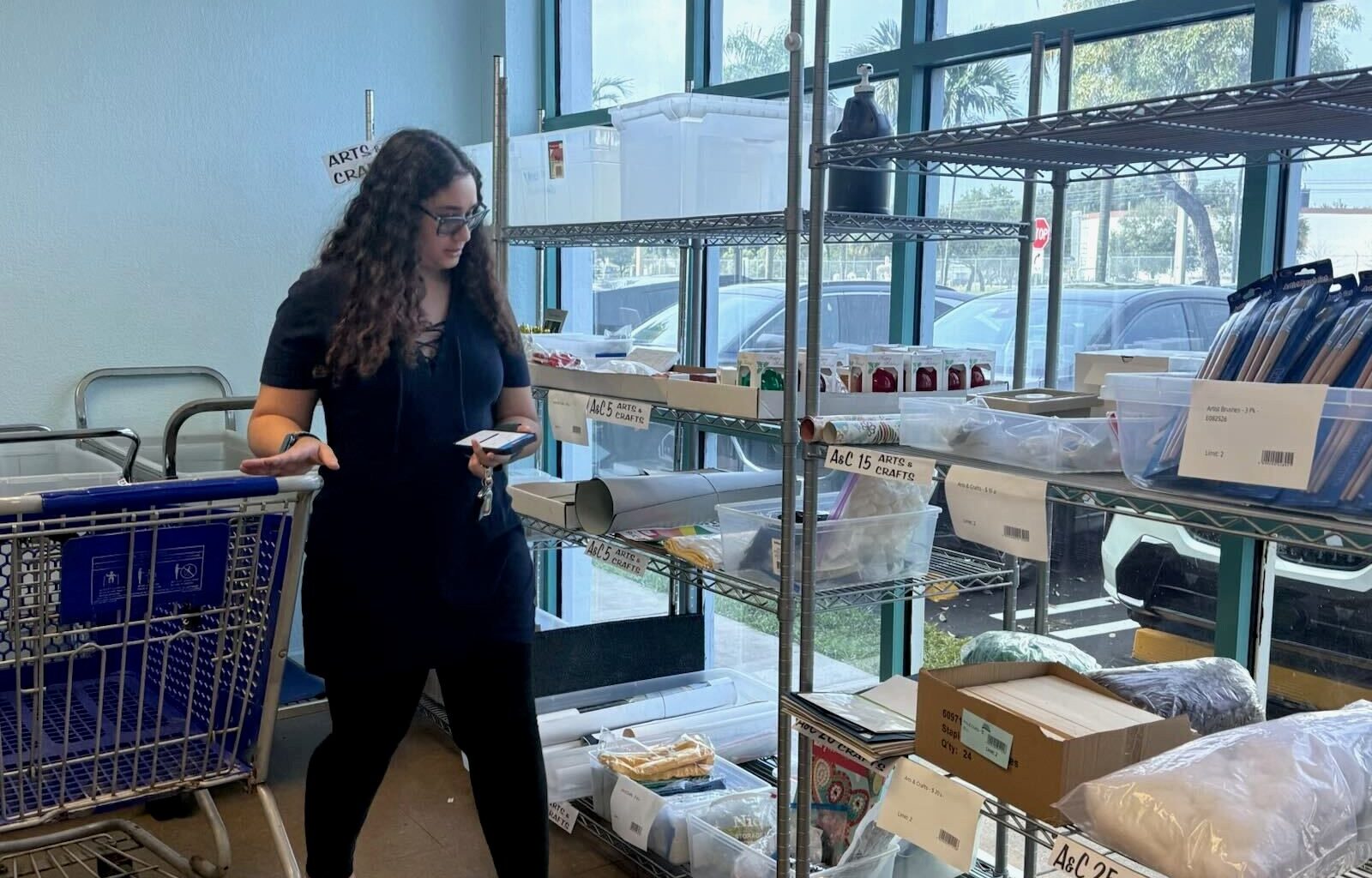
Hepburn said teachers would still be eligible to collect supplies through a supply center in Pompano Beach run by the Broward Education Foundation. The foundation is the non-profit fundraising arm of the district, and it pays for products and services to supplement what’s covered by local and state tax dollars.
Shelly Soffer, a speech language pathologist at Deerfield Beach High, said she has gotten some supplies through Broward Education Foundation, but her needs tend to be more specialized.
“I’ve gotten Velcro there. There is glue, and there are scissors. But there’s no curriculum. No curriculum supplies,” she said. Among supplies not available are straws, cotton balls, tongue depressors and certain manipulatives needed for speech- and language-impaired students, she said.
Soffer said she has spent $120 out-of-pocket for two subscriptions to speech and language curriculum services.
James Knapp, CEO of the Broward Education Center, said she’s happy to work with the district to try to address some of the gaps in supplies.
“The largest need that everybody has is on the basic school supply side,” Knapp told the South Florida Sun Sentinel. “If we have to go out and see what we can do for speech pathology or something like that, we are always open to doing that and would love to do that if they have a great need.”
Jacqui Luscombe, who chairs the district’s Exceptional Student Education Advisory Council, told the School Board on Oct. 6 that she was disappointed with how the district handled the change.
“This is bigger than $300. It’s about how poor communication and disordered decision-making left employees spending money out of pocket, damaged trust, created unnecessary controversy and diverted board time,” she told the board.
Board Chairwoman Sarah Leonardi, a former teacher, also criticized the district’s handling of the issue, saying it was “demoralizing” for teachers.
“As a teacher, I think one of the most offensive things to me was that I had to use my own money to purchase supplies to do my job, and I don’t know of any other profession that has to do that,” she said. “I’m not trying to say that this was done maliciously or anything like that. I think it was just a series of not-great communication and decisions that were made.”