
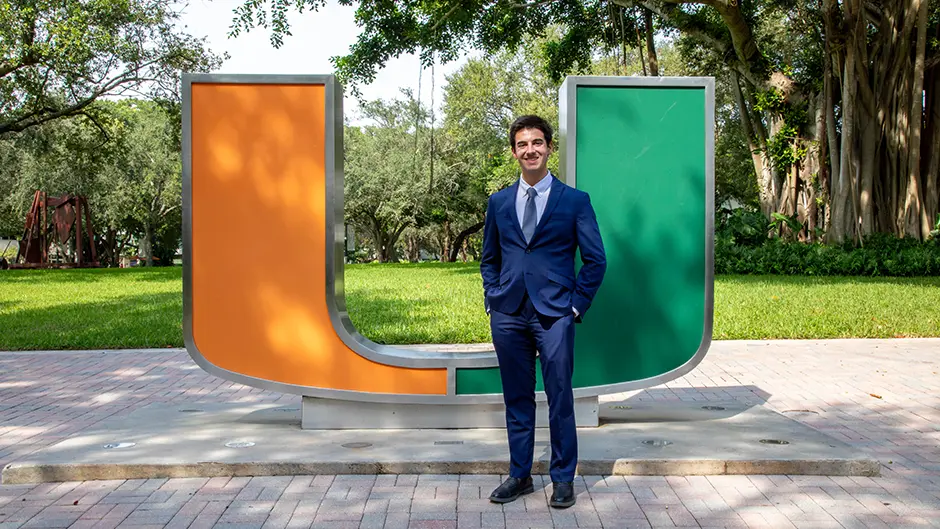
Just a few years ago, Arian Djahed had never written a line of code. Now, as he completes his final semester in the Master of Science in Data Science program at the University of Miami College of Arts and Sciences, he is helping lead an artificial intelligence project that brings together computer science and law.
Djahed serves as a project manager for the Bluebook project within the University of Miami School of Law’s Law & AI Lab. The project centers on developing a web-based tool that automatically generates citations compliant with the Bluebook, the citation system commonly used in legal writing.
Born and raised in Miami, Djahed has longstanding connections to the University. His mother and older brother are alumni, and his younger brother is currently a student. His own academic path, however, took several turns before leading him to his current passion: data science.
He initially studied physics as an undergraduate at the University until an introductory computer science class caught his attention.
“I was like, ‘Oh, I kind of like this,’” he recalled.
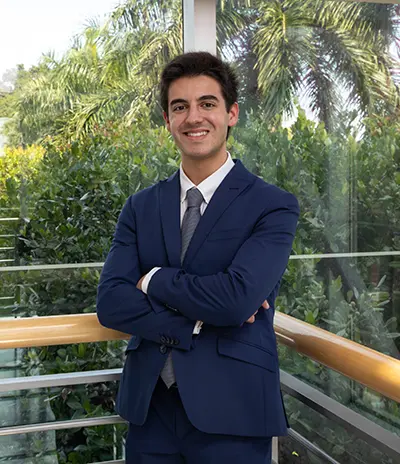
Arian Djahed Photo: Thaniuska Vivas
Although programming was more challenging than he initially expected, Djahed worked hard to develop his skills. He eventually gravitated toward data science and machine learning.
“I like the applications that data science and machine learning have in other scientific fields,” he said. “For me, it was a very good way to keep in touch with my scientific interests.”
Those interests ultimately led Djahed to pursue his master’s degree in data science at the University. The interdisciplinary program is designed for students from a variety of undergraduate backgrounds and allows them to explore how data science can be applied across programming, data engineering and database systems.
For Djahed, the program gave him the opportunity to expand his knowledge of data science and machine learning while building on the computer science foundation he developed as an undergraduate. It also helped him gain the experience he felt he had missed after learning computer science later than some of his peers.
“Probably the most valuable aspect of the program has been the access it has given me to higher-level, more specialized classes that I wouldn’t have otherwise taken,” Djahed said. “These have allowed me to explore more practical applications of programming and data science.”
One aspect of the program that stood out to Djahed when he was applying is that it does not require students to complete a thesis, allowing them to focus more on developing career-related skills. “I did not want to be pigeonholed into more of an academia-oriented route by the need to do a thesis,” Djahed said. “So, the absence of one allowed me to do what I initially intended to do with this master’s degree: accrue more skills to better prepare myself for the workforce.”
Djahed’s data science experience has extended beyond the classroom. He joined the Bluebook project in May 2025 and initially worked under its project manager before taking on this role when the previous project manager graduated.
From the beginning, the project required Djahed to familiarize himself with legal citations, a field with which he had no previous experience.
Unlike citation styles such as MLA or APA, which most students learn as undergraduates, legal writing follows its own detailed set of rules outlined in the Bluebook. The Bluebook citations are widely considered difficult and tedious. Law students and legal professionals frequently describe learning the citation system as a frustrating rite of passage due to its dense rules on typeface, spacing and abbreviations. The Bluebook project aims to make the citation process more efficient through technology.
“Anyone who has been through law school knows the Bluebook: hundreds of pages of rules on abbreviations, typeface and spacing that students, journal editors and lawyers apply by hand for countless hours,” said Or Cohen-Sasson, director of the Miami Law & AI Lab. “Automating that process frees them to focus on what actually matters: the substantive legal work.”
The web application is designed to take a legal document with incomplete citations, process it, and return the document with completed Bluebook-compliant citations while preserving its formatting.
“It basically automates that process,” Djahed said.
Developing the tool has required Djahed to use skills from his studies while learning technologies that extend beyond what he encounters in the classroom. One of the most valuable experiences, he said, has been learning how to work with large language models, or LLMs, in a programming environment and incorporate the technology into software.
“I had never done that before,” Djahed said. “I think that was a very valuable experience.”
The technical side, however, is only part of his role. As project manager, Djahed also oversees two other student developers. He assigns responsibilities, tracks issues that need addressing and helps ensure the team keeps moving toward its goals, while learning valuable leadership skills.
Djahed is also collaborating with Cohen-Sasson to draft a research paper about the Bluebook tool. The paper will evaluate the tool’s performance, which has meant continuing to refine the application and collecting data on how well it works. For Djahed, the work has become more than a coding assignment.
“It has a special place in my heart,” he said. “After working on it for so long, I feel a bit of ownership over the project and a duty to see it through as much as possible during my tenure as a student here.”
The project has reinforced Djahed’s interest in pursuing work centered on machine learning after he completes his master’s degree.
Djahed sees the versatility of the skills he has learned in the project and in the Master of Science in Data Science program as one of the field’s biggest advantages. Programming, data science and machine learning can be applied to numerous fields including law and medicine.
“Arian embodies interdisciplinary work in the best possible way,” Cohen-Sasson said. “He came in with no background in law, learned the logic of legal citation from the ground up and now leads a team building a tool that lawyers will actually use.”