Kate Anastasia Le | Staff Writer
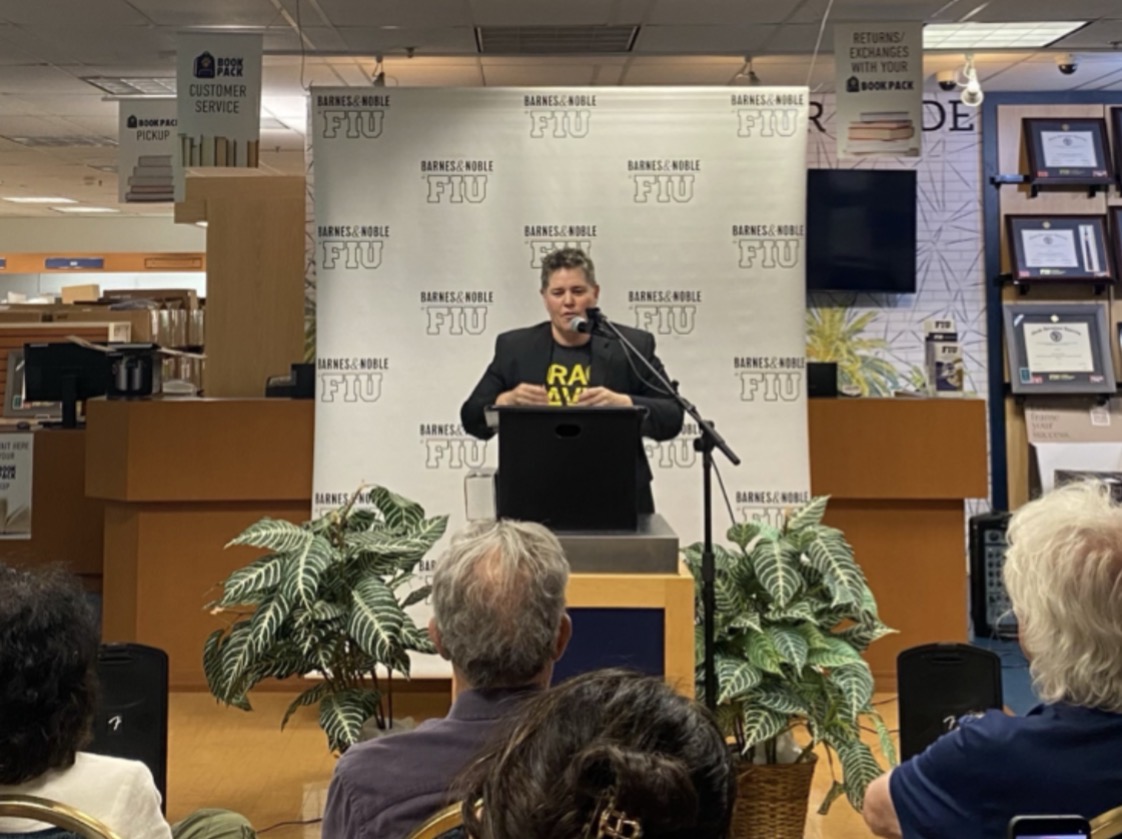
Poet and University of Nebraska–Lincoln professor Stacey Waite spoke on classroom pedagogy and recent university policy changes during a reading at FIU’s Biscayne Bay Campus Thursday, Oct. 8.
Waite, the Susan J. Rosowski Associate Professor of English at the University of Nebraska–Lincoln, delivered an animated reading that quickly expanded into a candid Q&A session on the intersections of creative writing, pedagogy, and contemporary higher education realities.
The discussion moved deeper into the craft of writing and public engagement when an attendee asked how she navigates humor alongside vulnerable subject matter. Drawing on her background in pedagogy, Waite explained her belief that students who speak and laugh in their first week of class are far more likely to participate throughout the term.
“As soon as you laugh, you’re open. You relax,” Waite explained. “Your imagination and your heart are just more open to whatever you’re hearing.”
When asked about her expressive reading presence, Waite clarified that she had no formal acting training. Instead, her delivery stems directly from internal pacing.
“I just read them the way that I hear them to myself,” Waite said, drawing laughs from the room as she recalled turning down poetry slams because she “can’t memorize anything.”
The conversation also touched on the socio-political climate surrounding public universities across the country. Waite shared firsthand observations regarding structural shifts at her home institution in Nebraska, including the recent closure of its DEI office and LGBTQ+ Resource Center amid state-level legislative and budgetary measures. Noting that UNL was among the first universities in the nation to offer courses in LGBTQ+ studies in the 1970s, Waite described the sudden policy changes as disorienting for long-standing faculty and students alike.
When an audience member asked how she navigates teaching amidst political pressures in higher education, Waite acknowledged that colleagues across several red states have relocated, but affirmed her commitment to remaining in Nebraska.
“I’ve been there for 15 years. It’s where my kids were born; it’s my home. I’m not leaving,” Waite said.
For Waite, these campus dynamics reinforce why writing remains a vital tool for community building rather than isolated aesthetic theory.
“It’s always been relational for me,” Waite told the audience. “If I thought no one would ever read another one of my poems again, I’d probably just do something else to connect with people.”
About Post Author