
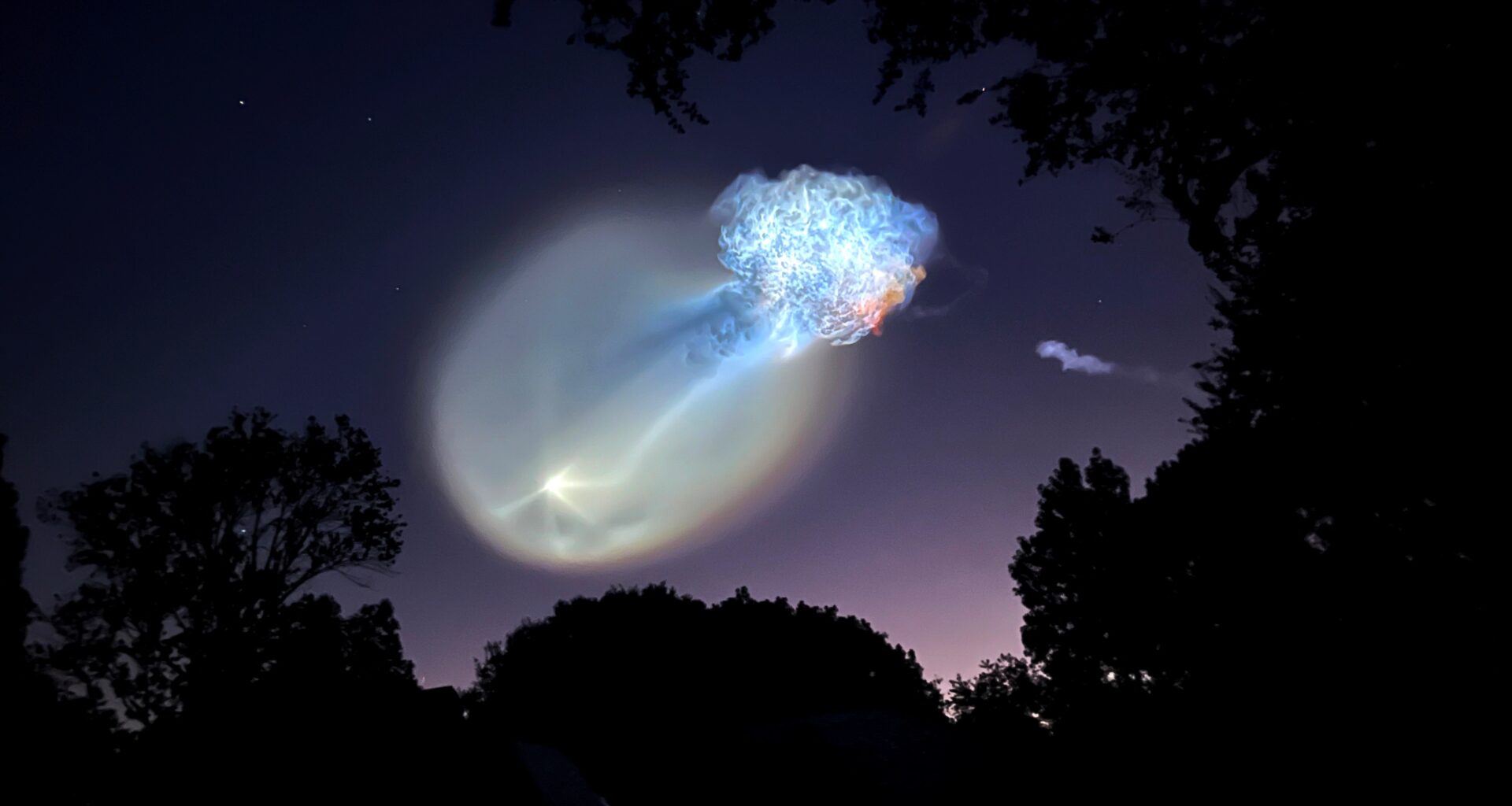
The crisp predawn skies over Central Florida had curious eyes wondering what was unfolding, as an orangish-blue wispy cloud billowed into life ahead of the rising sun.
For those in the know, what was forming is often called the “space jellyfish” effect, the result of the exhaust from a rocket launch creating luminescent clouds that expand and linger in the skies.
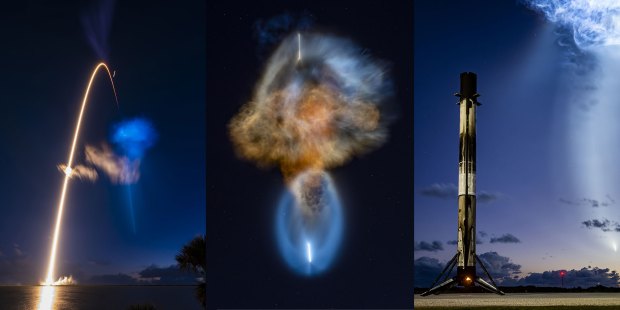 The SpaceX Falcon 9 launch on NASA’s CRS-35 mission to the International Space Station before dawn Tuesday, Oct. 13, 2026, created the space jellyfish effect in the sky that was seen up and down the U.S. East Coast. (Courtesy/SpaceX)
The morphing nebula from Tuesday morning’s launch was the result of a SpaceX Falcon 9 flight to resupply the International Space Station.
The rocket lifted off on the CRS-35 mission from Cape Canaveral Space Force Station’s Space Launch Complex 40 at 6:33 a.m., about 50 minutes before sunrise.
Space Jellyfish! This morning’s CRS-35 launch lit up the Space Coast! The phenomenon occurs when rocket exhaust expands in the thin upper atmosphere and catches sunlight before sunrise. Spectacular!@ccspacemuseum pic.twitter.com/2f0L4o6jxd
— James W. Draper (@James_W_Draper) October 13, 2026
As the first-stage booster separated from the cargo Dragon spacecraft, the light show began unfolding not only over the Space Coast, but for those who looked skyward hundreds of miles away.
“Out of this world cosmic jellyfish effect 65 + miles from our Seminole County, Florida backyard,” said retired Sentinel photographer Red Huber, who posted images to his Facebook page.
Amazing jellyfish this morning by the US Capital building in Washington, D.C. from @SpaceX CRS 35 rocket!@spacejellyalert @capitalweather @JustinWeather @WashingtonianWx @TonyPannWBAL @NationalMallNPS @visitthecapitol pic.twitter.com/GMrbvPz3Nm
— Scott Jacobson (@_scottjacobson) October 13, 2026
With clear skies across the East Coast, images began flowing onto social media from afar, with people reporting the phenomenon in South Florida, Tampa and even as far as Washington, D.C.

In this 480-second long exposure photograph, a SpaceX Falcon 9 rocket carrying the company’s Dragon spacecraft launches on NASA’s SpaceX CRS-35 mission to the International Space Station and its first stage returns to land at Landing Zone 40, Tuesday, Oct. 13, 2026, as seen from Cocoa Beach, Florida. The mission lifted off at 6:33 a.m. EDT from Space Launch Complex 40 at Cape Canaveral Space Force Station, carrying scientific investigations, supplies, and equipment to the orbital outpost on SpaceX’s thirty-fifth commercial resupply services mission for NASA. The rocket’s exhaust plumes, illuminated by sunlight against the predawn sky, were visible across the eastern United States.(John Kraus/NASA)

The exhaust plumes of a SpaceX Falcon 9 rocket carrying the company’s Dragon spacecraft are seen illuminated by sunlight against the predawn sky during the launch of NASA’s SpaceX CRS-35 mission, Tuesday, Oct. 13, 2026, as seen from Cocoa Beach, Florida. Also visible is the Falcon 9 rocket’s first stage performing its reentry burn to prepare for landing at Landing Zone 40 at Cape Canaveral Space Force Station. The mission lifted off at 6:33 a.m. EDT from Space Launch Complex 40 at Cape Canaveral Space Force Station, carrying scientific investigations, supplies, and equipment to the International Space Station on SpaceX’s thirty-fifth commercial resupply services mission for NASA. The rocket’s exhaust plumes, illuminated by sunlight against the predawn sky, were visible across the eastern United States. (John Kraus/NASA)

In this 15-second long exposure photograph, the International Space Station is seen as a streak of light during the launch of NASA’s SpaceX CRS-35 mission as the Falcon 9 rocket’s first stage begins its return to Landing Zone 40 for landing and the rocket’s second stage and Dragon spacecraft continue toward orbit, Tuesday, Oct. 13, 2026, as seen from Cocoa Beach, Florida. The mission lifted off at 6:33 a.m. EDT from Space Launch Complex 40 at Cape Canaveral Space Force Station, carrying scientific investigations, supplies, and equipment to the orbital outpost on SpaceX’s thirty-fifth commercial resupply services mission for NASA. The rocket’s exhaust plumes, illuminated by sunlight against the predawn sky, were visible across the eastern United States. (John Kraus/NASA)

In this 15-second long exposure photograph, the International Space Station is seen as a streak of light during the launch of NASA’s SpaceX CRS-35 mission as the Falcon 9 rocket’s first stage begins its return to Landing Zone 40 for landing and the rocket’s second stage and Dragon spacecraft continue toward orbit, Tuesday, Oct. 13, 2026, as seen from Cocoa Beach, Florida. The mission lifted off at 6:33 a.m. EDT from Space Launch Complex 40 at Cape Canaveral Space Force Station, carrying scientific investigations, supplies, and equipment to the orbital outpost on SpaceX’s thirty-fifth commercial resupply services mission for NASA. The rocket’s exhaust plumes, illuminated by sunlight against the predawn sky, were visible across the eastern United States. (John Kraus/NASA)

The exhaust plumes of a SpaceX Falcon 9 rocket carrying the company’s Dragon spacecraft are seen illuminated by sunlight against the predawn sky during the launch of NASA’s SpaceX CRS-35 mission, Tuesday, Oct. 13, 2026, as seen from Cocoa Beach, Florida. The mission lifted off at 6:33 a.m. EDT from Space Launch Complex 40 at Cape Canaveral Space Force Station, carrying scientific investigations, supplies, and equipment to the International Space Station on SpaceX’s thirty-fifth commercial resupply services mission for NASA. The rocket’s exhaust plumes, illuminated by sunlight against the predawn sky, were visible across the eastern United States. (John Kraus/NASA)
Show Caption
1 of 5
In this 480-second long exposure photograph, a SpaceX Falcon 9 rocket carrying the company’s Dragon spacecraft launches on NASA’s SpaceX CRS-35 mission to the International Space Station and its first stage returns to land at Landing Zone 40, Tuesday, Oct. 13, 2026, as seen from Cocoa Beach, Florida. The mission lifted off at 6:33 a.m. EDT from Space Launch Complex 40 at Cape Canaveral Space Force Station, carrying scientific investigations, supplies, and equipment to the orbital outpost on SpaceX’s thirty-fifth commercial resupply services mission for NASA. The rocket’s exhaust plumes, illuminated by sunlight against the predawn sky, were visible across the eastern United States.(John Kraus/NASA)
Local photographer John Kraus of Satellite Beach, a special communications assistant to NASA Administrator Jared Isaacman, posted his images of the launch as well.
Stunning ‘jellyfish’ effect as a Falcon 9 rocket launched cargo toward the International Space Station this morning. This was up there among the most stunning I’ve ever seen and was visible across much of the eastern U.S. pic.twitter.com/CQ3P6bOyRl
— John Kraus (@johnkrausphotos) October 13, 2026
“Stunning ‘jellyfish’ effect as a Falcon 9 rocket launched cargo toward the International Space Station this morning. This was up there among the most stunning I’ve ever seen and was visible across much of the eastern U.S.,” he posted.
Ok, I know I did a video explaining, but Al Mooney Cooper sent this picture in and I had to share.
Uh, WOW…. That jellyfish cloud from an airplane window. Sheesh…… pic.twitter.com/VixfXXz1P6
— Eric Burris (@EricBurrisWX) October 13, 2026
Al Mooney Cooper captured the effect as seen from flying in a plane, sending it to WESH-2 News meteorologist Eric Burris. “Uh, WOW….,” Burris wrote. “That jellyfish cloud from an airplane window. Sheesh.”
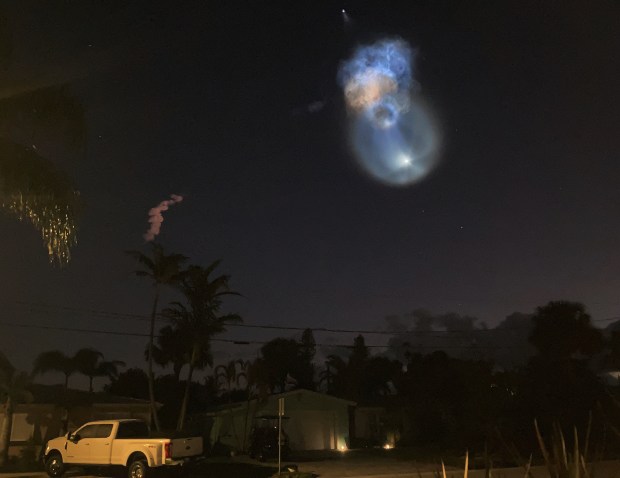 A SpaceX Falcon 9 launch on the CRS-35 mission creates a space jellyfish effect seen from Satellite Beach to the south on Tuesday, Oct. 13, 2026. (Richard Tribou/Orlando Sentinel)
About eight minutes after liftoff, the first-stage booster, making its eighth trip to space, made a recovery landing adjacent to the launch pad at Landing Zone 40.
SpaceX had warned that the return of the booster could bring a sonic boom as parts of the rocket broke through the sound barrier.
Liftoff! pic.twitter.com/0naEicD1Dl
— SpaceX (@SpaceX) October 13, 2026
“There is the possibility that residents of Brevard, Orange, Osceola, Indian River, Seminole, Volusia, Polk, St. Lucie and Okeechobee counties may hear one or more sonic booms during the landing, but what residents experience will depend on weather and other conditions,” SpaceX stated in a media alert.
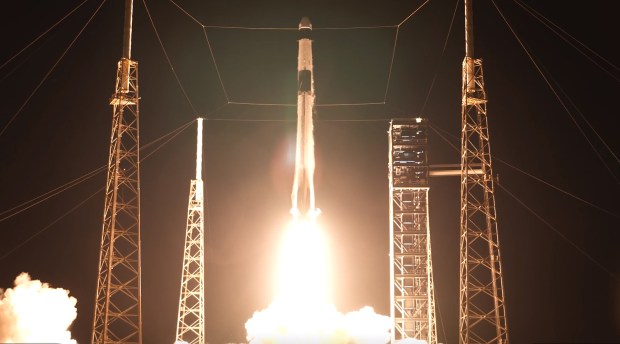 A SpaceX Falcon 9 rocket on the CRS-35 mission topped with a cargo Dragon spacecraft launches from Cape Canaveral Space Force Station’s Space Launch Complex 40 on Tuesday, Oct. 13, 2026. (Courtesy/SpaceX)
This was the 35th resupply mission for SpaceX under NASA’s Commercial Resupply Services contract. This one is bringing up about 6,300 pounds of supplies including science and technology experiments.
This was the 59th launch from the Space Coast from all providers in 2026, with all but seven coming from SpaceX.
This is the fourth trip to space for the Dragon spacecraft on the mission, which has about a 52-hour flight ahead of it before it meets up with the space station, targeting docking on Thursday at 11 a.m.
It heads to the station after a parking spot opened up last week when Crew-12 departed the orbiting laboratory, as there are only two docking ports that can support Dragon spacecraft.
The other port on the station is taken up by the Crew Dragon Grace that brought up the four members of Crew-13, including Central Florida and NASA astronaut Luke Delaney, at the beginning of the month.