
A massive Arctic blast is sweeping across the United States, sending temperatures plunging from the northern Plains to the Southeast. Northern states are already seeing lake-effect snow and daytime highs shattering records, marking one of the earliest and most widespread cold waves of the season.
Florida is not immune. In the state’s north and central regions, temperatures have already dropped into the 20s and 30s, with wind chills making it feel even colder.
The National Weather Service in Jacksonville warns that widespread frost and freezing temperatures are expected to persist tonight and early Wednesday, Nov. 12, potentially harming sensitive outdoor plants if left uncovered. Coastal northeast Florida is under a Frost Advisory, while inland areas remain under a Freeze Warning.
“Temperatures will fall into the upper 20s to low 30s tonight, with some spots in the southeast Big Bend possibly reaching the mid-20s,” the NWS in Tallahassee said Tuesday morning. “Wind chills this morning are expected to drop into the upper teens to lower 20s in some areas.”
Why is it so cold in Florida? Some areas see record-breaking temps
Florida’s unusually cold temperatures are the result of a powerful high-pressure system over the northern Gulf and southeastern U.S. that is funneling Arctic air southward. Clear skies and calm winds at night allow heat to escape rapidly, sending temperatures to record-low levels in some areas.
This week, temperatures are running about 20 to 25 degrees below normal, especially in the Big Bend and Panhandle. While freezes this early aren’t unheard of, they are rare — and some cities are experiencing some of the coldest temperatures on record for this time of year.
On Monday, Nov. 10, Tallahassee reported a low of 38 degrees, Jacksonville recorded 39 degrees and Pensacola tied its daily record low of 33 degrees. Early Tuesday morning, Nov. 11, even more records were likely broken — though not yet confirmed — with temperatures dipping into the mid-20s in some areas.
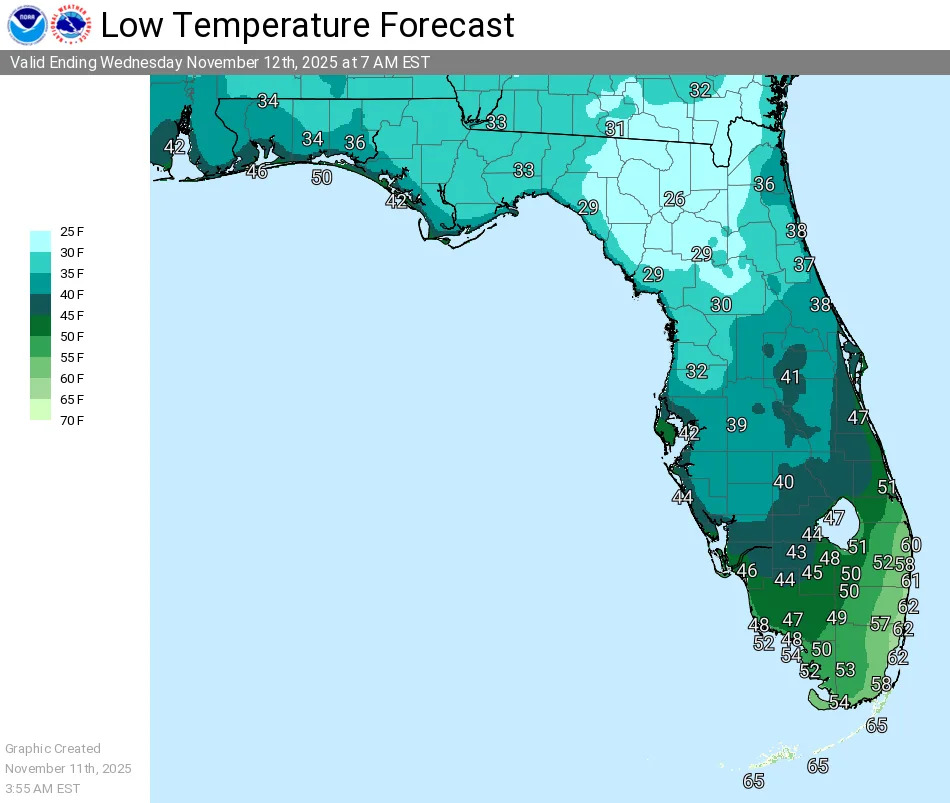
The National Weather Service office shows temperature lows across Florida on Wednesday, Nov. 12, and Thursday, Nov. 13, 2025.
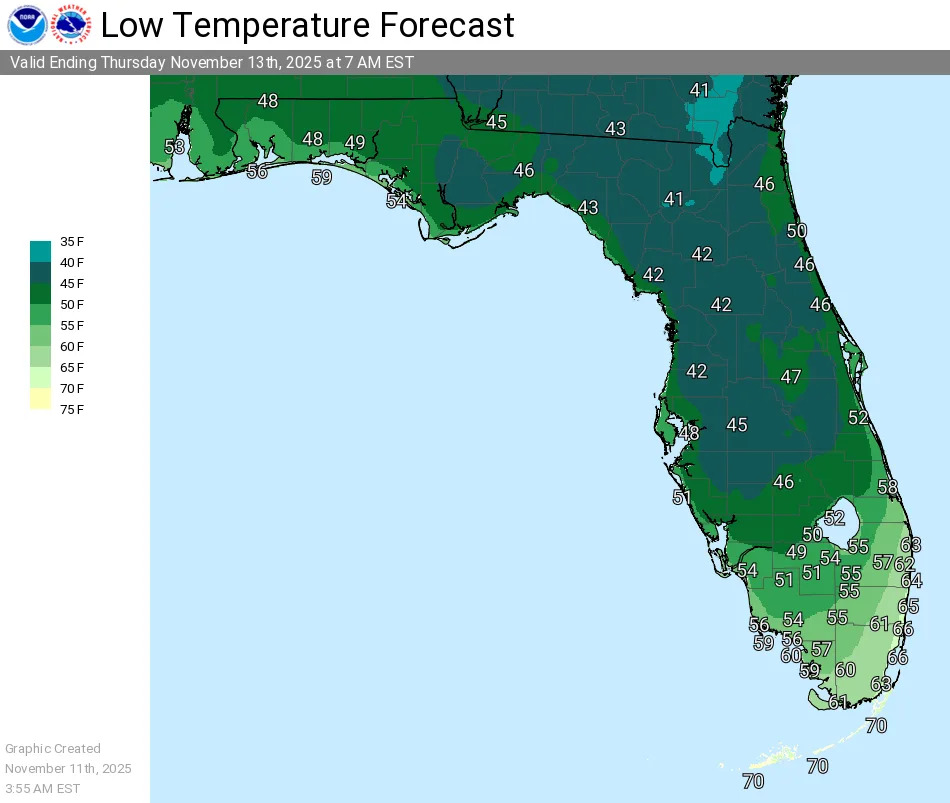
The National Weather Service office shows temperature lows across Florida on Wednesday, Nov. 12, and Thursday, Nov. 13, 2025.
When is the Arctic blast leaving Florida?
The deep freeze eases Wednesday, Nov. 12, as winds shift and moisture returns, with daytime highs climbing into the 70s by Thursday, Nov. 13
Is snow expected in Florida?
Unlike much of the northern U.S., this Arctic blast is not expected to bring snow to Florida or other southern states.
At what temperatures do pipes freeze?
Water in pipes begins to solidify into ice once temperatures dip below freezing, at 32 degrees or below.
Which pipes freeze most often?
The American Red Cross says the pipes most likely to freeze in homes include:
Pipes exposed to severe cold, such as outdoor hose bibs, swimming pool supply lines, and sprinkler lines. (Don’t forget to drain pool and sprinkler lines, too.)
Water supply pipes in unheated interior spaces, including basements, crawl spaces, attics, garages, and cabinets.
Pipes running along exterior walls with little or no insulation.
How to prevent pipes from freezing
Many people take precautions before the first cold front, since outdoor faucets are often unused until spring. If you haven’t prepared yet — or still need to use your faucets — here’s how to protect them:
Adjust your thermostat: Keep your home at a minimum of 60 degrees. Open cupboards and vanities, especially in kitchens and bathrooms, so warm air can reach pipes.
Drip faucets correctly: Set faucets to a small, steady drip rather than a stream to conserve water while preventing freezing. Focus on the faucet farthest from your home’s main water valve.
Cover outdoor spigots: Before temperatures drop below 32 degrees, open outdoor spigots to let water drain out and place protective covers over them.
Florida weather watches and warningsFlorida weather radarStay informed. Get weather alerts via text
Brandi D. Addison covers weather across the United States as the Weather Connect Reporter for the USA TODAY Network. She can be reached at baddison@gannett.com. Find her on Facebook here.
This article originally appeared on Pensacola News Journal: How much colder will Florida get? See Arctic blast timeline