
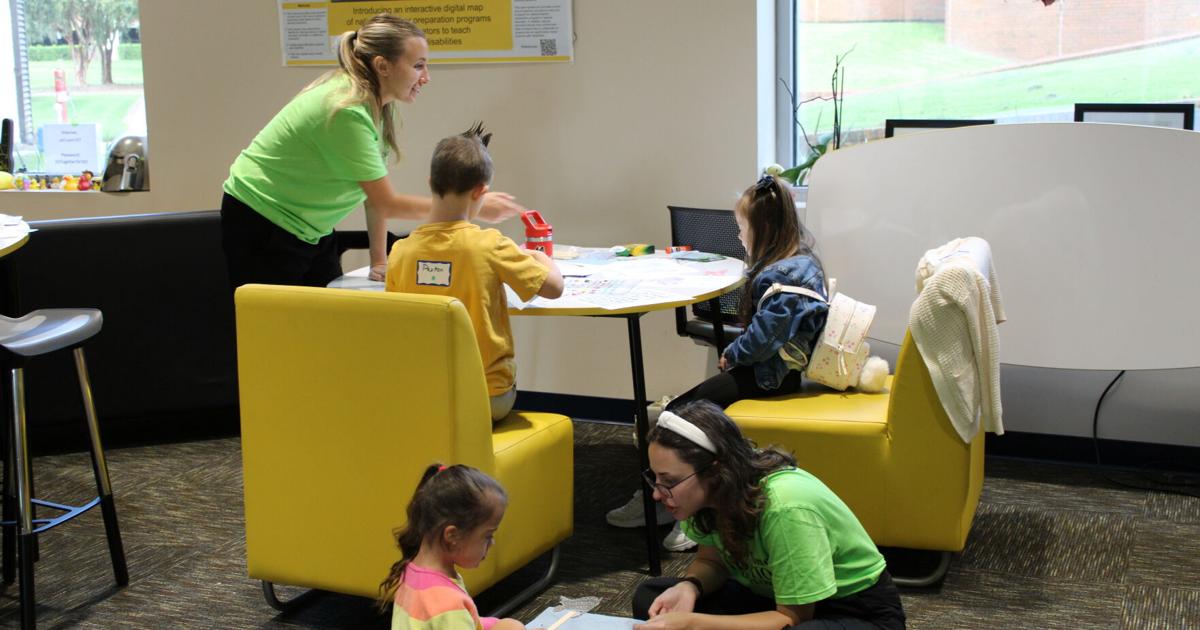

Children play with volunteers during the iCan! Learn session on Sept. 12 at the UCF College of Community Innovation and Education building. The session encourages children with Down syndrome to socialize with their peers and develop social skills.
Ana Ferreira Lizama
October is Down Syndrome Awareness Month, and this year, the Down Syndrome Foundation of Florida is marking 15 years of partnership with UCF’s Toni Jennings Exceptional Education Institute through its iCan! collaborative program.
The initiative connects families with resources while creating opportunities for individuals with Down syndrome to learn and develop new skills.
Observed since the 1980s, Down Syndrome Awareness Month celebrates the abilities and achievements of individuals with Down syndrome while raising awareness about the condition, according to the National Down Syndrome Society.
Down syndrome is a genetic condition caused by a full or partial extra copy of chromosome 21, according to the NDSS. The additional chromosome can affect physical characteristics, including stature and muscle tone, as well as cognitive development.
For Camille Gardner, co-founder of the Down Syndrome Foundation of Florida, finding opportunities for individuals with Down syndrome became a personal mission.
In 2010, Gardner looked for resources for her son, who is now 23 and has Down syndrome. She said she saw few programs available to support people like him and their families.
Gardner decided to help fill that gap by creating a community where families could find support and access opportunities throughout different stages of life.
“We’ve awarded over $1.8 million in scholarships, and we currently do about 20 programs a month,” Gardner said. “We service families from birth all the way through adults.”
One of those opportunities is the iCan! campus program, which UCF’s College of Community Innovation and Education has offered in partnership with the foundation once a month since 2011.
The collaboration benefits both participating families and UCF students. While children and their parents gain access to educational activities and resources, university students can volunteer, work directly with participants and gain experience related to their future careers, according to the foundation’s website.
“It’s kind of a win-win,” Gardner said. “Our members are getting an opportunity to work with individuals that are going to be professionals in that career path, and then those students are getting a chance to have some real-life experience.”
The program is organized into four sessions that address participants’ needs at different ages: from early childhood through the transition to adulthood.
For the youngest participants, iCan! Communicate (from birth to age four) and iCan! Learn (ages four to nine) focuses on children, helping them strengthen literacy, communication and fine motor skills.
The sessions also allow parents to connect with other families navigating similar experiences.
UCF students preparing to enter the teaching profession volunteer with the program and work with children ages 4 to 9 in the iCan! Learn session on Sept. 12 at the UCF College of Community Innovation and Education building.
Ana Ferreira Lizama
In the iCan! Learn website, parents are encouraged to “come together, share ideas and strategies, learn from one another, and feel supported throughout their journey.”
Camille Costa learned about the foundation through a mothers’ group chat in Miami and enrolled her daughter, Chloe, in the iCan! Learn session. Although they have only recently joined, Costa said the experience has already made an impression on her daughter.
“She [Chloe] told me she had so much fun. She was happy, and the volunteers came to me, and they told me she did amazing in the class,” Costa said.
For families who have participated for years, the program offers an opportunity to see their children’s progress over time.
Gemma Ferraro’s 8-year-old son, Randy, began attending when he was four years old.
“I can see how every year we come, the benefits it’s had and the advancements that he makes,” Ferraro said.
According to Ferraro, Randy is now becoming more verbal; he is learning to read “a little bit more” and is developing other skills.
Ferraro said she values the information and strategies she has gained as a parent, making the drive of more than an hour to UCF worthwhile.
“I’ve learned things that have been able to help me, not just with Randy, even for myself sometimes,” Ferraro said.
Parents are encouraged to apply what they learn during the sessions to their children’s development at home.
Director of Toni Jennings Exceptional Education Institute, Matt Marino and his doctoral students help facilitate that process by sharing educational strategies with families.
“I’m going to give a talk with one of my doctoral students to the parents to help them to improve their strategies to develop their kids’ reading, math and behavior skills,” Marino said.
As participants grow older, the program shifts its focus from foundational skills to managing everyday challenges and preparing for life beyond school.
The third session, iCan! Excel, serves participants ages 10 to 15. Through yoga and mindfulness activities, they learn techniques to manage stress, develop coping strategies related to anxiety and increase confidence.
For participants ages 16 and older, the College and Career Prep Program focuses on the transition from high school to adulthood, according to the DSFF website.
Activities include a college day for students and parents, financial planning sessions and vocational training to help participants prepare for further education and employment.
UCF’s Toni Jennings Exceptional Education Institute is starting off Down Syndrome Awareness Month strong by continuing its longstanding partnership with the Down Syndrome Foundation of Florida. This package aired in the Oct. 2 newscast. Anchored by Ella Shockley.
Claire Macchiarola and Ana Ferreira Verdugo Lizama
Christine Parsons, program manager at the Toni Jennings Exceptional Education Institute, said the transition can be difficult for individuals with intellectual disabilities when structured support becomes less available after high school.
“Traditionally, we have some really good transition programs, but once they graduate from high school, it’s like falling off a cliff,” Parsons said. “So this college and career prep program is to get them ready. It’s to give them the information that they need to start thinking about what’s going to happen after they graduate.”
According to Parsons, through the program, participants practice professional skills including how to shake hands, volunteer and send thank-you emails. The sessions are intended to help students prepare for the expectations they may encounter in college, vocational training and the workplace.
The initiative connects participants with broader opportunities at UCF, including a dedicated postsecondary program for students with intellectual disabilities.
Marino said creating opportunities for individuals with Down syndrome to enter the workforce can benefit both employees and employers.
He pointed to research on workplace diversity and said he was particularly struck by findings about the dedication of workers with Down syndrome.
“People with Down syndrome are actually some of the best workers, in terms of showing up and loving their jobs,” Marino said. “What really surprised me about this population when I started looking at the research was that their absenteeism rate at work and school is the lowest of most people because they’re extremely dedicated and they love what they do.”
After spending the day participating in activities with volunteers, mother and son reunite at the end of the iCan! Learn session on Sept. 12 at the UCF College of Community Innovation and Education building.
Ana Ferreira Lizama
For the people behind the iCan! program, the work goes beyond helping participants develop academic, social and professional skills, Parsons said.
Parsons said that providing these opportunities can challenge assumptions about what individuals with intellectual disabilities can accomplish and benefit the wider community.
While the partnership between UCF and the Down Syndrome Foundation of Florida tracks back to 2011, the university graduated its first group of 13 students with disabilities in 2019, as previously reported by the Orlando Sentinel.
“Anytime we exclude a group of people from society, society loses. Anytime we include everyone, everyone wins,” Parsons said. “The only people that are putting limits on these students right now is society, and as soon as we start saying, ‘Wait, they can do anything that they want, and they should have that opportunity,’ we’re all going to benefit.”